Breaking the Distance Barrier: ISTA Physicists Demonstrate Fully Autonomous Quantum Entanglement Using a Correlated Light Bath

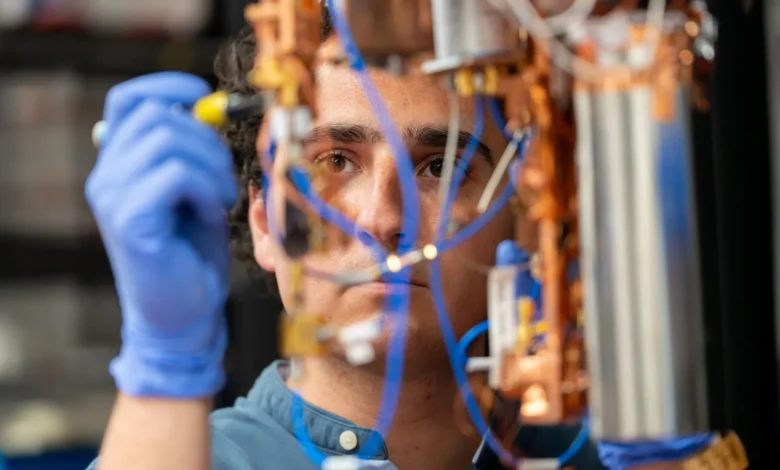
Physicists at the Institute of Science and Technology Austria (ISTA) have successfully demonstrated a fully autonomous method for connecting widely separated quantum bits, or qubits, using a specialized "quantum bath" composed of correlated particles of light. Published in the peer-reviewed journal Physical Review X, this milestone marks the experimental realization of a theoretical proposal first conceived more than twenty years ago. By bypassing the need for active feedback control, repeated measurements, or post-selection, the breakthrough offers a potential new foundation for scaling up distributed quantum computers and building robust, long-range quantum networks.
The Main Facts of the Breakthrough
At the heart of quantum computing lies the principle of entanglement—a physical phenomenon where two or more particles become interconnected in such a way that the state of one instantaneously dictates the state of another, regardless of the physical distance separating them. While creating local entanglement within a single processor chip has become increasingly routine, establishing distributed entanglement between physically isolated nodes remains one of the most formidable bottlenecks in the field.
Until now, achieving this cross-module connection required meticulous active management. Researchers typically relied on one of two paradigms: either transmitting an actively controlled single photon from one qubit to another, or having both distinct qubits emit photons that are subsequently matched and interfered in an optical setup to force a correlation. The latter approach was famously recognized with the 2022 Nobel Prize in Physics. However, even this celebrated method suffers from inherent limitations: it is probabilistic, demands repeated destructive measurements, relies heavily on post-selection, and frequently fails to yield a successful connection.
The ISTA research team, spearheaded by PhD student Alejandro Andrés-Juanes and Professor Johannes Fink alongside international collaborators, sidestepped these constraints entirely. Instead of forcing qubits to communicate via discrete, actively managed signaling events, the team immersed the distant qubits in a shared, continuous environment known as a quantum bath. Powered by a steady stream of correlated microwave photons, this environmental bath automatically synchronizes the qubits, locking them into a stable, mutually entangled ground state without human intervention or real-time electronic adjustments.
A Chronological Perspective: From Two-Decade-Old Theory to Laboratory Reality
The journey from theoretical physics to a functional laboratory prototype spans more than twenty years, reflecting the immense experimental hurdles involved in controlling fragile quantum states.
In the early 2000s, quantum theorists began modeling open quantum systems, proposing that dissipative environments—traditionally viewed as the ultimate enemy of quantum coherence—could paradoxically be harnessed to prepare and stabilize desired quantum states. Among these theoretical propositions was the idea of utilizing a correlated light bath to drive distant quantum systems into entanglement.
However, translating these mathematical models into physical hardware proved exceptionally difficult. Idealized theoretical models often assumed frictionless conditions and perfectly isolated systems that could not be easily replicated in a tangible laboratory environment. For over two decades, the concept remained an unrealized blueprint.
The turning point came when Andrés-Juanes, Fink, and their colleagues successfully engineered a superconducting circuit architecture capable of hosting the required quantum bath. By utilizing microwave frequency photons—which interact strongly with superconducting circuits—the researchers constructed a prototype device that could reliably generate, distribute, and maintain entanglement between two isolated physical nodes. According to the research team, building this prototype shed light on why the 20-year-old prediction had resisted experimental implementation for so long, specifically revealing how unwanted parasitic couplings and environmental noise historically derailed attempts to build a functional single-source quantum bath.
Supporting Data, Technical Specifications, and Methodology
To rigorously evaluate the success of their autonomous system, the ISTA researchers had to contend with the fundamental nature of quantum observation. Measuring a quantum state invariably causes it to collapse, transforming a delicate superposition into a classical binary outcome of either zero or one.
To overcome this diagnostic challenge, the team employed quantum tomography—an advanced analytical technique that reconstructs the complete density matrix of a quantum system by taking numerous distinct snapshot measurements of its statistical behavior. In this experiment, the researchers performed precise measurements lasting between 20 and 80 nanoseconds (with a nanosecond representing one billionth of a second). These ultra-fast diagnostic sweeps allowed the team to verify that the two isolated qubits were indeed continuously synchronized within the quantum bath.
Despite the elegance of the design, the current prototype operates with specific operational trade-offs. The researchers noted that their present system successfully transfers approximately 10% of the bath’s theoretically available entanglement to the qubits. While this efficiency rate is currently lower than that of active control methods—which can achieve higher single-shot fidelity at the cost of immense computational overhead and latency—the autonomous nature of the bath compensates by offering a continuous, self-healing resource.
Furthermore, the choice of microwave photons was critical to the architecture. Unlike optical photons, which are optimal for long-distance transmission through fiber-optic cables, microwave photons are foundational to leading superconducting-qubit processors. They possess the low-energy profile required to manipulate delicate quantum information natively inside advanced cryostats. Bridging the gap between microwave-based processors and optical communication remains a major objective for modern physics laboratories, including the Fink group at ISTA, which is actively investigating hybrid architectures.
Official Responses and Expert Analysis
The implications of the ISTA experiment extend far beyond a mere validation of historical theory. By rethinking how quantum systems interact with their surroundings, the research challenges the conventional wisdom that environmental isolation is the absolute prerequisite for quantum stability.
"In this work, we aimed to overcome this mismatch between the readily available and the practically useful forms of entanglement," explained Alejandro Andrés-Juanes, highlighting the structural divide between continuous-variable states (which behave analogously to a pendulum’s continuous motion) and discrete-variable, all-or-nothing states required for advanced quantum logic. "By stabilizing the entangled states remotely, our approach is fully autonomous and requires no active control or measurement."
Professor Johannes Fink emphasized the conceptual shift represented by the quantum bath model. "In our method, the quantum bath—meaning the qubits’ environment—is the source of entanglement," Fink noted. "It creates a new ground state through a continuous stream of correlated photons. This way, the entangled qubit state is stabilized, even beyond the qubits’ own lifetime, and remains always available as a resource for further quantum processing. This makes the approach conceptually significant."
Because the entangled state persists as a persistent reservoir rather than a fleeting moment in time, quantum processors can draw upon it asynchronously. This decoupling of generation time from utilization time represents a profound architectural advantage for complex, multi-step quantum algorithms.
Broader Impact and Future Implications for Fault-Tolerant Computing
As the global scientific community races toward the realization of large-scale, fault-tolerant quantum computers, the ability to network multiple modular processors is paramount. Single quantum processing units are ultimately limited by physical space, thermal management constraints, and the sheer complexity of scaling up monolithic chip designs. Distributed quantum computing—where modular processors are linked together via entanglement networks—offers a viable path around these physical walls.
The ISTA prototype introduces a scalable blueprint. Because the quantum bath relies on a shared, continuous stream of correlated light rather than bespoke, point-to-point electronic triggers, the methodology holds theoretical potential for scaling up to synchronize multiple distant qubits simultaneously.
While significant engineering challenges remain—particularly regarding the improvement of entanglement transfer efficiency and the integration of microwave systems with optical telecommunications infrastructure—the successful demonstration of a 20-year-old theoretical prediction marks a vital milestone. By transforming environmental dissipation from a destructive nuisance into a constructive resource, the ISTA researchers have opened a promising new avenue in quantum optics and processor architecture, bringing the scientific community one step closer to practical, fault-tolerant quantum networks.
Related posts: