Minister of Home Affairs Muhammad Tito Karnavian Oversees Significant Financial Aid Handover for Aceh’s Post-Disaster Recovery Efforts.

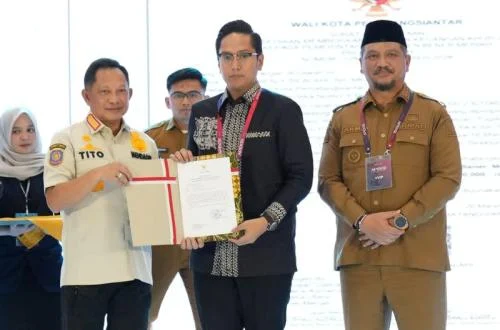
In a pivotal demonstration of national solidarity and inter-regional cooperation, Minister of Home Affairs Muhammad Tito Karnavian, acting as the Head of the Task Force for the Acceleration of Rehabilitation and Reconstruction (Kasatgas PRR), presided over the formal handover of Special Financial Assistance Letters. This significant event, aimed at expediting post-disaster rehabilitation and reconstruction in Aceh, saw multiple regional governments commit substantial funds to support the affected areas. The ceremony took place in Banda Aceh, marking a crucial step in the coordinated national response to the recent calamities that have beset the westernmost province of Indonesia.
The solemn occasion unfolded during the working meeting of the Regional Commission I of the Association of Indonesian Municipalities (APEKSI), an organization vital for fostering collaboration and sharing best practices among local governments across the archipelago. The primary highlight was the commitment by the Government of Medan City, North Sumatra, to provide Rp50 billion (approximately USD 3.2 million) in aid to the Government of Aceh Tamiang Regency. This generous pledge underscores the deep-seated spirit of mutual assistance that characterizes Indonesia’s disaster response mechanisms, particularly between neighboring provinces. Beyond Medan, the City Government of Pematangsiantar also extended a helping hand, committing to support Kabupaten Bener Meriah, further illustrating the widespread commitment to Aceh’s recovery. In total, eight regional administrations declared their readiness to contribute financial resources to the disaster-stricken areas in Aceh, signaling a united front against the challenges of reconstruction.
A Call for National Solidarity Amidst Adversity
Minister Tito Karnavian, a figure central to Indonesia’s disaster management and internal governance, expressed profound gratitude to the contributing regional heads. "My sincere thanks to all the heads of the eight regions who have donated or granted funds to the disaster-affected regions in Aceh. I understand the difficulties they face in their respective areas," Tito remarked, acknowledging the inherent challenges faced by local governments in allocating significant funds, even for humanitarian causes. His statement resonated with the understanding that such commitments often involve difficult budgetary decisions, especially when donor regions themselves might be grappling with their own developmental priorities. The Minister’s presence underscored the central government’s unwavering commitment to overseeing and facilitating these crucial inter-regional aid initiatives, ensuring accountability and efficiency in the deployment of resources.
The need for such an extensive coordinated effort arose from a series of devastating natural disasters that struck Aceh in late 2025 and early 2026. While specific details of the calamity were not elaborated in initial reports, the scale of the financial commitments suggests widespread damage across multiple regencies. Aceh, situated in a highly active seismic zone within the Pacific Ring of Fire, is no stranger to natural catastrophes, ranging from earthquakes and tsunamis to floods and landslides. The memory of the 2004 Indian Ocean Tsunami, which decimated large parts of the province and claimed over 170,000 lives in Indonesia alone, serves as a stark reminder of its vulnerability. This historical context provides a deeper understanding of the urgency and comprehensive nature of the current recovery efforts, which aim not only to rebuild but also to enhance resilience against future events.
Comprehensive Financial Commitments for Reconstruction
According to detailed data compiled by the Directorate General of Regional Finance as of April 20, 2026, the eight regions have formalized their financial commitments as follows:
- Medan City committed Rp50 billion to Aceh Tamiang Regency.
- Deli Serdang Regency committed Rp50 billion to Aceh Timur Regency.
- Simalungun Regency committed Rp30 billion to Aceh Utara Regency.
- Asahan Regency committed Rp30 billion to Bireuen Regency.
- Serdang Bedagai Regency committed Rp25 billion to Pidie Jaya Regency.
- Labuhanbatu Selatan Regency proposed Rp25 billion for Aceh Tengah Regency.
- Pematangsiantar City committed Rp25 billion for Bener Meriah Regency.
- Labuhanbatu Regency committed Rp25 billion for Gayo Lues Regency.
These commitments collectively amount to Rp265 billion (approximately USD 17.1 million), representing a significant injection of funds into the affected regions. The allocation reflects a strategic distribution of aid, targeting multiple regencies that have borne the brunt of the recent disasters. The funds are expected to be channeled into critical areas such as rebuilding damaged infrastructure, reconstructing homes, restoring public facilities like schools and healthcare centers, and revitalizing local economies. The diverse range of donor regions, predominantly from North Sumatra, highlights the strong regional ties and the collective understanding that a disaster in one part of the country impacts the broader national fabric.
The Broader Framework of National Disaster Response
The current aid initiative is not an isolated effort but is deeply embedded within a broader national policy framework designed to enhance disaster resilience and facilitate rapid recovery. Earlier, President Prabowo Subianto had established a significant policy adjustment regarding the Transfer to Regions (Transfer ke Daerah – TKD) to specifically support recovery efforts in Aceh, North Sumatra, and West Sumatra. This presidential directive provided the necessary legal and financial impetus for local governments to allocate resources towards post-disaster recovery, not just within their own jurisdictions but also to assist other affected regions. The TKD mechanism, a crucial component of Indonesia’s fiscal decentralization, allows the central government to channel funds to provinces and regencies/cities for various development purposes, including emergency response and reconstruction.
Following the President’s policy, the Minister of Home Affairs further bolstered this initiative by issuing a Circular Letter. This letter actively encouraged regional governments not directly impacted by the recent disasters to contribute to the recovery efforts in affected areas. This top-down approach, combining presidential policy with ministerial guidance, created a robust framework for soliciting and coordinating inter-regional aid. It emphasized the principle of gotong royong (mutual cooperation), a cornerstone of Indonesian communal life, elevating it to the level of inter-governmental collaboration. Such a coordinated strategy is vital for a vast archipelago like Indonesia, where localized disasters can have cascading effects and require a unified national response.
Statements from Stakeholders: Gratitude and Commitment
The announcement of these substantial aid packages elicited a range of reactions from both donor and recipient regions. Mayor of Medan, Bobby Nasution, speaking on the sidelines of the APEKSI meeting, articulated his city’s commitment. "Medan, as a neighboring city with strong cultural and economic ties to Aceh, feels a deep responsibility to assist. Our contribution to Aceh Tamiang is a testament to our solidarity and hope for their swift recovery," he stated, emphasizing the historical bonds between the two regions. Similar sentiments were echoed by other donor representatives, who highlighted the humanitarian imperative and the spirit of national unity.
From the recipient side, the Regent of Aceh Tamiang, expressing profound gratitude, outlined the anticipated impact of the aid. "The Rp50 billion from Medan City is an invaluable lifeline for us. It will significantly bolster our efforts in rebuilding critical infrastructure, particularly schools and health clinics, and in providing much-needed housing for displaced families. We are deeply thankful for this act of kindness and solidarity," he remarked. The funds are expected to be crucial for long-term recovery, moving beyond immediate emergency relief to sustainable reconstruction that aims to ‘build back better’ and more resilient communities. This includes not only physical infrastructure but also the restoration of livelihoods and the psychological well-being of affected populations.
The Spiritual Dimension of Recovery: Masjid Raya Baiturrahman
Beyond the financial aid, Minister Tito Karnavian also extended support to the spiritual heart of Aceh. Following the handover ceremony, he paid a visit to the iconic Masjid Raya Baiturrahman in Banda Aceh, a symbol of resilience and faith for the Acehnese people, particularly after it miraculously withstood the 2004 tsunami. During his visit, Tito personally handed over an operational vehicle to the mosque management. This gesture, while seemingly modest compared to the billions in financial aid, carries profound symbolic weight.
"I hope this assistance will support the operational activities of the mosque, which serves as a central hub for community life in Aceh," Tito stated. He further emphasized the critical role of religious institutions during times of crisis. "I also ask for the support and prayers from Masjid Baiturrahman so that the task of disaster recovery can be expedited and receive blessings from Allah SWT." This appeal underscores the understanding that recovery from large-scale disasters is not merely a logistical or financial undertaking but also a deeply spiritual and communal process. The mosque, as a place of worship, solace, and community gathering, plays an indispensable role in fostering social cohesion, providing psychological support, and instilling hope amidst despair. Its operational efficiency, therefore, directly contributes to the overall well-being and recovery trajectory of the community.
Analysis: Implications for Decentralized Disaster Management
The comprehensive response to Aceh’s disaster, spearheaded by the central government and significantly supported by inter-regional cooperation, offers valuable insights into Indonesia’s evolving disaster management framework. The combined impact of presidential policy adjustments to regional transfers and the Minister of Home Affairs’ circular has created a powerful mechanism for resource mobilization. This model effectively leverages the decentralized administrative structure of Indonesia, enabling regions to act as both recipients and donors, fostering a sense of shared responsibility.
The financial commitments, totaling Rp265 billion, while substantial, represent only a fraction of the overall estimated cost for comprehensive rehabilitation and reconstruction following a major disaster. The World Bank and other international organizations often estimate post-disaster recovery costs to be in the billions of dollars for events of significant scale. Therefore, these inter-regional contributions, while critical, must be seen as complementary to larger national budgetary allocations and potential international aid. The challenge ahead lies not only in the disbursement of these funds but also in ensuring their transparent, accountable, and efficient utilization. Oversight mechanisms, involving both central and local government agencies, as well as community participation, will be crucial to prevent misuse and maximize impact.
Furthermore, this initiative strengthens the bonds between regions, fostering a robust network of mutual support that can be activated in future crises. The APEKSI platform, in particular, demonstrates its potential beyond mere administrative discussions, emerging as a vital forum for coordinating humanitarian efforts. The success of this model in Aceh could serve as a blueprint for responding to future large-scale disasters across the archipelago, highlighting the effectiveness of a multi-tiered approach that combines central leadership with strong regional collaboration. Ultimately, these efforts are not just about rebuilding structures but about restoring lives, livelihoods, and the enduring spirit of the Indonesian people, reinforcing their resilience in the face of adversity and their unwavering commitment to gotong royong.
Related posts: