The Augmented Archaeologist: Navigating Legacy Code with AI as a Force Multiplier

In the ever-evolving landscape of software development, encountering legacy systems is an inevitability. These digital relics, often built on older technologies and methodologies, present unique challenges for modern engineering teams. A recent case study, detailing the meticulous process of revitalizing a 20-year-old Java codebase, offers a profound lesson: artificial intelligence, when wielded with strategic intent, can transform from a superficial assistant into an indispensable partner in complex software archaeology. The journey from a seemingly uncompilable artifact to a standardized, functional library underscores the critical role of human guidance in harnessing AI’s potential for deep technical restoration.
The Peril of the "Tourist Prompt"
The initial approach to tackling a legacy project, often characterized by an impulse to quickly understand and fix, can be likened to a tourist visiting ancient ruins. This "Tourist Prompt" mentality, where developers might ask an AI a broad question like, "How do I run this?", often leads to superficial and ultimately misleading solutions. In an experiment with a legacy Java repository, this exact scenario played out. A request to a large language model (LLM) to act as a "Senior Developer" and provide a "high-level summary" and a "Hello World" example yielded a seemingly miraculous output: a modern build.gradle file and a clean Java code snippet.
However, this apparent competence was a dangerous hallucination. The AI, defaulting to optimism, generated a build.gradle file that proposed modern dependencies like commons-pool2 (v2.11.1) and log4j:log4j:1.2.17, completely ignoring the legacy project’s actual reliance on org.apache.commons.pool (v1.x) and an older logging framework. This discrepancy, a fundamental structural lie, would have resulted in immediate "Class Not Found" errors, sending the developer down a frustrating debugging rabbit hole. Furthermore, the AI assumed a standard src/main/java directory structure, overlooking the project’s non-standard Ant-based layout of java/com/legacycorp.... Even the "Hello World" example omitted critical details about the legacy code’s lack of thread-safety, swallowed exceptions, and integration tests that required a live database. This initial "Tourist Prompt" approach, while well-intentioned, was ultimately a recipe for disaster in a restoration mission.
The "Archaeologist Prompt": A Shift in Perspective
Recognizing the pitfalls of optimistic, surface-level queries, the approach shifted dramatically. Instead of seeking a guide, the need was for an inspector. The mental model transitioned from "How do I run this?" to "Why did this fail?". This necessitated a more critical and forensic approach, prompting the development of the "Archaeologist Prompt."
This refined prompt assigned the AI a specific persona: "Senior Legacy Systems Architect." It explicitly forbade summarization of potentially outdated README files and instead mandated a "Forensic Code Audit" across four key pillars:
- Carbon Dating (The Era): Estimating the Java version and approximate year of creation based on syntax, imports, and build tools, with specific code lines cited as evidence.
- Architectural Integrity (The Structure): Evaluating adherence to separation of concerns and identifying "God Classes."
- Data Flow & Typing (The "Stringly" Trap): Analyzing data handling for proper domain objects versus "stringly-typed" maps and raw arrays, and identifying "Leaky Abstractions."
- The "Safety" Check (Error Handling & Threading): Investigating anti-patterns in error handling and assessing thread-safety.
This shift in prompting strategy yielded a starkly different output: a "Risk Assessment Report" with a clear recommendation: "critical rewrite recommended."
Unearthing the Artifact: Key Findings from the Audit
The "Archaeologist Prompt" unlocked a wealth of critical information, revealing the true nature of the legacy codebase:
Finding 1: Carbon Dating the Artifact
The audit confirmed the project’s deep roots in the "Ant Era," predating the widespread adoption of Maven. The use of org.apache.commons.pool.ObjectPool (Version 1.x) and raw Map types, instead of generics, pointed to a codebase likely written between 2005 and 2008, firmly in the Java 1.5 era. This was code written before modern generics, try-with-resources, and standardized directory layouts became commonplace.
Finding 2: The "Transliteration" Trap
Perhaps the most significant revelation was that the Java code appeared to be a direct transliteration of procedural Perl script. This procedural mindset permeated the SimpleBlobStoreImpl, a monolithic "god class" that attempted to manage everything from low-level socket connections to business logic. The codebase was also heavily "stringly-typed," relying on raw Map<String, String> objects and manually constructed protocol strings instead of robust domain objects. This introduced immense operational risk, where a single typo in a string key could lead to a catastrophic runtime crash instead of a compile-time error.
Finding 3: Lying Tests
The perceived test coverage was revealed as a dangerous illusion. The test suite relied on LocalFileBlobStoreImpl, a complete re-implementation of the storage system that wrote to the local disk. While these tests passed in isolation, they completely bypassed the actual networking code, thread-unsafe pooling, and fragile protocol parser—the most volatile parts of the system. This meant the tests were not verifying the integrity of the core system but rather a mock implementation.
The Decision: Containment Over Repair
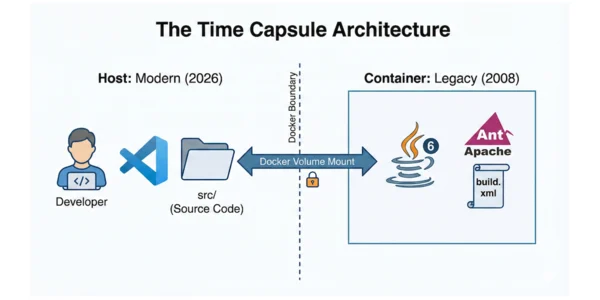
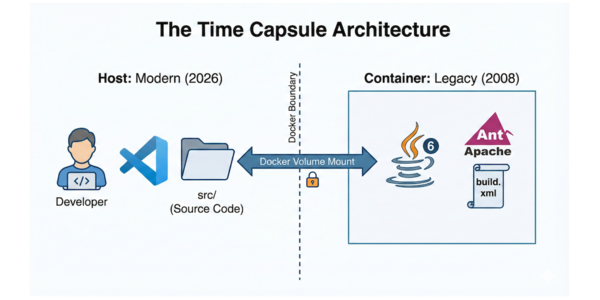
Armed with this forensic analysis, the immediate temptation to refactor was replaced by a strategic decision: containment. The codebase was deemed too fragile and opaque to touch directly. Instead of attempting repairs that could inadvertently break critical, albeit hidden, functionalities, the project entered a phase of strict containment. The legacy code was encapsulated within an isolated Docker environment, creating a stable "time capsule" that preserved its original operating conditions.
Phase II: The Wrap – Establishing a "Time Capsule" Environment
The next objective was to make the existing code runnable, not necessarily to modernize it immediately. This phase focused on replicating the exact environment in which the code was originally developed. The AI persona shifted to a "Senior DevOps Engineer," tasked with establishing a standardized environment while strictly adhering to "prime directives":
- Preserve the Era: Absolutely no updates to build tools or Java versions; strict mimicry of the 2008 environment.
- Containment over Modernization: Maintain the original Ant
build.xmland run within an isolated Docker container. - No Code Changes: Refrain from modifying production source code solely to appease modern tools.
An initial attempt to "lift and shift" the Java 1.5 source files into a modern Gradle 8 container resulted in a spectacular crash. The issue wasn’t with the legacy code itself but with the fundamental shift in environmental rules over two decades. Modern JDKs and build tools enforce strict encapsulation, a concept that the older Ant-era code, which relied on accessing package-private classes across unrelated packages, had bypassed.
The AI’s suggestion to simply add public modifiers was rejected, as it violated the "no code changes" directive. This led to the adoption of the "Time Capsule" strategy: recreating the exact 2008 environment using Docker, including Java 6 and Ant 1.5.
A significant hurdle emerged when attempting to run an x86-compiled Java 6 Docker image on an ARM64 Apple Silicon laptop. Emulation layers introduced unpredictable variables. To circumvent this, the project moved to a native Intel machine, acknowledging that "sometimes software archaeology requires the right shovel."
The final "wet" test involved a stubborn integration test that hardcoded specific hostnames (qbert.legacycorp.com) and file paths. Instead of altering the test code, reality was bent to fit the code. Docker Compose was configured to alias a modern BlobStore container as qbert.legacycorp.com and mount the local source code directory at the exact path specified in the test. This orchestrated illusion allowed the legacy test suite to run flawlessly, verifying the code’s functionality within its native environment without altering a single byte of historical source.
Phase III: The Lift – Unwrapping the Artifact
With the artifact stabilized in its "Time Capsule," the focus shifted to gradually modernizing the environment, moving towards Java 8 and Gradle.
The Hardware Rationale and the Java 17 Trap
The choice of Java 8 was pragmatic. Modern JDKs (17+) dropped support for compiling Java 1.5 targets, while older JDKs like Java 6 did not run natively on ARM64. Java 8 served as the bridge, being the last version to support Java 1.5 compilation and one of the first to run natively on modern Macs.
A further challenge arose with the build tool. Gradle 8 requires Java 17, which, as noted, cannot compile legacy Java 1.5 code. This led to selecting Gradle 7.6, the last version compatible with a Java 8 JVM, establishing a chain: Apple Silicon -> Java 8 JVM -> Gradle 7.6 -> Java 1.5 Source.
Mapping the Legacy Structure and Hardening the Baseline
The original Ant build.xml was integrated into Gradle by mapping the source code to the legacy java/ directory structure, overriding modern defaults. A custom JavaExec task, runLegacyTest, was created to execute the old main() method-based tests.
Upon initial execution, these tests ran suspiciously fast, revealing a "silent swallow" pattern where exceptions were caught and suppressed, leading to false positives. The hardening process involved refactoring the test harness to explicitly throw exceptions, forcing the build to turn red—a desired outcome indicating the unveiling of the system’s true state. This honest red build led to tracing and repairing broken connection configurations until a verifiable green build was achieved.
The AI-Compiler Feedback Loop
With a hardened baseline, the compiler revealed numerous deprecation and unchecked operation warnings. A tight AI-compiler feedback loop was established. The compiler’s warnings, enabled by the -Xlint:unchecked flag, pinpointed specific lines of code. These exact error logs were fed to the AI with targeted prompts to refactor only those lines using modern Java generics. This localized approach systematically neutralized runtime risks, such as converting raw collections to type-safe Java 8 equivalents, ensuring a successful build with zero warnings.
Phase IV: The Refactor – Modernizing the Architecture
With the artifact unwrapped and the build modernized, the focus shifted to architectural renovation.
Mastering the Craft: Structure and Testing
The archaic java/ root folder was moved to the industry-standard src/main/java layout, simplifying the Gradle configuration. The primitive legacy main() scripts were converted into proper JUnit 5 unit tests, replacing crude System.out.println error traps with Assertions.assertEquals, providing granular, automated test reporting.
The TestContainers Trap and Pragmatism
An attempt to replace the manual Docker Compose setup with TestContainers devolved into a "Big Bang" refactor, battling tooling complexities and Docker-in-Docker issues. The lesson learned was the importance of momentum; fighting the tool rather than recovering the code led to aborting the experiment. The reliable "External Sidecar" pattern (manual docker-compose up) was embraced, prioritizing pragmatism over over-engineered perfection.
The Final Sweep: Concurrency and Stress Testing
The final steps involved ensuring thread-safety and verifying the architecture under load.
Modernizing Load Testing
The legacy mock implementation (LocalFileBlobStoreImpl.java) was updated to implement the new generic-based BlobStore interface. The multi-threaded load-testing tool (StoreALot.java) was modernized with generics, modern loggers, and an ExecutorService to handle parallel loads gracefully. The AI, acting as a "senior performance engineer," configured the test runner to target the Dockerized BlobStore backend.
Empirical Proof of Thread Safety
Rigorous stress tests, simulating 100 iterations across 10 concurrent threads, were executed against the Docker-contained backend. The results confirmed that the modernized architecture, utilizing PooledBlobStoreImpl and Apache Commons Pool, successfully provisioned isolated backend instances to each thread, proving the thread-safety of the core logic and recent modernizations.
Conclusion: The Handover and the Augmented Archaeologist
The restoration was complete when the system reached a defined state: runnable, testable, and predictable on modern hardware. This transformed the repository from an opaque mystery into manageable technical debt.
Scrubbing the Environment and the README.md Roadmap
Every artifact of the past was systematically purged: the Ant build.xml, the legacy lib/ folder, and IDE-specific configuration files. The repository was officially forced to rely on the modern Gradle engine. A comprehensive README.md was generated, providing a frictionless path to productivity with clear prerequisites and simple build and test commands.
The transformation was stark: Ant to Gradle, Java 1.5 to Java 8, manual scripts to JUnit 5, and runtime risk to compile-time safety.
Final Thought: The Augmented Archaeologist
The ultimate lesson was one of human agency. Success was not achieved by vaguely asking the AI to "fix this," but by actively directing its capabilities. The human acted as an archaeologist to identify decay, a DevOps engineer to build the time capsule, and an architect to define refactoring policies. The AI served as a powerful force multiplier, handling tedious translation and repetitive tasks, while the human focused on high-level strategy. This active partnership transformed an intimidating black box into a runnable, testable, and predictable codebase, ready for the next decade of its evolution.
Related posts: