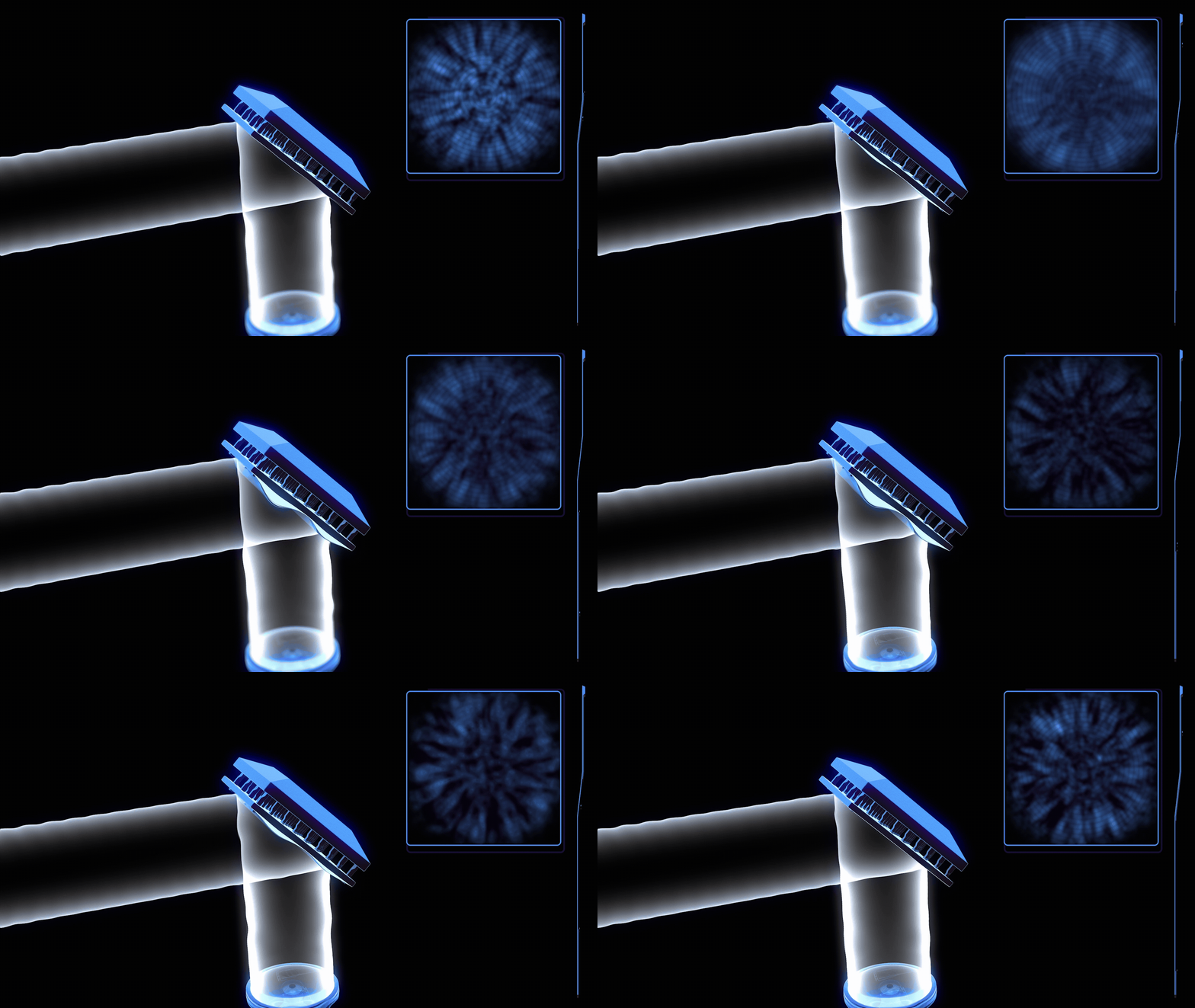
Researchers at Seoul National University and the University of Seoul have announced the successful development of a programmable photonic integrated circuit (PIC) capable of slowing and manipulating the speed of light on demand. This breakthrough, led by Professors Namkyoo Park and Sunkyu Yu of Seoul National University’s Department of Electrical and Computer Engineering, in collaboration with Professor Xianji Piao from the University of Seoul, addresses one of the most significant hurdles in the transition from electronic to optical computing. By providing a method to synchronize and delay optical signals without the need for fixed, single-purpose hardware, the team has opened a new pathway for high-efficiency data centers and the rapidly expanding infrastructure required for generative artificial intelligence.
The study, which has been published in the prestigious international journal Advanced Science, introduces a design that allows for the dynamic reconfiguration of optical signals within a chip. As global demand for computing power surges—driven largely by large-scale AI models such as GPT-4 and specialized machine learning workloads—the limitations of traditional silicon-based electronic semiconductors have become increasingly apparent. Current electronic systems suffer from significant energy loss due to heat and physical constraints on how quickly electrons can move through copper interconnects. While optical computing offers a solution by using photons to transmit data at the speed of light with minimal energy consumption, the "fixed" nature of light’s velocity has historically made it difficult to manage, store, or buffer information within a processor.
The Critical Bottleneck in Next-Generation AI Infrastructure
The rise of generative AI has fundamentally altered the requirements of global data center infrastructure. According to industry reports, the energy consumption of data centers is projected to double by 2026, largely due to the massive computational overhead of training and deploying neural networks. Conventional electronic semiconductors are reaching a "thermal wall," where the energy required to move data between memory and processing units generates more heat than current cooling systems can efficiently manage.
Optical computing and silicon photonics have emerged as the primary contenders to replace electronic interconnects. However, the inherent speed of light—approximately 300,000 kilometers per second—presents a unique engineering challenge. In any computing system, data must occasionally be held in a "buffer" or delayed so that different streams of information can be synchronized. In electronic systems, this is achieved through capacitors and transistors. In optical systems, "stopping" or "slowing" light is notoriously difficult. Without the ability to create optical buffers or adjustable delay lines, a fully optical computer remains a theoretical ideal rather than a practical reality.
The South Korean research team’s programmable photonic integrated circuit addresses this specific "synchronization gap." By creating a chip that can slow light whenever necessary, the researchers have provided the functional equivalent of an adjustable memory buffer for photons.
Technological Breakthrough: Programmable Coupled-Resonator-Induced Transparency
The core of the team’s innovation lies in a phenomenon known as coupled-resonator-induced transparency (CRIT). This technique utilizes the interference patterns generated among multiple optical resonators—microscopic structures that trap light in circular paths—to allow specific frequencies of light to pass through a medium that would otherwise be opaque. More importantly, CRIT significantly reduces the "group velocity" of light, effectively slowing the signal down as it traverses the circuit.
Until now, CRIT devices were largely static. Once a photonic chip was manufactured, its ability to slow light was fixed to a specific frequency and a specific delay time. If an engineer required a different delay or needed to process a different wavelength of light, an entirely new chip had to be designed and fabricated. This lack of flexibility made optical components expensive and difficult to scale for the dynamic, real-time needs of an AI server.
The researchers at Seoul National University and the University of Seoul overcame this limitation by treating the two primary optical states within CRIT systems—the "bright mode" and the "dark mode"—as a single, unified degree of freedom. By integrating two controllable loop couplers into the circuit, the team created a programmable architecture. This allows the chip to be reconfigured after fabrication, enabling users to adjust the bandwidth, the shape of the passband, and the duration of the signal delay in real time.
Performance Metrics and Simulation Validation
To verify the practical utility of their design, the research team conducted exhaustive three-dimensional electromagnetic simulations. These tests were performed using a silicon nitride (Si3N4) platform, a material widely used in the photonics industry for its low optical loss and compatibility with existing CMOS (Complementary Metal-Oxide-Semiconductor) manufacturing processes.
The simulations focused on several critical real-world variables, including:
- Material Losses: Ensuring the signal remains strong even when slowed.
- Thermal Crosstalk: Analyzing how heat from one part of the chip affects the performance of another—a vital consideration for high-density AI servers.
- Phase Errors and Coupling Fluctuations: Testing the resilience of the programmable loop couplers against minor manufacturing defects.
- Backscattering: Managing light that reflects backward through the circuit, which can cause interference.
The results demonstrated that the speed of optical pulses could be adjusted dynamically while the circuit was in operation without sacrificing processing performance. Furthermore, the system showed the ability to perform frequency conversion—changing the "color" or wavelength of the light—without requiring additional specialized hardware. This multi-functionality is a significant departure from previous generations of photonic devices.
A Timeline of Development and Future Implementation
The development of this programmable PIC follows several years of intensive research into the physics of light-matter interaction at Seoul National University’s Intelligent Wave Systems Laboratory. The project moved from theoretical physics models to numerical analysis and finally to the 3D simulation stage that proved its feasibility on silicon nitride platforms.
The research was supported by the Ministry of Science and ICT (MSIT) through several high-level initiatives, including the Innovative Research Center (IRC) program, the Basic Research Laboratory (BRL) program, and the Young Researcher Program. These grants reflect the South Korean government’s strategic interest in securing a lead in the "Photonic AI" sector, which is viewed as a cornerstone of future national economic security.
Professor Namkyoo Park, a co-corresponding author of the study, highlighted the significance of the shift from fixed to programmable hardware. "This research is significant in that it proposes a new design principle that allows the flow of light within photonic integrated circuits to be reconfigured as needed, greatly enhancing design flexibility," Park stated. He further noted that the team’s next objective is to scale this technology toward "large-scale programmable photonic integrated circuits based on silicon photonics and photonic AI technologies."
Broader Implications for Industry and Science
The potential applications for a programmable "slow light" chip extend far beyond the immediate needs of AI data centers. By enabling precise control over the timing and frequency of optical signals, this technology could impact several high-growth industries:
- Autonomous Driving: Lidar systems, which use light to map the environment around a vehicle, require extremely precise timing to calculate distances. Programmable delays could improve the resolution and adaptability of these sensors in varying weather conditions.
- Quantum Computing: Quantum information is often carried by single photons. The ability to delay a photon without destroying its quantum state (coherence) is essential for quantum memory and the synchronization of quantum gates.
- 5G and 6G Communications: As telecommunications move toward higher frequency bands, the ability to manage signal interference and synchronization at the chip level will be critical for maintaining high-speed data links.
- Edge Computing: By reducing the energy footprint of high-speed data processing, programmable photonic chips could allow sophisticated AI models to run on smaller, localized devices rather than relying solely on the cloud.
The researchers believe their "unified degree of freedom" approach can be applied to a wide variety of resonator-based photonic circuits, not just those using CRIT. This suggests the dawn of a "software-defined" era for optical hardware, where the same physical chip can be repurposed for different tasks—ranging from signal synchronization to optical buffering—simply by adjusting its programming.
As the industry moves toward "Photonic AI," where light is used not just to move data but to perform the actual mathematical calculations required by neural networks, the ability to control the "timing" of light will become as fundamental as the clock speed of a modern CPU. The work of the Seoul-based team represents a critical step in making that future commercially viable.
Dr. Seungkyun Park and Ph.D. student Beomjoon Chae, the co-first authors of the study, emphasized that this breakthrough was the result of re-examining established physics through a new lens. "We realized that reinterpreting conventional photonic resonator physics from a different perspective can serve as a starting point for discovering new functionalities," they noted. Their upcoming work will focus on the experimental validation of these chips in real-world computing environments, moving the technology from the simulation lab to the production line.
Related posts: