React Native 0.74 Enhances Performance and Web Alignment Through Yoga 3.0 and New Architecture Advancements

The Meta-led React Native team has officially announced the release of version 0.74, a significant update that signals a new era for the popular cross-platform mobile development framework. This latest iteration introduces Yoga 3.0, sets Bridgeless Mode as the default for the New Architecture, and transitions to Yarn 3 as the primary package manager for new projects. By focusing on performance optimization, layout predictability, and the removal of legacy technical debt, React Native 0.74 aims to bridge the gap between web development standards and native mobile performance.
A New Foundation: The Shift to Bridgeless Mode
The most transformative change in React Native 0.74 is the transition to Bridgeless Mode as the default setting when the New Architecture is enabled. For years, React Native relied on a "Bridge" to facilitate communication between the JavaScript layer and the native platform (iOS or Android). While revolutionary at its inception, the Bridge became a performance bottleneck due to its asynchronous nature and the need for data serialization.
Bridgeless Mode is the culmination of a multi-year re-architecture project. By removing the Bridge, React Native allows JavaScript to call native methods directly and synchronously via JSI (JavaScript Interface). This release enhances the interop layers, ensuring that older libraries and components can still function within the New Architecture without requiring immediate, extensive refactoring. Engineering teams at Meta have worked closely with major library maintainers to ensure that the ecosystem is prepared for this shift, providing a smoother migration path for developers moving away from the legacy architecture.
Yoga 3.0: Aligning Mobile Layouts with Web Standards
React Native 0.74 integrates Yoga 3.0, the newest version of the underlying layout engine that powers the framework’s flexbox implementation. Yoga 3.0 represents a major milestone in layout consistency, addressing long-standing discrepancies between how React Native and web browsers interpret CSS.
One of the most notable changes in Yoga 3.0 is the corrected handling of logical edges in row-reverse containers. Previously, React Native incorrectly flipped certain margins, paddings, and borders when dealing with reversed rows. Version 0.74 brings these behaviors into alignment with the W3C standards used by modern web browsers. While this is a breaking change for developers who relied on the previous "incorrect" behavior, it ensures that styling becomes more predictable for developers who work across both web and mobile platforms.
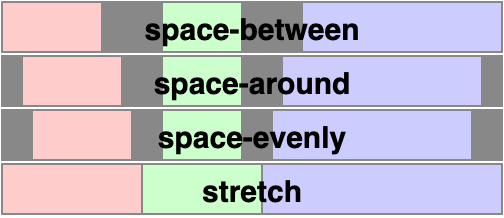
Furthermore, Yoga 3.0 introduces support for align-content: 'space-evenly'. This property allows for multi-line flex containers to distribute space between lines and container edges with mathematical uniformity. Additionally, the New Architecture now supports position: 'static'. This addition allows elements to be positioned relative to an ancestor rather than just their direct parent, providing layout flexibility that was previously difficult to achieve in native environments.

Optimized Performance via Batched onLayout Updates
In a move to further optimize rendering performance, React Native 0.74 introduces batched updates for the onLayout callback within the New Architecture. In previous versions, every state update triggered within an onLayout event would result in a separate render commit. In complex applications with multiple nested views, this could lead to "render storms" that degraded performance and caused UI stuttering.
Under the 0.74 update, multiple state updates occurring within onLayout are batched into a single render pass. This aligns the event’s behavior with standard React state management practices. However, the development team has issued a warning that this change may break codebases that implicitly relied on un-batched, sequential updates. Developers are encouraged to utilize updater functions or refactor logic to accommodate the more efficient, unified rendering cycle.
Modernizing Tooling: Yarn 3 and the Decoupling of Flipper
The developer experience (DX) receives a significant overhaul in this release. Yarn 3 is now the default package manager for new projects initialized through the React Native Community CLI. This move replaces the deprecated Yarn Classic (1.x). To maintain compatibility with the unique requirements of native mobile development, Yarn 3 is configured to use the nodeLinker: node-modules mode. This ensures that the migration provides the performance benefits of modern Yarn while remaining compatible with the existing ecosystem of native modules.
Simultaneously, the React Native team has removed the native Flipper libraries and setup code from new projects. Flipper, once the primary tool for inspecting layouts and network requests, had become a source of significant dependency bloat and increased build times. By decoupling Flipper from the core, React Native 0.74 reduces the complexity of the native build process. The team now recommends using the Hermes Debugger or the new experimental debugger, which is also the default in the Expo ecosystem, as the primary tools for JavaScript debugging.
Breaking Changes and Infrastructure Upgrades
As part of the modernization effort, React Native 0.74 introduces several breaking changes aimed at reducing the framework’s footprint and keeping pace with platform requirements.
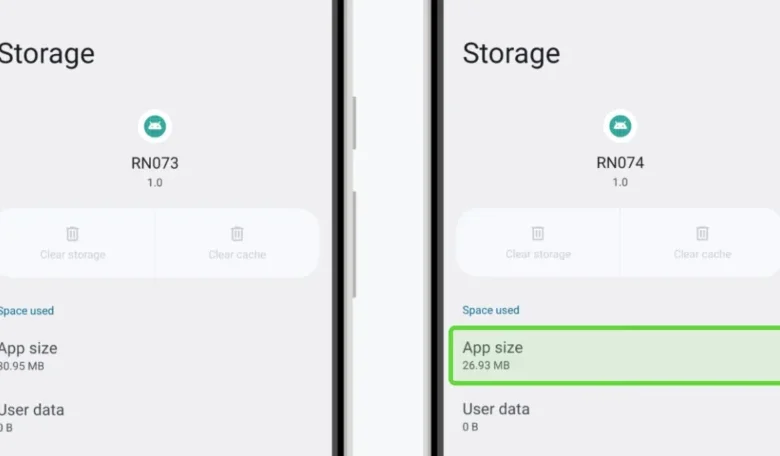
- Android SDK 23 Requirement: The minimum supported Android version has been raised to Android 6.0 (API 23), moving up from Android 5.0 (API 21). This shift allows the framework to leverage modern Android APIs and has resulted in a notable reduction in app size. Meta reports that a newly created app in 0.74 occupies approximately 13% less space on a user’s device, saving roughly 4MB per installation.
- Removal of PropTypes: Following a long-standing deprecation that began in React 15.5 (2017), React Native has finally removed all built-in
PropTypes. This removal reduces the minified bundle size by 26.4kB and decreases memory overhead. Developers still usingPropTypesare urged to migrate to TypeScript or Flow for type safety. - PushNotificationIOS Migration: The deprecated
PushNotificationIOSlibrary has been updated to use Apple’s modern User Notifications framework. This is a preparatory step for version 0.75, where the library will be removed from the core React Native repository and moved to a community-maintained package. Developers must update theirAppDelegateimplementations to remain compatible with these changes.
Chronology and Release Context
The release of React Native 0.74 follows the successful deployment of version 0.73 in late 2023, which focused on debugging improvements. The current release cycle demonstrates Meta’s commitment to a predictable, biannual major update schedule. With the release of 0.74, version 0.71 moves into the "unsupported" category, with a final end-of-life update planned for early May 2024.
This timeline reflects a broader strategy to push the New Architecture into the mainstream. While the New Architecture has been available as an opt-in feature for several versions, 0.74 makes it more robust and accessible, setting the stage for it to become the sole architecture in future releases.
Industry Implications and Analysis
Industry analysts view React Native 0.74 as a defensive and offensive maneuver in the competitive mobile framework landscape. By aligning more closely with web standards through Yoga 3.0, React Native lowers the barrier to entry for web developers, a key demographic for the framework.
The reduction in Android app size is particularly significant for developers targeting emerging markets, where device storage and data costs remain a primary concern. By trimming 4MB from the base install size, React Native remains a viable competitor to Flutter and native development for large-scale enterprise applications.
The removal of Flipper and the shift toward specialized debugging tools also suggest a move toward a more modular, "lean" core. This allows the core team to focus on the framework’s performance while letting the community innovate on tooling and secondary libraries.
Official Responses and Community Support
In the official release documentation, the React Native team thanked over 57 contributors who provided more than 1,600 commits to the 0.74 branch. The team emphasized that while the New Architecture is still maturing, the stability provided by Bridgeless Mode marks a "production-ready" milestone for many use cases.
The Expo team, a major stakeholder in the React Native ecosystem, has confirmed that React Native 0.74 will be supported in the upcoming Expo SDK 51. This ensures that a large portion of the developer community will have immediate access to these improvements through the Expo managed workflow.
Conclusion
React Native 0.74 is a pivotal release that prioritizes the long-term health of the framework over short-term backward compatibility. By mandating modern Android versions, embracing the New Architecture’s Bridgeless Mode, and refining the layout engine with Yoga 3.0, the framework is positioning itself as a modern, efficient tool for the next generation of mobile applications. Developers are encouraged to use the React Native Upgrade Helper to navigate the transition, particularly regarding the layout changes and the removal of legacy APIs. As the ecosystem moves toward version 0.75, the focus remains clear: a faster, lighter, and more web-aligned React Native.
Related posts: