For decades, large enterprises have built their digital foundations on deterministic software, meticulously embedding business rules, modeling explicit state transitions, and pre-defining escalation paths. This approach, characterized by advanced system behavior specification and validated conditional branches, has been the bedrock of reliability and control for mission-critical operations. The underlying assumption has been that most situations can be anticipated and logically expressed, a model that thrives when variation is limited and conditions are manageable. However, as processes are increasingly required to respond to nuanced context rather than mere predefined thresholds, this rigid structure begins to strain.
This tension is vividly illustrated in the complex realm of customer onboarding within the banking sector. Onboarding sits at a critical nexus, intersecting digital channels, sophisticated fraud detection mechanisms, stringent regulatory obligations, and ambitious revenue goals. Financial institutions must not only satisfy Know Your Customer (KYC) and Anti-Money Laundering (AML) mandates but also minimize customer abandonment rates and actively resist sophisticated threats like synthetic identity attacks.
A deep dive into digital account opening initiatives at a major North American bank, as observed by industry professionals, repeatedly exposed a fundamental trade-off during cross-functional design sessions. Product teams, driven by the imperative to reduce friction and boost conversion rates, found themselves in constant negotiation with fraud teams. The latter, responding to a surge in bot-driven account creation and mule schemes, advocated for increasingly stringent safeguards. Simultaneously, compliance departments insisted on unwavering adherence to regulatory standards, while engineering teams grappled with integrating each new requirement into the existing orchestration framework. While each individual decision was rational and strategically sound within its silo, their collective impact was a significant increase in workflow complexity.
The core of this challenge wasn’t a deficit of rules, but rather the inherent difficulty of encoding contextual judgment within a static, branching logic structure. Differentiation in these processes typically occurred only at predetermined checkpoints, and information was often collected in a broad, undifferentiated manner rather than adapting to known facts about the applicant. This created a precarious balancing act: collecting too little information risked regulatory exposure or fraud, while demanding too much led to increased customer abandonment. The attempt to address every conceivable variation by adding more branching logic resulted in increasingly fragile and unwieldy workflows.
The Emergence of Adaptive Scoring and Contextual Models
To address these limitations, adaptive scoring and contextual models are increasingly being employed to complement deterministic logic. Instead of attempting to enumerate every possible scenario in advance, these models assist in determining whether additional verification is warranted or if the process can proceed with existing evidence. While deterministic workflows continue to enforce core regulatory requirements and final state transitions, an adaptive layer provides crucial intelligence on how the system navigates toward those outcomes.
Although customer onboarding provides a clear illustration, this architectural challenge is not unique to that domain. Similar patterns are observed in credit adjudication, claims processing, and dispute management. As adaptive signals are integrated into these workflows, the fundamental architectural question shifts from simply adding more branches to discerning where contextual judgment should reside. The critical missing element, in many views, is not another conditional path but a different runtime model – one capable of interpreting context and dynamically determining the next appropriate action within defined limits. This crucial architectural layer, which can be termed the Agent Tier, effectively separates contextual reasoning from deterministic execution.
Introducing the Agent Tier: Separating Execution from Contextual Judgment
In numerous enterprise environments, the orchestration logic governing complex processes does not reside within a formal, dedicated workflow platform. Instead, it is often embedded within Single Page Applications (SPAs), implemented within Application Programming Interfaces (APIs), supported by rule engines, and coordinated through intricate service calls across disparate systems. User journeys are frequently assembled through API calls in predefined sequences, with eligibility or routing conditions evaluated at specific, hardcoded checkpoints.
This conventional approach proves effective for repeatable, well-understood processes. When all inputs are complete, risk signals are minimal, and no exception handling is required, a clean, deterministic execution path can be followed. State transitions are predictable, service calls adhere to established patterns, and human tasks are invoked at designated points.
The complexities arise when these workflows encounter ambiguity. Inputs might be incomplete, requiring further investigation. Risk signals may necessitate nuanced interpretation beyond simple threshold comparisons. Multiple systems might need to be coordinated in a sequence that wasn’t explicitly modeled beforehand. Attempting to encode every such eventuality into SPA logic or orchestration APIs inevitably leads to increasingly convoluted condition trees and significantly more challenging code to maintain. Rather than indefinitely expanding hard-coded branching, a more robust solution involves separating the runtime into two complementary operational lanes: repeatable execution and sophisticated contextual reasoning.
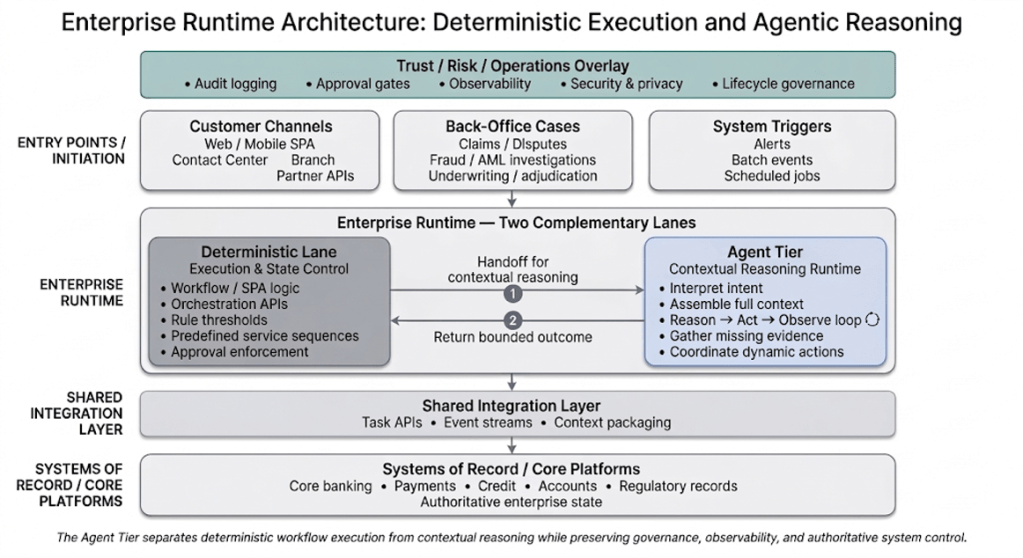
Conceptually, the enterprise runtime evolves into a two-lane structure.
(Illustration of Enterprise Runtime Architecture: Deterministic Execution and Agentic Reasoning – Imagine a diagram showing two parallel lanes. The left lane is labeled "Deterministic Execution" and depicts a straight, controlled flow. The right lane is labeled "Agentic Reasoning" and shows a more dynamic, adaptive flow. Arrows indicate a handoff from Deterministic to Agentic for complex decisions, and a return from Agentic to Deterministic for final execution.)

The deterministic lane retains ultimate control over authoritative state changes and rule enforcement. It meticulously manages eligibility checks, applies stringent regulatory criteria, invokes known service sequences, and finalizes cases within core systems. This lane continues to efficiently handle the vast majority of predictable scenarios.
The runtime then invokes the Agent Tier when contextual judgment becomes necessary. This occurs, for instance, when additional evidence must be gathered before a rule can be accurately evaluated, when multiple signals demand collective interpretation rather than independent assessment, or when coordination across various systems cannot be achieved through a fixed, pre-programmed sequence. The Agent Tier evaluates available actions and returns a bounded recommendation, enabling the deterministic execution lane to resume its controlled progression.
The transition between these lanes is explicit. The deterministic workflow orchestrator hands off control when it reaches a point where static branching proves insufficient. The Agent Tier then undertakes the crucial tasks of synthesis or dynamic coordination. Once the Agent Tier produces a structured and actionable result – such as a completed evidence bundle, a validated set of inputs, or a recommended next step – control is returned to the deterministic lane for controlled progression and final state transition. This architectural separation facilitates incremental adoption. Existing SPA logic and orchestration APIs can remain largely intact, with points of ambiguity simply redirected to the Agent Tier without destabilizing the core deterministic execution.
What Happens Inside the Agent Tier
The Agent Tier is not a monolithic "AI decision" engine. Instead, it functions as a structured reasoning cycle that harmoniously combines interpretation with controlled action.
When the deterministic workflow hands off a case, the Agent Tier begins by interpreting the current situation. This involves assembling all available context, including user inputs, existing customer relationships, real-time fraud signals, the current journey state, and relevant policy constraints. Based on this comprehensive view, it selects the next appropriate action from an approved set of enterprise capabilities. This action might entail retrieving supplementary information, invoking a specialized verification service, requesting clarification directly from the user, or orchestrating a sequence of operations across multiple systems. Once the selected action is completed, its outcome is meticulously evaluated, and the cycle continues until the deterministic execution lane can safely resume control.
This alternating pattern of reasoning and action is a well-established principle in agentic system design. In technical literature, it is frequently referred to as the ReAct (Reason and Act) pattern, which interleaves distinct reasoning steps with structured action selection. Rather than attempting to arrive at a final solution in a single, monolithic pass, the system iteratively gathers evidence, reassesses its position, and proceeds incrementally. In enterprise settings, this pattern provides a disciplined and effective method for managing complex contextual interpretation.
Crucially, reasoning within the Agent Tier does not involve unrestricted system access. Instead, it proceeds through a catalog of approved operations exposed via meticulously governed interfaces. In practice, these "tools" often represent enterprise primitives such as:
- Data Retrieval Services: Accessing customer databases, transaction histories, or third-party data sources.
- Verification APIs: Engaging services for identity verification, document validation, or fraud checks.
- Communication Interfaces: Triggering outbound notifications to customers or internal stakeholders.
- Workflow Task Creation: Initiating specific human review tasks or escalations.
- Policy Checkers: Querying rules engines or compliance databases.
Each operation is rigorously defined by explicit input/output contracts and permission boundaries, and carries essential metadata describing its purpose and inherent constraints. The runtime dynamically selects from this governed catalog – a mechanism commonly referred to as "tool calling." Some advanced frameworks further group related tools into higher-level capabilities known as "skills," which are reusable functions designed to achieve specific objectives, such as comprehensive identity verification or the assembly of complete KYC evidence.
Before control is returned to the deterministic lane, the agentic runtime can also perform a structured self-check. This might involve verifying that all required conditions have been satisfied, confirming alignment with policy constraints, and ensuring that any necessary approvals have been identified. In technical discussions, this process is often described as "reflection."
Collectively, these patterns do not introduce unchecked autonomy. Instead, they provide a structured and controlled mechanism for managing contextual synthesis and dynamic coordination without allowing adaptive logic to diffuse indiscriminately across SPA code and disparate orchestration services. Deterministic systems continue to enforce authoritative state transitions, while the Agent Tier diligently prepares the precise conditions under which those transitions occur.
In many implementations, the Agent Tier does not directly control the workflow. Rather, it provides a recommendation for the next step based on the available context. The deterministic tier remains fundamentally responsible for the actual execution. After each step is completed – whether it involves retrieving evidence, invoking a verification service, or preparing a case for manual review – the updated context is returned to the Agent Tier. The Agent Tier then evaluates this new state and recommends the subsequent action. In this model, contextual reasoning effectively informs the progression of the workflow, while deterministic systems rigorously enforce authoritative state transitions.
Returning to the customer onboarding example, the Agent Tier fundamentally alters how the journey adapts to each individual applicant. The deterministic tier continues to execute core steps such as creating the customer profile, enforcing regulatory checks, and committing account state within core banking systems. The Agent Tier, however, continuously evaluates the evolving context – encompassing customer relationships, emerging fraud signals, identity verification results, and available documentation – and dynamically recommends whether the workflow can proceed along the "clean path," trigger additional verification measures, or escalate to a manual review process. The outcome is not a new, fundamentally different onboarding process, but rather a workflow that adapts its progression dynamically while meticulously preserving the deterministic controls essential for regulated financial operations.
Conceptually, the intricate interaction between contextual reasoning and deterministic execution can be visualized as a continuous runtime loop.
(Illustration of Context-Driven Workflow Loop: Imagine a circular diagram. Starting at the top, a box labeled "Deterministic Workflow" feeds into a box labeled "Contextual Reasoning (Agent Tier)" which recommends the next step. This recommendation then feeds into a box labeled "Execution (Deterministic)" which performs the action. The result of the action feeds back into the "Contextual Reasoning" box, creating a continuous loop.)
The workflow progresses through this perpetual loop: contextual reasoning recommends the next strategic step, deterministic systems execute that action, and the resulting context feeds back into the next iteration of recommendation.
Governing Adaptive Systems Without Losing Control
The separation of contextual reasoning from deterministic execution clarifies responsibilities but does not, by itself, eliminate inherent risks. In highly regulated environments, adaptive sequencing must operate strictly within explicit, predefined governance boundaries.
An essential overlay of trust and operations represents cross-cutting controls that span the entire runtime. This includes robust audit logging, explicit approval gates, comprehensive observability, stringent security enforcement, and disciplined lifecycle management. Within this overarching structure, authoritative state transitions remain firmly deterministic. Core systems continue to reliably create client profiles, enforce transaction limits, record critical disclosures, and apply regulatory thresholds. While the Agent Tier may significantly influence the progression of a workflow, final state changes occur exclusively through controlled, authorized interfaces.
This containment boundary is critical for preserving explainability. When progression changes – for instance, when additional verification is triggered or an escalation to manual review occurs – institutions must possess the ability to meticulously reconstruct the precise sequence of events that led to that outcome. Which specific signals were assembled? Which tools were invoked? What underlying reasoning produced the recommendation? Concentrating contextual evaluation within a defined runtime layer makes this essential traceability achievable.
Operational experience strongly reinforces the necessity of these robust guardrails. Engineering discussions surrounding the development of production-ready agent systems consistently emphasize constrained tool access, meticulously curated explicit action catalogs, bounded iteration limits, and highly effective observability mechanisms. In enterprise environments, contextual reasoning must therefore operate through governed tools and transparent control points.
Approval gates remain an integral part of this structure. High-risk actions, such as the issuance of credit, the imposition of account restrictions, the execution of large payment transactions, or the submission of regulatory filings, may still necessitate explicit human authorization, regardless of how the progression to that point was determined. Reflection within the Agent Tier can effectively validate readiness, but the ultimate authorization remains a distinct and explicit process.
Lifecycle discipline is equally paramount. Changes to underlying models, identity providers, tool contracts, or orchestration logic can significantly alter workflow behavior. Consequently, the Agent Tier should operate as a governed platform capability, featuring versioned reasoning logic, carefully managed tool catalogs, and clearly defined testing and rollback mechanisms.
The ultimate objective is not to eliminate probabilistic reasoning altogether, but rather to meticulously contain it within observable workflows and clearly defined governance boundaries. As adaptive capabilities continue to expand and evolve, the fundamental architectural question becomes not whether contextual reasoning will exist, but rather where it resides – whether it is diffused haphazardly across the entire technology stack or concentrated within a controlled and manageable runtime layer.
Architectural Leadership in an Adaptive Era
The introduction of an Agent Tier represents a new runtime component, but enterprise complexity itself is not new; it is already widely dispersed across channel code, numerous orchestration services, various rule engines, and an ever-increasing proliferation of conditional branches. The critical architectural question, therefore, is not whether complexity exists, but where it is strategically located. As fraud models become more sophisticated, verification technologies advance, and regulatory expectations continue to shift, adaptive capabilities will inevitably expand.
In this evolving landscape, architecture must transition from merely enumerating state transitions to strategically defining containment boundaries. Deterministic systems will continue to enforce critical regulatory and operational requirements and retain responsibility for authoritative state changes. Adaptive reasoning, conversely, will operate within explicit policy constraints, intelligently informing how workflows progress toward those outcomes. Instead of attempting to encode every conceivable path in advance, enterprises can increasingly move toward context-driven workflows, where deterministic execution handles authoritative actions, while the Agent Tier intelligently determines the next appropriate step based on continuously evolving context.
This architectural evolution does not necessitate a wholesale reinvention of existing systems. It can commence with a single, high-impact workflow where contextual variability is already demonstrably evident. By introducing a disciplined runtime layer that effectively mediates uncertainty while meticulously preserving deterministic control, organizations can modernize incrementally and strategically. In this sense, the Agent Tier is not merely a new feature; it represents a fundamental structural response to a changing runtime reality, one that empowers adaptive systems to operate effectively within clear architectural and governance boundaries.