NVIDIA and Global Industrial Leaders Accelerate the Era of Agentic Manufacturing and Physical AI at Hannover Messe 2026

The global manufacturing sector has reached a critical inflection point where the transition from traditional automation to AI-driven production is no longer a strategic option but a competitive necessity. As industrial economies face a trifecta of pressures—accelerated design cycles, the mandate for leaner operations, and a tightening global pool of skilled labor—the focus has shifted from the theoretical adoption of artificial intelligence to the practicalities of speed and scale. At Hannover Messe 2026, the world’s premier industrial trade fair held in Hannover, Germany, from April 20-24, NVIDIA and an expansive ecosystem of partners are demonstrating that the "factory of the future" is already operational. Through a combination of accelerated computing, AI physics, agentic workflows, and humanoid robotics, the industrial landscape is undergoing its most profound transformation since the dawn of the digital age.
The Foundation of Industrial Sovereignty: Europe’s AI Cloud
The deployment of AI at a scale capable of managing global supply chains and massive production facilities requires more than just advanced algorithms; it demands a robust, secure, and scalable infrastructure. In Europe, where data sovereignty and regulatory compliance are paramount, the development of localized AI infrastructure has become a top priority for industrial leaders. A cornerstone of this movement is the Industrial AI Cloud, one of Europe’s largest AI factories, established in Germany by Deutsche Telekom. Built on NVIDIA’s high-performance AI infrastructure, this cloud serves as a blueprint for how sovereign nations can foster industrial innovation while maintaining control over sensitive proprietary data.
The Industrial AI Cloud provides the computational power necessary to run AI-accelerated workloads that were previously impossible in real-time. During Hannover Messe, major industry players including SAP, Siemens, Agile Robots, and Wandelbots are showcasing how they utilize this sovereign platform. One notable development comes from EDAG, a premier independent engineering service provider, which announced that its industrial metaverse platform, metys, will now run on the Industrial AI Cloud. This move brings sovereign AI infrastructure to automotive and industrial engineering at a scale that allows for the seamless integration of digital twins and software-defined robotics across the entire production lifecycle. To meet this surging demand, hardware giants such as Dell Technologies, IBM, Lenovo, and PNY are unveiling NVIDIA-accelerated systems designed for environments ranging from the rugged edge to centralized data centers.
AI-Driven Engineering: Beyond Traditional Simulation
As industrial systems grow exponentially more complex, the software used to design and test them must evolve. Traditional Computer-Aided Engineering (CAE) is being superseded by AI physics and agentic AI. Leaders in the design space, including Cadence, Dassault Systèmes, Siemens, and Synopsys, are now integrating NVIDIA CUDA-X libraries and NVIDIA Omniverse into their core software stacks. By leveraging NVIDIA Nemotron open models, these companies are enabling "agentic design"—a workflow where AI agents assist engineers in real-time to explore design variations, predict physical outcomes with high accuracy, and optimize systems before a single physical prototype is built.
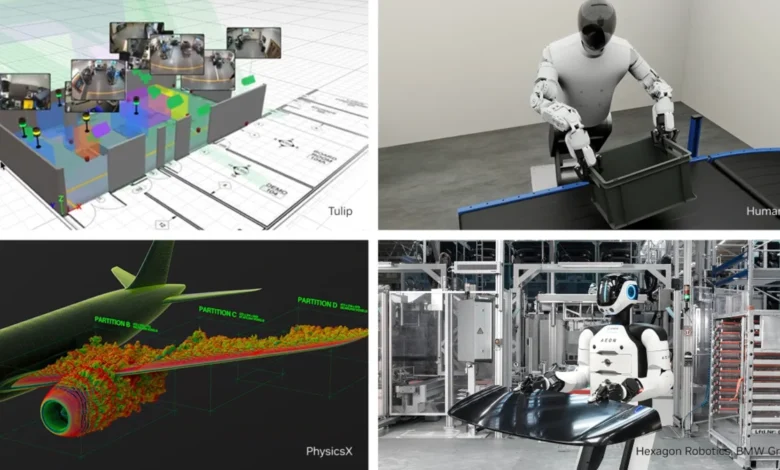
This shift toward AI physics-grounded simulation allows for a level of design exploration that was once computationally prohibitive. Engineers can now simulate fluid dynamics, structural stress, and thermal management in a fraction of the time previously required. This acceleration is critical for industries like aerospace and automotive, where reducing time-to-market by even a few months can result in billions of dollars in competitive advantage.
Real-Time Digital Twins and the Power of OpenUSD
The concept of the digital twin has evolved from a static 3D model into a living, real-time representation of a factory’s physical state. At the heart of this evolution is OpenUSD (Universal Scene Description), an open framework that allows for the synchronization of massive datasets across disparate software tools. At Hannover Messe, the integration of NVIDIA Omniverse with various industrial IoT platforms is demonstrating how digital twins are used to stress-test and optimize operations continuously.
ABB is showcasing the integration of Omniverse libraries with Microsoft Azure cloud services within its ABB Genix Industrial IoT and AI Suite. This allows operations teams to engage AI agents for root-cause analysis, identifying why a specific asset is underperforming by analyzing its digital twin in full context. Similarly, Kongsberg Digital is highlighting its Kognitwin platform, which provides "spatial intelligence" for critical energy infrastructure. By combining live operational data with virtual twin models, energy companies can test scenarios virtually—such as the impact of a sudden load shift—before implementing changes in the physical world.
Siemens is also playing a pivotal role with its Digital Twin Composer, which transforms multi-domain engineering data into simulation-ready environments. For manufacturers, the benefit is quantifiable: identifying production bottlenecks in a virtual environment before they manifest on the factory floor leads to significant throughput gains and a reduction in costly downtime.
The Rise of Vision AI Agents on the Factory Floor
While traditional AI often operates under rigid, pre-defined conditions, the new generation of "AI agents" is proactive and adaptive. These agents do not merely follow instructions; they analyze visual data, understand context, and take action based on what they perceive. At Hannover Messe, vision AI agents built on NVIDIA Metropolis and NVIDIA Cosmos are proving to be transformative for quality control and worker safety.
Invisible AI has launched its Vision Execution System, which uses agents to capture and structure every production cycle on a factory floor in real-time. This system, built with the NVIDIA Metropolis VSS (Video Search and Summarization) blueprint, is already being utilized by global leaders like Toyota. By surfacing actionable insights directly to operators, these agents can prevent defects before they happen.
Tulip Interfaces is presenting its "Factory Playback" feature, which synchronizes machine telemetry with video feeds into a searchable timeline. For Terex, a global manufacturer of industrial equipment with more than 40 plants, this technology is expected to yield a 3% increase in production yield and a 10% reduction in rework. These figures represent a massive return on investment when applied across large-scale industrial operations. Furthermore, Fogsphere is extending these capabilities to high-risk environments, where AI agents detect safety hazards—such as a worker entering a restricted zone or a potential gas leak—and trigger immediate responses to prevent accidents.
Autonomous Machines and the Humanoid Frontier
Perhaps the most visually striking advancement at Hannover Messe 2026 is the deployment of autonomous robots and humanoids that can "think" and navigate unstructured environments. Historically, industrial robots were confined to repetitive tasks in caged environments. Today, AI reasoning is breaking these constraints.
In a landmark proof of concept, Siemens has deployed the HMND 01 wheeled humanoid robot at its electronics factory in Erlangen, Germany. Running on the NVIDIA Jetson Thor edge AI module, the robot successfully completed autonomous logistics tasks within a live production environment. What is most remarkable is the timeline: by using a simulation-first development approach with NVIDIA Isaac Sim and Isaac Lab, the development team compressed a hardware and software cycle that typically takes two years into just seven months.
The democratization of this technology is also a major theme. SCHUNK’s GROW automation cell and Wandelbots’ NOVA platform are designed to put physical AI within reach of small- and medium-sized enterprises (SMEs). By allowing robot behavior to be validated in simulation before deployment, these platforms reduce the financial and operational risks associated with automation. In the automotive sector, Hexagon Robotics and AEON are preparing for humanoid deployments at a BMW Group plant in Leipzig, marking one of the first instances of humanoid robots performing assembly operations in a major German automotive facility.
Safety, Reliability, and the Road Ahead
As AI agents and robots move from isolated testbeds to the core of industrial production, functional safety becomes a non-negotiable requirement. The collaboration between NVIDIA and QNX (BlackBerry) highlights this shift. By integrating the QNX OS for Safety 8.0 with the NVIDIA IGX Thor industrial-grade edge compute platform, manufacturers can now deploy AI systems that meet the rigorous safety standards required for human-robot collaboration and medical-grade precision.
The implications of these advancements extend far beyond the walls of the factory. The integration of AI into manufacturing is a response to a global labor crisis; as the workforce ages and the "skills gap" widens, AI agents and autonomous machines are filling roles that are increasingly difficult to staff. However, this is not merely a story of replacement, but one of augmentation. By automating routine analysis and physical labor, these technologies allow human workers to focus on higher-level problem solving and strategic management.
The data presented at Hannover Messe 2026 suggests that the industrial sector is moving into a phase of unprecedented efficiency. With yield increases, dramatic reductions in rework, and the compression of development timelines, the economic impact of AI-driven manufacturing is expected to be measured in the trillions of dollars over the coming decade. As NVIDIA and its partners have demonstrated, the transition to agentic, autonomous production is no longer a vision of the future—it is the operational standard for the present.