React Native 0.86 Release Marks Major Milestone with Android 15 Edge-to-Edge Support and Organizational Transition to the React Foundation

The React Native core team has officially announced the release of React Native 0.86, a significant update that introduces comprehensive support for Android 15’s edge-to-edge display requirements and marks a historic shift in the project’s governance. This latest version continues the project’s recent trend of prioritizing stability and upgrade predictability, notably featuring zero user-facing breaking changes for the second time in recent release cycles. Beyond technical refinements, the 0.86 release coincides with the migration of the React Native repository to the newly established React Foundation, signaling a new era of independent stewardship for one of the world’s most popular cross-platform mobile frameworks.
A Strategic Shift in Governance: The Move to the React Foundation
Perhaps the most impactful non-technical change accompanying the 0.86 release is the migration of the React Native repository. The project, along with associated technologies such as React, Metro, Yoga, and the official documentation website, has officially moved from the facebook GitHub organization to a dedicated react organization. This transition is not merely a cosmetic change in URL structure but represents the formalization of the React Foundation.
The React Foundation is an independent entity designed to provide long-term stewardship for the React ecosystem. By moving away from a single corporate entity’s organizational umbrella, the foundation aims to foster a more neutral, community-driven environment. While Meta (formerly Facebook) remains a primary contributor and investor in the technology, the foundation model ensures that the roadmap and governance of React Native are insulated from the shifting priorities of any single corporation. This move aligns React Native with other major open-source projects like Node.js and Linux, which benefit from foundation-based oversight to ensure longevity and industry-wide adoption.
For developers, the transition is designed to be seamless. GitHub’s automated redirection systems ensure that existing pull requests, issues, and documentation links remains functional. However, the symbolic weight of this change cannot be overstated, as it reinforces the maturity of React Native as a foundational piece of global digital infrastructure.
Comprehensive Edge-to-Edge Support for Android 15
From a technical perspective, the headline feature of React Native 0.86 is its robust handling of Android 15’s "edge-to-edge" display paradigm. With the release of Android 15, Google has moved toward enforcing a layout where applications utilize the entire screen real estate, including the areas behind the system status bar and the navigation bar.
In previous versions of Android, developers often had to manually opt into edge-to-edge rendering. However, Android 15 makes this the default behavior for apps targeting the new API level. React Native 0.86 introduces comprehensive fixes to ensure that apps remain functional and visually appealing under these new constraints. Specifically, the update addresses scenarios where edge-to-edge mode is enforced by the operating system even if the developer has not explicitly enabled the edgeToEdgeEnabled Gradle property.
The integration includes sophisticated handling of system insets, ensuring that UI elements like headers, buttons, and text inputs are not obscured by the camera notch or system navigation gestures. This update is critical for maintaining a "native" feel on the latest flagship Android devices, where edge-to-edge displays have become the industry standard. By automating much of the heavy lifting associated with layout adjustments, React Native 0.86 allows developers to focus on feature development rather than fighting with OS-level UI changes.
Enhancing the Developer Experience: DevTools and Emulation
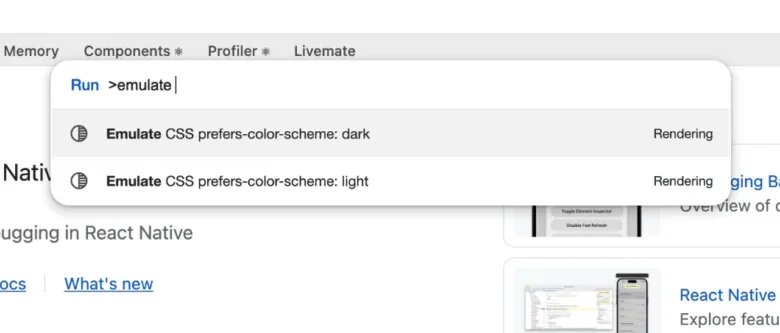
React Native 0.86 brings significant quality-of-life improvements to the development workflow, particularly through updates to the React Native DevTools. A standout feature in this release is the introduction of light and dark mode emulation.
Testing how an application responds to system-level appearance changes has historically been a cumbersome process, often requiring developers to dive into the settings menu of a physical device or an emulator. With the new support for Emulation.setEmulatedMedia, developers can now toggle between light and dark modes directly from the DevTools interface. By using the Command Palette (accessible via cmd/ctrl + shift + P), developers can instantly see how their styles, themes, and assets adapt to different appearance modes.
This emulation is temporary and resets once the DevTools are disconnected, mirroring the behavior of Chrome DevTools for the web. This alignment with web standards is a recurring theme in the 0.86 release, as the team continues to bridge the gap between mobile and web development environments.
Technical Refinements and Web Spec Alignment
The 0.86 release continues the ongoing effort to align React Native’s runtime with modern web specifications. This alignment is crucial for the "React Native for Web" ecosystem and for developers who share logic between platforms. The update includes various under-the-hood improvements to the JavaScript environment, ensuring that APIs behave consistently regardless of whether they are running on iOS, Android, or a browser.
Furthermore, the release introduces several new JavaScript Interface (JSI) APIs. JSI is the high-performance C++ layer that allows JavaScript to communicate directly with native modules without the need for the traditional "Bridge." The new APIs make the C++ interface more capable and flexible, which is a vital component of the "New Architecture" that React Native has been rolling out over the past few years. These enhancements enable more complex native-to-JS interactions with lower latency, paving the way for more performant animations and complex data processing within mobile apps.
Commitment to Stability: The "No Breaking Changes" Milestone
For the second time in recent history—following the 0.83 release—React Native 0.86 contains no user-facing breaking changes. This is a deliberate strategic choice by the core team to improve the developer experience by making the upgrade process more predictable.

In the early years of React Native, upgrades were often viewed with trepidation by engineering teams due to frequent breaking changes in core APIs. By shifting toward a more incremental and stable release cadence, the React Native team is making it easier for large-scale enterprise applications to stay current with the latest versions. Developers currently running version 0.85 should find that upgrading to 0.86 requires no changes to their existing application code, significantly reducing the "maintenance tax" associated with modern mobile development.
Infrastructure, Dependencies, and Community Contributions
The 0.86 release is the result of extensive collaboration between Meta engineers and the broader open-source community. The statistics for this release are a testament to the project’s health:
- Total Commits: Over 596
- Unique Contributors: 97
This level of community engagement is a key metric for the React Foundation, demonstrating that the project remains a vibrant ecosystem. The release also includes various updates to infrastructure and dependencies, ensuring compatibility with the latest versions of Gradle, Ruby, and CocoaPods.
On the Android side, the release includes specific improvements to input handling, navigation, and image processing. Networking modules have also been refined to handle edge cases in connectivity more gracefully. For iOS, the focus remained on layout engine performance and accessibility improvements, ensuring that React Native apps remain inclusive and performant for all users.
Chronology of Recent Releases and Support Policy
The launch of React Native 0.86 marks a transition in the project’s support lifecycle. According to the official support policy, 0.86 is now the latest stable version, while version 0.83.x has moved to "unsupported" status. The community is encouraged to maintain their projects on one of the three most recent stable versions (currently 0.84, 0.85, and 0.86) to receive security patches and critical bug fixes.
The evolution from 0.83 to 0.86 shows a clear trajectory:
- 0.83: Focused on the New Architecture and stability.
- 0.84 & 0.85: Introduced incremental UI improvements and expanded the capabilities of the New Architecture.
- 0.86: Formalized the React Foundation transition and prioritized Android 15 compatibility.
Impact and Implications for the Mobile Industry
The release of React Native 0.86 has broad implications for the mobile development industry. By addressing Android 15’s edge-to-edge requirements ahead of the OS’s widespread adoption, React Native ensures that its users are not left behind as Google pushes for a more immersive UI standard.
Furthermore, the stability of the 0.86 release reinforces React Native’s position as a viable alternative to native development (Swift/Kotlin) and competing frameworks like Flutter. For businesses, the lack of breaking changes translates to lower development costs and faster time-to-market for new features.
The transition to the React Foundation is perhaps the most significant long-term signal. It suggests that React Native is moving toward a "boring technology" phase—not in terms of lack of innovation, but in terms of reliability and institutional stability. As the framework becomes more decoupled from Meta’s corporate structure, it is likely to see even greater adoption among conservative industries such as banking, healthcare, and government services, where long-term support and neutral governance are paramount.
Looking Ahead: Expo and Future Versions
For developers using the Expo ecosystem, React Native 0.86 will soon be available through expo@canary releases. Expo, which provides a suite of tools and services around React Native, typically integrates new core releases quickly, allowing developers to leverage new features like Android 15 support within the managed Expo workflow.
As the community begins to adopt 0.86, the core team’s focus is expected to shift toward further optimizing the New Architecture and expanding the JSI capabilities introduced in this version. The precedent set by 0.86 suggests that future releases will continue to balance cutting-edge OS features with a "stability-first" philosophy, ensuring that React Native remains a cornerstone of mobile application development for years to come.
To upgrade existing projects, developers are encouraged to utilize the React Native Upgrade Helper, a web-based tool that provides a side-by-side diff of code changes required between versions. For new projects, the community CLI remains the standard entry point, now defaulting to the 0.86 stable release.
In summary, React Native 0.86 is a landmark release that successfully navigates the complexities of modern OS requirements while securing the framework’s future through the React Foundation. It offers a clear path forward for developers seeking a high-performance, stable, and community-governed platform for mobile innovation.