The Pragmatic Summit and the AI Conundrum: Navigating the Future of Software Development

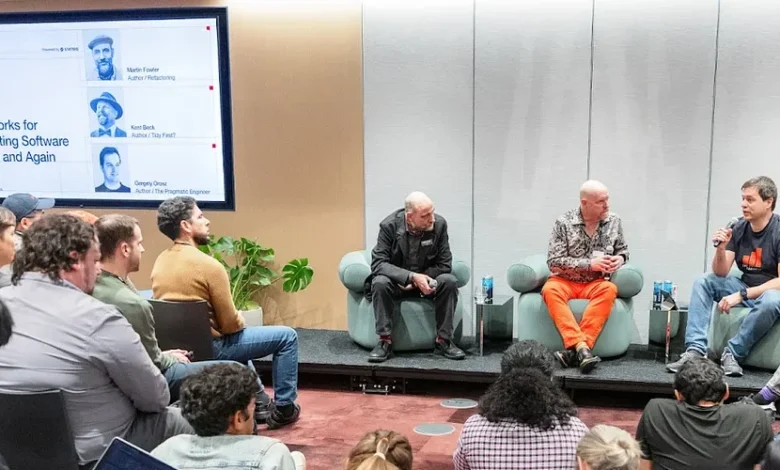
The inaugural Pragmatic Summit, held earlier this year, provided a platform for leading figures in software development to dissect the burgeoning impact of Artificial Intelligence (AI) on the industry. A key highlight of the event was an onstage interview featuring renowned software engineer Kent Beck and the author, conducted by Gergely Orosz. The approximately thirty-minute discussion, now available on YouTube, delved into the multifaceted implications of AI, drawing parallels with historical technological shifts and examining the core tenets of agile methodologies, test-driven development (TDD), and the often-misunderstood virtue of programmer laziness.
AI’s Shadow Over Agile and Abstraction
The conversation at the Pragmatic Summit was inevitably dominated by the pervasive influence of AI. While the summit itself celebrated pragmatic approaches to software engineering, the presence of advanced AI tools, particularly Large Language Models (LLMs), cast a long shadow, prompting a re-evaluation of established practices. Orosz skillfully guided the discussion, probing how AI’s rapid advancement compares to earlier technological revolutions, such as the internet boom or the widespread adoption of agile development.
The core of the debate revolved around the potential for AI to either augment or undermine fundamental programming principles. Beck and the author explored how AI might alter the experience of agile development, which emphasizes iterative progress and continuous improvement. They also touched upon the role of Test-Driven Development (TDD), a methodology where tests are written before the code itself, ensuring a robust and verifiable development process.
The Paradox of Laziness in the Age of AI
A recurring theme throughout the discussion was the concept of "laziness" as a virtue in programming, a notion famously articulated by Perl’s creator, Larry Wall, in his "three virtues of a programmer: hubris, impatience, and—above all—laziness." This seemingly counterintuitive principle, often interpreted as a drive for efficiency and elegance, was central to the dialogue.
Bryan Cantrill, a prominent figure in systems engineering, has eloquently championed this virtue. In a recent reflection, Cantrill argued that programmer laziness is not about idleness but about the profound pursuit of abstraction. "Laziness drives us to make the system as simple as possible (but no simpler!)—to develop the powerful abstractions that then allow us to do much more, much more easily," he stated. This sentiment resonates deeply with many experienced developers, who find immense satisfaction in crafting elegant solutions that simplify complex problems. The act of building effective abstractions, a process that involves deep domain understanding, is often described as a "buzz" when it leads to significant functionality with minimal code.
However, Cantrill raised a significant concern regarding AI’s impact on this virtue. He posited that LLMs, by their very nature, lack this inherent drive for efficiency. "Work costs nothing to an LLM," Cantrill observed. "LLMs do not feel a need to optimize for their own (or anyone’s) future time, and will happily dump more and more onto a layercake of garbage. Left unchecked, LLMs will make systems larger, not better—appealing to perverse vanity metrics, perhaps, but at the cost of everything that matters." This perspective suggests that AI, unguided by human constraints of time and cognitive load, might inadvertently lead to the proliferation of overly complex and inefficient systems. The implicit understanding is that true laziness in programming is hard-won, requiring significant effort to design systems that are simple and maintainable.
The author provided a personal anecdote illustrating this tension. While modifying a music playlist generator, they encountered a situation where the initial approach became overly complicated. The realization that they had included unnecessary features, a direct violation of the "You Ain’t Gonna Need It" (YAGNI) principle, allowed them to drastically simplify the solution. This experience prompted a critical question: if an LLM had been used, would it have opted for a similar over-complication, and would the resulting complexity have been accepted without sufficient scrutiny? The potential for AI to obscure underlying inefficiencies, leading to future maintenance burdens, was a significant point of reflection.

Applying Pragmatic Principles to AI Interactions
The summit also explored how established software development principles can be adapted to the new landscape of AI-assisted development. Jessica Kerr (Jessitron) presented a compelling example of applying Test-Driven Development (TDD) to the process of prompting AI agents. Her approach focuses on ensuring that all code changes generated by an AI agent also include corresponding updates to documentation.
Kerr outlined a two-part strategy: first, modifying the AI’s instructions (prompts) to explicitly include documentation updates, and second, implementing a reviewer agent to verify that these updates are indeed made. This mirrors the TDD cycle of instruction (writing the test) and verification (running the test). The author noted that in the context of TDD, the instruction phase would logically precede the verification phase, underscoring the enduring relevance of foundational development methodologies.
The Specter of Overconfidence and the Need for Doubt
A related concern discussed was the tendency of AI systems to exhibit overconfidence, leading to the generation of incorrect information or the execution of actions without sufficient caution. Mark Little brought to light an analogy from the classic science fiction film "Dark Star," where a sentient bomb is eventually dissuaded from detonating through philosophical reasoning.
In a pivotal scene from "Dark Star," a crew member named Doolittle engages a bomb programmed for self-destruction. The bomb relies on its perceived certainty of its orders, but Doolittle challenges this certainty by introducing the concept of false data and the lack of absolute proof. This dialogue highlights the importance of doubt and critical self-reflection, even in seemingly deterministic systems.
Little draws a parallel between this fictional scenario and the current state of AI development. He observes that "Most AI systems are optimised for decisiveness. Given an input, produce an output. Given ambiguity, resolve it probabilistically. Given uncertainty, infer. This works well in bounded domains, but it breaks down in open systems where the cost of a wrong decision is asymmetric or irreversible." The inherent design of many AI architectures prioritizes generating an output, even when faced with ambiguity.
The implication for AI development is clear: for systems to operate safely and reliably in complex, real-world scenarios, they must be designed with mechanisms for deferral and even deliberate inaction. "Inaction is not a natural outcome of most AI architectures. It has to be designed in," Little emphasizes. This suggests a fundamental shift in AI design philosophy, moving beyond mere decisiveness to incorporate a nuanced understanding of when not to act.
The Critical Capability of Restraint
The author’s personal reflections on the "Dark Star" analogy underscore a long-held appreciation for doubt and a healthy skepticism towards undue certainty. This perspective suggests that doubt, rather than leading to paralysis, can foster more robust decision-making by acknowledging the inherent risks of inaccurate information or flawed reasoning, especially in situations with significant consequences.
As the article concludes, the need to imbue AI systems with the capacity for restraint is paramount. "If we want AI systems that can operate safely without constant human oversight, we need to teach them not just how to decide, but when not to," the author posits. In an era where autonomous systems are becoming increasingly prevalent, restraint is not a limitation but a critical capability, and potentially the most vital one to cultivate. The Pragmatic Summit served as a crucial forum for these discussions, signaling a growing awareness within the software development community that navigating the AI revolution will require not just embracing new tools, but also reinforcing and re-evaluating the core principles that have guided effective engineering for decades. The challenge lies in harnessing the power of AI without sacrificing the elegance, efficiency, and critical judgment that define superior software.
Related posts: