AWS Enhances Amazon ECS with Managed Daemon Support for Streamlined Operations and Increased Reliability

Amazon Elastic Container Service (Amazon ECS) has introduced a significant new feature: managed daemon support for ECS Managed Instances. This enhancement, building upon the managed instances capabilities first unveiled in September 2025, empowers platform engineers with independent control over essential software agents like monitoring, logging, and tracing tools. The new functionality aims to alleviate operational burdens by decoupling daemon management from application development cycles, ensuring every instance consistently runs required daemons, and enabling more comprehensive host-level monitoring.
The expansion of managed instances with daemon support marks a pivotal moment in simplifying the complex landscape of containerized application management at scale. Previously, the lifecycle of critical operational agents was intrinsically linked to application deployments. Any update to a monitoring agent, for instance, necessitated coordination with application development teams, modifications to task definitions, and often, the redeployment of entire applications. This process, while ensuring consistency, presented a considerable operational overhead, particularly for organizations managing hundreds or thousands of distinct services. The introduction of managed daemons directly addresses this challenge by providing a dedicated construct for platform teams to centrally manage these crucial tools.
Decoupling Daemon Lifecycle Management
The core innovation lies in the creation of a distinct "managed daemons" construct within Amazon ECS. This separation of concerns allows platform engineers to independently deploy, update, and manage monitoring, logging, and tracing agents directly on the infrastructure. This means that platform teams can now roll out updates to these essential tools without requiring application teams to redeploy their services. Furthermore, the system enforces the consistent use of these required tools across all instances, ensuring a uniform operational posture.
A key benefit of this new approach is the guarantee that daemons will always start before application tasks and drain last. This ensures that critical logging, tracing, and monitoring services are consistently available from the moment an application begins its lifecycle, and remain operational throughout its termination. This "start before stop" principle is crucial for maintaining data integrity and providing uninterrupted visibility into application and host performance.
Platform engineers are afforded considerable flexibility in how they deploy managed daemons. They can choose to roll them out across multiple capacity providers simultaneously or target specific capacity providers for more granular control. This allows for phased deployments and tailored agent configurations based on the needs of different infrastructure segments.
Resource management has also been centralized. Daemon CPU and memory parameters can now be defined separately from application configurations. This eliminates the need to rebuild Amazon Machine Images (AMIs) or update task definitions for agent resource adjustments. Moreover, this approach optimizes resource utilization, as each instance will run exactly one copy of a daemon, shared across multiple application tasks, rather than each application task potentially running its own instance of the same agent.
Practical Implementation: Deploying the CloudWatch Agent
To illustrate the practical application of ECS Managed Daemons, the CloudWatch Agent was chosen as an initial managed daemon. The process begins with an existing Amazon ECS cluster that has already been configured with a Managed Instance capacity provider, following the established documentation.

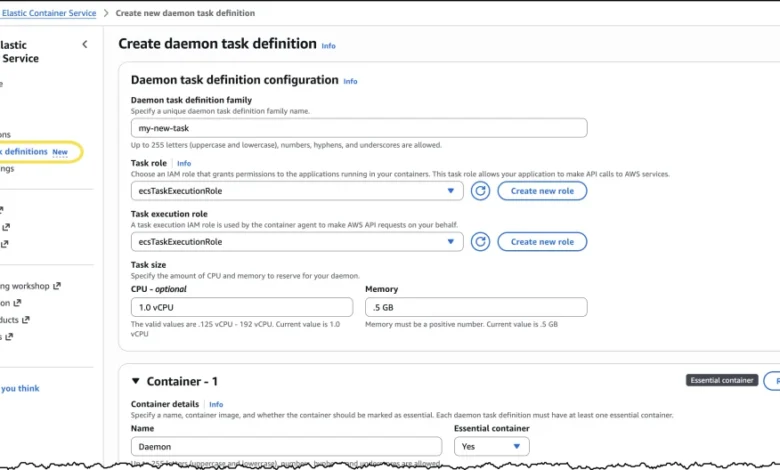
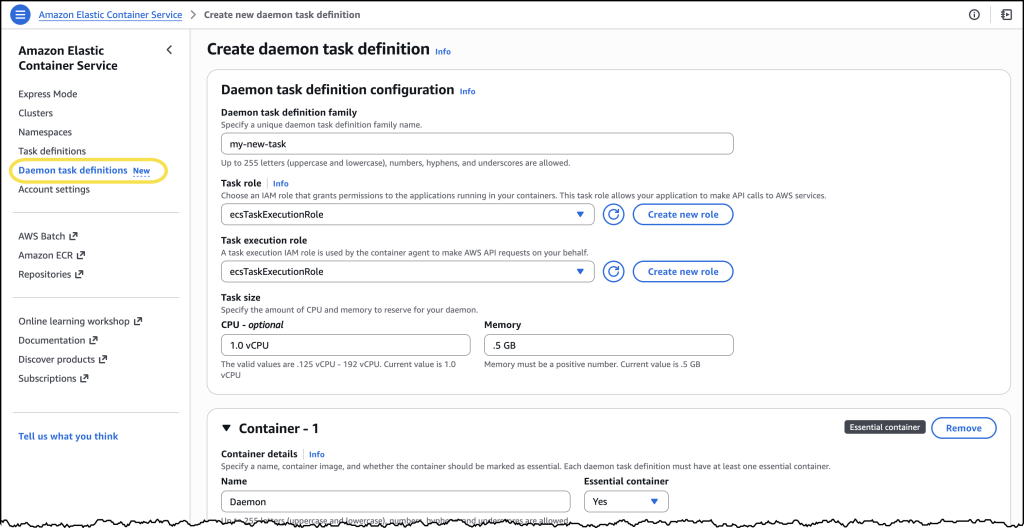
Within the Amazon ECS console, a new navigation option, "Daemon task definitions," becomes visible. This is where platform engineers define the parameters for their managed daemons. The creation process involves specifying details such as the desired CPU and memory allocation for the daemon. For the CloudWatch Agent example, 1 vCPU and 0.5 GB of memory were allocated. A descriptive name is assigned to the "Daemon task definition family" for easy identification.
The "Task execution role" is set to "ecsTaskExecutionRole," a standard IAM role for ECS tasks. Under the "Container" section, a descriptive name is given to the container, and the appropriate image URI is provided – in this case, public.ecr.aws/cloudwatch-agent/cloudwatch-agent:latest. Additional necessary details are also configured. Upon reviewing these settings, the daemon task definition is created.
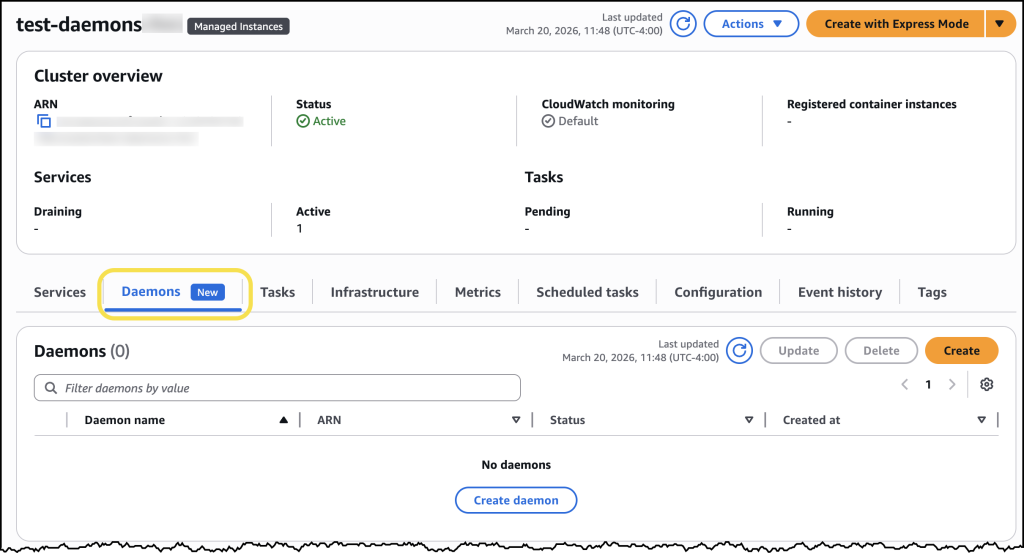
Once the daemon task definition is established, the next step involves navigating to the "Clusters" page, selecting the relevant cluster, and accessing the new "Daemons" tab. Here, the "Create daemon" button initiates the daemon configuration process.
During daemon configuration, the newly created daemon task definition family is selected. The daemon is then assigned a unique name. For "Environment configuration," the previously set up ECS Managed Instances capacity provider is chosen. After confirming all settings, the daemon is created.
Following this, Amazon ECS automatically ensures that the daemon task is launched on every provisioned ECS managed instance within the selected capacity provider before any application tasks are placed. As a practical demonstration, a sample Nginx web service was deployed as a test workload. Upon deployment, the ECS console clearly indicated that the CloudWatch Agent daemon had been automatically deployed alongside the application, requiring no manual intervention for the daemon itself.
The update process for daemons is equally streamlined. When a daemon is updated, ECS orchestrates a rolling deployment. This involves provisioning new instances with the updated daemon, starting the daemon on these new instances first, and then migrating application tasks to the new instances before terminating the old ones. This "start before stop" methodology ensures continuous daemon coverage, meaning logging, monitoring, and tracing agents remain operational throughout the update with no gaps in data collection. The "drain percentage" setting allows for control over the pace of replacement, enabling addon updates without any application downtime.
Technical Underpinnings of Managed Daemons
The managed daemon experience is underpinned by a new daemon task definition, distinct from standard task definitions, with its own set of parameters and validation mechanisms. A novel daemon_bridge network mode has been introduced, which enables daemons to communicate with application tasks while maintaining isolation from application networking configurations. This ensures that daemon operations do not interfere with or inadvertently expose application network services.
Managed daemons are equipped with advanced host-level access capabilities, which are critical for operational tooling. Platform engineers can configure daemon tasks as privileged containers, grant additional Linux capabilities, and mount specific paths from the underlying host filesystem. These permissions are particularly vital for monitoring and security agents that require deep visibility into host-level metrics, processes, and system calls for comprehensive analysis and threat detection.
When a daemon is deployed, ECS ensures that precisely one daemon process is launched per container instance before any application tasks are scheduled. This fundamental sequencing guarantees that essential operational tooling is fully operational and accessible before an application begins to receive any network traffic. Furthermore, ECS natively supports rolling deployments with automatic rollback capabilities, allowing for confident and secure updates of agents.
Availability and Cost Implications
Managed daemon support for Amazon ECS Managed Instances is now available across all AWS Regions. To get started, users can access the Amazon ECS console or consult the detailed Amazon ECS documentation. The new managed daemons also have their own dedicated Application Programming Interfaces (APIs), which are accessible through the provided documentation links.
A significant aspect of this new feature is its cost structure. There is no additional cost associated with using managed daemons. Customers will only incur charges for the standard compute resources consumed by their daemon tasks, aligning with the existing AWS pay-as-you-go model. This makes it a cost-effective solution for enhancing operational oversight and reliability.
The introduction of managed daemon support represents a substantial step forward for organizations leveraging Amazon ECS. By abstracting the complexities of agent management, AWS empowers platform engineers to focus on core infrastructure responsibilities, while simultaneously enhancing the reliability, security, and observability of containerized applications. This feature is expected to accelerate development cycles and reduce operational friction for a wide range of businesses operating on AWS.