A Novel Social Engineering Campaign Exploits Obsidian Application to Distribute PHANTOMPULSE Remote Access Trojan

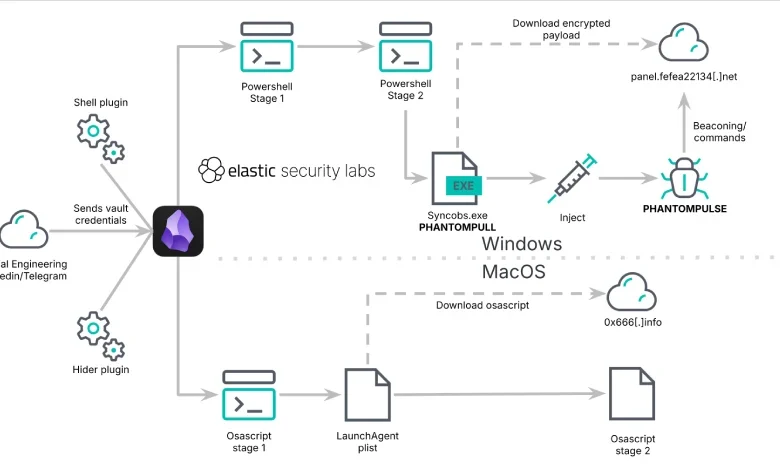
A sophisticated and previously undocumented social engineering campaign, identified as REF6598 by Elastic Security Labs, has emerged, leveraging the popular cross-platform note-taking application Obsidian as an ingenious initial access vector. This campaign aims to distribute a new Windows remote access trojan (RAT) known as PHANTOMPULSE, with a particular focus on individuals within the high-value financial and cryptocurrency sectors. The attackers have demonstrated a remarkable aptitude for crafting elaborate social engineering schemes, primarily utilizing LinkedIn and Telegram to compromise both Windows and macOS systems. This innovative approach bypasses traditional security measures by exploiting the trust placed in legitimate applications and their features.
The Anatomy of the Attack: A Multi-Stage Social Engineering Scheme
The REF6598 campaign begins with attackers meticulously profiling and approaching potential victims on LinkedIn. Posing as representatives of a seemingly legitimate venture capital firm, they initiate contact with individuals in their target industries. This initial outreach is designed to be professional and enticing, aiming to pique the interest of professionals seeking investment or partnership opportunities. The conversation is then strategically steered towards a private Telegram group. This group is a crucial element of the deception, engineered to cultivate an illusion of legitimacy and exclusivity.
Within the Telegram group, multiple individuals, acting as purported partners of the venture capital firm, engage in discussions centered around financial services, cryptocurrency liquidity solutions, and other relevant industry topics. This carefully orchestrated dialogue serves to build credibility and foster a sense of trust among potential targets. The ultimate goal is to convince the victim to access what is presented as a shared dashboard or a repository of crucial project information.
Exploiting Obsidian’s Functionality for Malicious Execution
The attackers instruct the target to access this shared resource through Obsidian by connecting to a cloud-hosted vault using provided credentials. This is where the technical ingenuity of the attack truly unfolds. Obsidian, a powerful application for organizing notes and information, allows users to sync their vaults across devices and with cloud storage. Crucially, it also supports community-developed plugins, which extend its functionality.
The infection sequence is triggered the moment the victim opens the malicious vault within Obsidian. The attackers have designed the vault’s configuration to prompt the user to enable "Installed community plugins" synchronization. This seemingly innocuous request is, in fact, the lynchpin of the attack. By convincing the user to manually enable this feature – which is disabled by default and cannot be remotely activated by the attacker – the victim inadvertently allows malicious code embedded within the vault’s configuration to execute.
Researchers Salim Bitam, Samir Bousseaden, and Daniel Stepanic from Elastic Security Labs detailed this critical step in their technical analysis: "The threat actors abuse Obsidian’s legitimate community plugin ecosystem, specifically the Shell Commands and Hider plugins, to silently execute code when a victim opens a shared cloud vault."

The Role of Obsidian Plugins: Shell Commands and Hider
Two specific Obsidian plugins, "Shell Commands" and "Hider," are central to the execution of the malicious payload. The "Shell Commands" plugin, as its name suggests, allows users to execute shell commands directly from within Obsidian. The attackers leverage this to issue arbitrary commands to the underlying operating system.
The "Hider" plugin, on the other hand, is used to mask the presence of certain user interface elements within Obsidian, such as the status bar, scrollbars, and tooltips. This is likely employed to conceal any unusual activity or visual cues that might alert the victim to the execution of unauthorized commands, thereby maintaining the stealth of the operation.
The researchers emphasized the novelty of this technique: "While this attack requires social engineering to cross the community plugin sync boundary, the technique remains notable: it abuses a legitimate application feature as a persistence and command execution channel, the payload lives entirely within JSON configuration files that are unlikely to trigger traditional AV [antivirus] signatures, and execution is handed off by a signed, trusted Electron application, making parent-process-based detection the critical layer."
PHANTOMPULSE: The AI-Generated Backdoor
Once the malicious code is executed, the attack branches based on the victim’s operating system.
On Windows Systems:
The commands executed via the "Shell Commands" plugin invoke a PowerShell script. This script is responsible for dropping an intermediate loader, codenamed PHANTOMPULL. PHANTOMPULL’s primary function is to decrypt and then launch the main payload, PHANTOMPULSE, directly in memory. This in-memory execution is a common tactic to evade detection by traditional file-based antivirus solutions.
PHANTOMPULSE itself is described as an artificial intelligence (AI)-generated backdoor. This suggests that parts of its code or its operational logic might have been developed or enhanced using AI tools, a growing trend in sophisticated malware development. A particularly unique aspect of PHANTOMPULSE is its method of resolving its command-and-control (C2) server. Instead of relying on traditional DNS resolution or hardcoded IP addresses, it utilizes the Ethereum blockchain. The malware fetches the latest transaction associated with a hard-coded wallet address on the Ethereum network. This transaction’s metadata or associated information is then used to derive the IP address or domain of the C2 server. This innovative C2 resolution mechanism makes it significantly harder for security analysts to block or track the malware’s communication infrastructure, as blockchain transactions are inherently difficult to disrupt.
Upon successfully obtaining the C2 address, PHANTOMPULSE communicates using the WinHTTP protocol. This allows it to perform a wide range of malicious activities, including:

- Sending system telemetry data to the attacker.
- Receiving and executing commands from the C2 server.
- Uploading collected data, such as files or screenshots.
- Capturing keystrokes from the infected system.
The specific set of supported commands is designed to grant the attackers comprehensive remote access and control over the compromised machine, enabling extensive espionage and data exfiltration.
On macOS Systems:
The execution path on macOS differs, though it shares the reliance on the "Shell Commands" plugin. In this case, the plugin delivers an obfuscated AppleScript dropper. This dropper is designed to iterate over a hard-coded list of domains. In parallel, it employs Telegram as a "dead drop" mechanism for fallback C2 resolution. This means that if the primary domain-based C2 communication fails, the malware can fall back to using Telegram channels to receive instructions or C2 addresses. This dual approach provides the attackers with increased flexibility and resilience, making it easier to rotate their C2 infrastructure and rendering simple domain-based blocking strategies ineffective.
The dropper script then contacts the determined C2 domain to download and execute a second-stage payload via the osascript command. At the time of Elastic Security Labs’ reporting, the exact nature of this second-stage payload remained unknown because the C2 servers were offline. This suggests that the threat actors were either in the early stages of deploying their payload or had temporarily deactivated their infrastructure.
Incident Outcome and Broader Implications
Fortunately, in the instance observed by Elastic Security Labs, the intrusion was ultimately unsuccessful. The attack was detected and blocked by security measures before the adversary could achieve their objectives on the infected machines. This underscores the importance of robust endpoint detection and response (EDR) capabilities that can identify suspicious process behavior, even when initiated by trusted applications.
The REF6598 campaign serves as a potent reminder of the evolving threat landscape. As Elastic noted, "REF6598 demonstrates how threat actors continue to find creative initial access vectors by abusing trusted applications and employing targeted social engineering. By abusing Obsidian’s community plugin ecosystem rather than exploiting a software vulnerability, the attackers bypass traditional security controls entirely, relying on the application’s intended functionality to execute arbitrary code."
This method of attack carries significant implications for the cybersecurity industry:
- Abuse of Legitimate Functionality: The campaign highlights a shift towards exploiting legitimate application features rather than solely relying on software vulnerabilities. This makes detection more challenging, as security tools may not flag the activity as inherently malicious.
- Social Engineering Sophistication: The elaborate social engineering tactics, including the creation of seemingly credible online personas and group environments, demonstrate a high level of planning and execution by the threat actors.
- Blockchain for C2: The use of the Ethereum blockchain for C2 resolution is a novel and concerning development, presenting new challenges for network defenders in tracking and disrupting attacker infrastructure.
- Targeting Critical Sectors: The focus on financial and cryptocurrency sectors indicates that these industries remain prime targets for cybercriminals seeking to exploit volatility and access sensitive financial data.
- Cross-Platform Threat: The ability to target both Windows and macOS systems broadens the attack surface and necessitates cross-platform security strategies.
Organizations and individuals in these high-risk sectors are advised to exercise extreme caution when engaging with unsolicited contacts, especially those originating from professional networking sites. Verifying the legitimacy of individuals and organizations, scrutinizing requests that involve enabling advanced application features, and maintaining up-to-date security software with strong EDR capabilities are crucial steps in mitigating the risks posed by such sophisticated attacks. The continuous evolution of threat actor methodologies necessitates a proactive and adaptive approach to cybersecurity defense.