The Collective Defiance: How 14 Ministerial Resignations Catalyzed the End of Soeharto’s Three-Decade Rule in Indonesia

On May 20, 1998, a pivotal moment in Indonesia’s modern history unfolded as 14 ministers collectively tendered their resignations from the Seventh Development Cabinet, plunging the nation deeper into an unprecedented political crisis amidst a raging economic downturn. This coordinated act of defiance, coming just four days after the cabinet had been sworn in by President Soeharto, served as a resounding vote of no confidence from within his inner circle, irrevocably shattering his legitimacy and setting the stage for his eventual downfall the very next day, thereby concluding his 32-year authoritarian grip on power.
The Economic and Political Tempest of 1997-1998
To fully grasp the magnitude of the ministers’ resignations, one must understand the tumultuous backdrop against which they occurred. Indonesia, once hailed as an Asian economic miracle under Soeharto’s New Order regime, found itself at the epicenter of the 1997 Asian Financial Crisis (AFC). What began as a currency crisis in Thailand in July 1997 rapidly spread, devastating economies across Southeast Asia. Indonesia, however, was particularly vulnerable due to its opaque financial system, widespread corporate debt denominated in foreign currencies, and deeply entrenched practices of corruption, collusion, and nepotism (KKN) that characterized Soeharto’s rule.
The Indonesian Rupiah (IDR), which had traded steadily at around IDR 2,500 to the US dollar, began a precipitous freefall, plummeting to an astonishing IDR 16,000 by early 1998—a depreciation of over 80%. This currency collapse crippled businesses, leading to mass bankruptcies, soaring unemployment, and hyperinflation that reached over 70% in 1998. The country’s Gross Domestic Product (GDP) contracted by a staggering 13.1% that year, marking one of the sharpest economic declines in modern history. Essential goods became unaffordable for ordinary citizens, sparking widespread hardship and public anger.
In October 1997, Indonesia sought an emergency bailout package from the International Monetary Fund (IMF), totaling an estimated $43 billion. However, the stringent conditionalities attached to the loan, which included drastic structural reforms, budget cuts, and the closure of several banks linked to Soeharto’s family and cronies, were perceived by many as an infringement on national sovereignty and failed to immediately stabilize the economy or restore public confidence.
Parallel to the economic collapse, political discontent, long suppressed by the authoritarian New Order, began to boil over. Student protests, initially focused on economic grievances and the demand for an end to KKN, escalated into calls for political reform and Soeharto’s resignation. Despite the growing unrest, Soeharto was re-elected for his seventh presidential term in March 1998, a move widely seen as an affront to democratic principles and a sign of his refusal to acknowledge the depth of the crisis or the public’s demands.
The Intensifying Crisis: May 1998
The situation reached a critical boiling point in May 1998. On May 12, four students from Trisakti University were shot and killed by security forces during a peaceful protest. This tragedy ignited widespread riots, looting, and arson across Jakarta and other major cities, leading to hundreds of deaths and massive destruction. The capital descended into chaos, with the military (ABRI, now TNI) struggling to maintain order, and segments of the population living in fear.
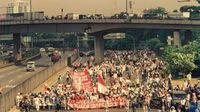
Amidst the escalating violence, thousands of students converged on and occupied the DPR/MPR (People’s Consultative Assembly/House of Representatives) building in Jakarta, transforming it into a symbolic bastion of the reform movement. Their demands for Soeharto’s immediate resignation grew louder and more insistent, reflecting the overwhelming sentiment of a populace that had lost all faith in its long-serving leader. The international community, including the United States and other Western powers, also began to openly call for Soeharto to step down, emphasizing the need for a peaceful transition to democracy.
The Bappenas Meeting: A Reckoning from Within
It was against this backdrop of national upheaval that a crucial meeting took place on May 20, 1998, at the Bappenas (National Development Planning Agency) building in Jakarta. The meeting, initiated and led by Ginandjar Kartasasmita, then the Coordinating Minister for Economy, Finance, and Industry, brought together several key cabinet ministers, prominent journalists, and business leaders. Ginandjar, a technocrat known for his pragmatic approach, understood the gravity of the situation.
In his 2013 book, Managing Indonesia’s Transformation, Ginandjar recounted the intense deliberations of that morning. He presented a stark and unvarnished assessment of Indonesia’s economic condition, warning that the nation was on the verge of total collapse if the situation were allowed to fester. The consensus among the attendees was chillingly clear: Indonesia was hurtling towards an irreversible economic and political catastrophe without any visible path to recovery under the current leadership. "Indonesia was moving towards an economic and political crisis with no clear way out," Ginandjar concluded.
The majority of ministers present at the Bappenas meeting concurred with Ginandjar’s grim assessment. Their expertise in economic management and public policy gave them a unique insight into the systemic failures that plagued the nation. Only one minister, Ary Mardjono, the State Minister for Agrarian Affairs/Head of the National Land Agency, reportedly expressed a differing view, advocating for continued support of the President. However, his was a lone voice against a tide of growing conviction among his peers.
The Collective Resignation: A Fatal Blow to Legitimacy
Following the intense discussions, Ginandjar Kartasasmita declared his intention to resign from the cabinet. His decision, coming from a highly respected economic minister, proved to be the catalyst. One by one, other ministers followed suit, affirming their commitment to the collective decision. By the end of the day, 14 members of the newly formed cabinet had signed a joint letter of resignation.
These 14 ministers, representing a significant portion of Soeharto’s cabinet and including many of his most capable technocrats and political allies, were:
- Akbar Tandjung (State Secretary)
- A.M. Hendropriyono (State Minister for Transmigration and Forest Dwellers Resettlement)
- Giri Suseno Hadihardjono (Minister of Mines and Energy)
- Haryanto Dhanutirto (Minister of Public Works)
- Ginandjar Kartasasmita (Coordinating Minister for Economy, Finance, and Industry)
- Kuntoro Mangkusubroto (Minister of Mining and Energy)
- Justika Baharsjah (Minister of Social Affairs)
- Rachmadil Bambang Sumadhijo (Minister of Cooperatives and Small and Medium Enterprises)
- Rahardi Ramelan (Minister of Industry and Trade)
- Subiakto Tjarawerdaya (State Minister for Cooperatives and Small and Medium Enterprises)
- Sanyoto Sastrowardoyo (State Minister for Investment/Head of the Investment Coordinating Board)
- Sumahadi (Minister of Forestry and Plantations)
- Theo L. Sambuaga (Minister of Manpower)
- Tanri Abeng (State Minister for Empowerment of State-Owned Enterprises)
Their joint statement unequivocally declared that "the formation of a new cabinet would not solve the root problems of the crisis." This powerful assertion not only reflected their deep concern for the nation’s future but also signaled a complete erosion of trust among the economic elite in Soeharto’s capacity to lead Indonesia out of its predicament. It was a clear and public rejection of his leadership, a stark admission that his regime had become irredeemably compromised.
Soeharto’s Final Attempts and the Inevitable End
The mass resignation sent shockwaves through the presidential palace. Historian Robert Edward Elson, in his 2017 biography Soeharto: A Political Biography, noted that the President was "stunned" by the collective action of his ministers. Soeharto had reportedly been planning to announce a "Reform Cabinet" on May 21, 1998, in a last-ditch effort to retain a semblance of legitimacy and appease public demands for change. He had even tried to invite prominent reformists and opposition figures into this proposed new cabinet, but most had refused.
Vice President B.J. Habibie, who would soon inherit the presidency, revealed in his 2006 memoir Detik-detik yang Menentukan (Decisive Moments) that he had personally appealed to the ministers to remain in their positions, urging them to reconsider for the sake of national stability. However, the ministers’ resolve was unshakeable. Their decision, born of deep conviction and a clear understanding of the national emergency, had been made.
The loss of support from these key ministers, especially the technocrats responsible for managing the economy, signaled the complete unraveling of Soeharto’s power base. It demonstrated that even those closest to him, who had served his administration for years, no longer believed in his ability to govern. With the military’s loyalty increasingly ambiguous, student protests intensifying, and international pressure mounting, Soeharto found himself isolated and without viable options.
On May 21, 1998, at precisely 9:05 AM local time, after more than three decades at the helm, President Soeharto announced his resignation from office, effectively ending the New Order era. In a brief and somber speech, he handed over the presidency to his Vice President, B.J. Habibie, ushering in the period known as Reformasi (Reformation).
Implications and Legacy
The resignation of the 14 ministers was not merely a symbolic act; it was a decisive turning point that directly accelerated Soeharto’s fall. It demonstrated that even the pillars of his own government had abandoned him, stripping away the last vestiges of his political authority. This collective act of defiance signaled to the military, the public, and the international community that the regime had lost internal cohesion and was no longer sustainable.
The immediate implication was the peaceful transfer of power, albeit under immense pressure, which prevented further widespread violence and potentially civil unrest. In the long term, this event paved the way for Indonesia’s transition to democracy. The Reformasi era brought about unprecedented political freedoms, including free and fair multi-party elections, freedom of the press, decentralization of power, and efforts to address human rights abuses and the endemic KKN that had characterized the New Order.
The 1998 crisis and the ministers’ resignations serve as a powerful historical lesson on the importance of political legitimacy, accountability, and the fragility of even long-entrenched authoritarian rule when faced with a complete loss of public and elite confidence. It underscored the critical role that technocrats and civil servants can play in challenging entrenched power structures during times of national crisis, prioritizing national interest over personal loyalty. Indonesia’s journey since 1998 has been one of complex democratic consolidation, but the events of May 20, 1998, undeniably stand as the moment when the nation collectively decided to chart a new, more democratic course.