Microsoft Azure Databricks Delivers Unprecedented Value and Performance, Confirmed by Independent Analysis

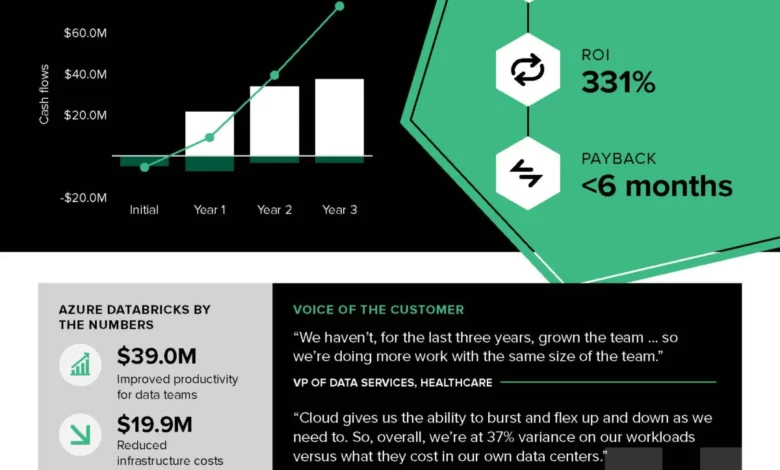
Microsoft Azure Databricks, the integrated data analytics and AI platform, is demonstrating significant and quantifiable business value for organizations, according to a recent commissioned study by Forrester Consulting. The findings highlight a compelling return on investment (ROI) of 331% over three years, a net present value (NPV) of $58.1 million, and a remarkably short payback period of less than six months for a composite organization. This comprehensive analysis underscores the strategic advantage of Databricks as a first-party service within the Microsoft Azure ecosystem, offering deep integration, enhanced performance, and reduced costs.
The strategic partnership between Microsoft and Databricks, which co-engineers the platform as a native Azure service, has been a key driver of these impressive results. This co-engineering approach ensures that Azure Databricks seamlessly integrates with existing Microsoft tools, identity management systems, and governance frameworks, thereby simplifying adoption and maximizing efficiency for organizations. Unlike add-on solutions, the advantages of Azure Databricks are built-in, reflecting a shared integration roadmap and a unified go-to-market strategy that simplifies procurement, billing, and support.
The Forrester Total Economic Impact™ Study: Quantifying Business Value
To address the critical question of tangible business value, Microsoft commissioned Forrester Consulting to conduct a Total Economic Impact™ (TEI) study of Azure Databricks. The study, conducted in June 2026, involved in-depth interviews with existing Azure Databricks customers. From these interviews, Forrester constructed a composite organization—a $6 billion company operating within a regulated industry and managing approximately 10 petabytes of data—to model the platform’s impact.
Prior to implementing Azure Databricks, this composite organization grappled with a fragmented, costly, and unreliable data estate that proved difficult to govern at scale. The adoption of Azure Databricks led to a transformative shift, generating an estimated $75.6 million in benefits against $17.5 million in costs over a three-year period. This resulted in the aforementioned $58.1 million in net present value and an ROI of 331%, with the initial investment being recouped in less than six months.
Key Drivers of Value Identified in the Study
Forrester’s analysis identified four primary areas where the composite organization realized significant value:
- Increased Productivity and Efficiency: The seamless integration of Azure Databricks with existing Microsoft tools and workflows significantly boosted the productivity of data professionals, engineers, and analysts. This reduction in manual effort and the streamlining of data pipelines translated into substantial time savings.
- Reduced Infrastructure and Operational Costs: By consolidating data operations onto a unified, cloud-native platform, organizations could eliminate redundant infrastructure, optimize resource utilization, and reduce the overhead associated with managing disparate data systems.
- Accelerated Time-to-Market for Data-Driven Initiatives: The enhanced capabilities of Azure Databricks, coupled with its intuitive interface and robust performance, allowed organizations to derive insights from data more rapidly. This expedited the development and deployment of data-driven products, services, and strategic initiatives, leading to quicker realization of business objectives.
- Improved Data Governance and Security: The platform’s advanced governance features, particularly through Unity Catalog, ensured that data access and usage adhered to strict compliance and security policies. This not only mitigated risk but also fostered a more trustworthy and reliable data environment, enabling wider data democratization without compromising control.
Beyond these quantifiable benefits, the Forrester study also highlighted several qualitative advantages that contribute to the overall value proposition of Azure Databricks. These include deeper native integration with other Azure services, faster delivery of critical insights, broader access to data for more users across the organization, and enhanced governance facilitated by Unity Catalog. These unpriced benefits are instrumental in driving the productivity and cost efficiencies that were ultimately quantified.
The Genesis of Value: A True First-Party Azure Service
The profound value derived from Azure Databricks can be attributed to its fundamental nature as a true first-party Azure service. This means it is not merely a hosted solution but is co-engineered by Microsoft and Databricks, ensuring a level of integration and performance that is difficult to achieve with third-party offerings. This co-engineering process allows for a tightly coupled experience, eliminating the need for costly data duplication, complex tooling, and extensive integration work that often plague multi-cloud or hybrid data architectures.
A prime example of this deep integration is the Azure Databricks Genie integration with Microsoft Copilot Cowork. This feature allows users to imbue their business context and build upon existing intelligence directly within the tools they already use daily. Genie empowers individuals to query their lakehouse using natural language, with the capability now extending across Microsoft Teams, Microsoft 365 Copilot, and the latest Copilot Cowork. Through Genie Ontology, tasks are grounded in trusted data, and all responses are scoped by Unity Catalog, ensuring that each user receives information only to which they are permitted access. This seamless flow of secure and relevant intelligence into the user’s workflow exemplifies the platform’s ability to enhance productivity without compromising governance.
The depth of integration extends across the entire Azure Databricks platform and its surrounding Azure services. This includes:
- Azure Active Directory Integration: Streamlined user authentication and authorization, ensuring seamless access control aligned with existing organizational security policies.
- Azure Monitor and Azure Log Analytics: Comprehensive monitoring and diagnostics capabilities, providing deep visibility into platform performance and operational health.
- Azure Key Vault: Secure management of secrets, keys, and certificates, enhancing the security posture of data and AI workloads.
- Azure Machine Learning Integration: A fluid pathway for developing, training, and deploying machine learning models, leveraging the strengths of both platforms.
- Azure Data Factory and Azure Synapse Analytics: Enhanced data integration and analytics capabilities, enabling end-to-end data pipelines and advanced warehousing solutions.
- Azure Kubernetes Service (AKS): Facilitating the deployment and management of containerized AI applications at scale.
These integrations, while not always directly priced in economic impact studies, are critical enablers of the productivity gains and cost efficiencies that were quantified by Forrester. They represent the foundational elements that allow organizations to innovate faster and operate more effectively.
Performance Benchmarks: Independent Validation of Speed and Efficiency
Beyond the economic impact, the performance of Azure Databricks has also been rigorously tested by independent third parties. Principled Technologies, a reputable firm specializing in technology benchmarking, conducted an industry-standard decision-support benchmark, similar to TPC-DS, on a 10-terabyte dataset. The results demonstrated a clear performance advantage for Azure Databricks.
In a single query stream scenario, Azure Databricks completed queries up to 21.1% faster than Databricks on AWS when autoscale was disabled. Furthermore, when running four concurrent query streams, Azure Databricks outperformed its AWS counterpart by more than nine minutes. These benchmarks provide concrete evidence of the platform’s efficiency and its ability to handle demanding workloads with superior speed, which directly translates to faster insights and a more responsive data environment.
What This Means for Businesses Today
The selection of a data and AI platform is a strategic, long-term decision with significant implications for an organization’s future. Azure Databricks offers a cohesive and reinforcing ecosystem where each component enhances the others. The deep integrations drive the cost savings identified by Forrester, while the platform’s robust performance ensures that these gains are sustained as data volumes and usage patterns evolve.
At its core, the value of Azure Databricks is built upon a first-party partnership that aligns the engineering efforts, product roadmaps, and support structures of both Microsoft and Databricks. This unified approach provides organizations with a reliable and future-proof foundation for their data estate. The measured results—a 331% three-year ROI and a payback period of under six months—are not mere marketing claims but validated indicators of tangible business advantage. This compelling value proposition is a primary reason why an increasing number of teams are choosing to leverage Azure Databricks for their lakehouse initiatives.
The implications for businesses are clear: by adopting Azure Databricks, organizations can expect to:
- Accelerate Innovation: Faster access to data and insights empowers teams to develop new products, services, and business models more quickly.
- Reduce Total Cost of Ownership (TCO): Streamlined operations, optimized resource utilization, and reduced integration overhead lead to significant cost savings.
- Enhance Decision-Making: Reliable, governed, and accessible data ensures that business decisions are informed by accurate and timely intelligence.
- Mitigate Risk: Robust governance and security features protect sensitive data and ensure compliance with regulatory requirements.
- Empower the Workforce: Intuitive tools and seamless integration with familiar applications enable a broader range of employees to leverage data effectively.
Exploring the Future of Data and AI with Azure Databricks
The continuous evolution of the Azure Databricks platform, driven by the ongoing collaboration between Microsoft and Databricks, promises further advancements. Innovations such as the integration with Microsoft Copilot and the expansion of Genie’s capabilities demonstrate a commitment to making advanced AI and data analytics accessible to everyone within an organization. As businesses navigate an increasingly data-driven world, platforms like Azure Databricks are becoming indispensable tools for achieving competitive advantage and driving sustainable growth.
For organizations looking to unlock the full potential of their data and AI initiatives, exploring the comprehensive capabilities and proven economic benefits of Azure Databricks is a strategic imperative. The platform’s ability to deliver both immediate and long-term value, backed by independent validation, positions it as a leader in the modern data analytics landscape.
Explore Further:
- Deep Dive into the Forrester TEI Study: Access the full report to understand the detailed methodology and findings.
- Discover Azure Databricks Capabilities: Explore the extensive features and functionalities of the platform.
- Learn About Microsoft Copilot Integration: Understand how Azure Databricks enhances AI-powered productivity.
- Evaluate Performance Benchmarks: Review independent tests that showcase Azure Databricks’ speed and efficiency.
- Engage with Azure Experts: Connect with Microsoft and Databricks specialists to discuss your specific data and AI needs.