The landscape of serverless computing has undergone a significant transformation with the introduction of GPU support for AWS Lambda Managed Instances (LMI), marking a shift in how developers handle compute-intensive tasks. This update allows for the deployment of machine learning inference, media processing, and scientific simulations within the serverless paradigm, effectively eliminating the operational overhead traditionally associated with managing specialized GPU infrastructure. By enabling GPU support directly within the Lambda environment, Amazon Web Services (AWS) is addressing a long-standing requirement from enterprise customers to bridge the gap between high-performance hardware and the simplicity of event-driven architectures.
The Evolution of Serverless Compute
Historically, the serverless model—defined by AWS Lambda—was optimized for CPU-bound tasks such as API orchestration, data transformation, and lightweight logic. While this revolutionized web development, it left a gap for developers working on artificial intelligence and machine learning. Previously, building a production-grade GPU pipeline required a complex stack: selecting specific EC2 instances, manually configuring NVIDIA drivers, synchronizing CUDA libraries, and building custom scaling logic.
This manual approach often resulted in "infrastructure sprawl," where the maintenance of the environment became as demanding as the application code itself. Furthermore, the lack of native event integration in many third-party serverless GPU providers often forced engineers to build fragile "glue code" to connect their inference engines to event sources like Amazon S3 or Amazon SQS. The integration of GPU support into LMI changes this by treating a GPU-backed function as a first-class citizen within the AWS ecosystem.
Architectural Advantages and Operational Simplicity
The core of this new capability lies in its use of Open Container Initiative (OCI) images. Developers can now package their inference logic, dependencies, and models into a container, which Lambda then deploys across its managed infrastructure. By abstracting the hardware layer, Lambda handles the provisioning, auto-scaling, and health monitoring of the underlying EC2 G-series instances.
For engineering teams, this eliminates the need for "driver reconciliation"—the tedious process of ensuring that the installed CUDA version matches the requirements of the model framework and the underlying OS kernel. Because these functions run on the LMI foundation, they inherit the security and networking benefits of the broader AWS environment, including integration with Identity and Access Management (IAM) and Virtual Private Clouds (VPC).

Addressing the Economic Barrier of GPUs
One of the most significant challenges in deploying GPU-based applications has been cost efficiency. GPUs are inherently expensive, and in traditional architectures, they are often over-provisioned to ensure peak availability, leading to low utilization rates. A typical inference workload may leave a high-end GPU idle for long periods while still accruing costs.
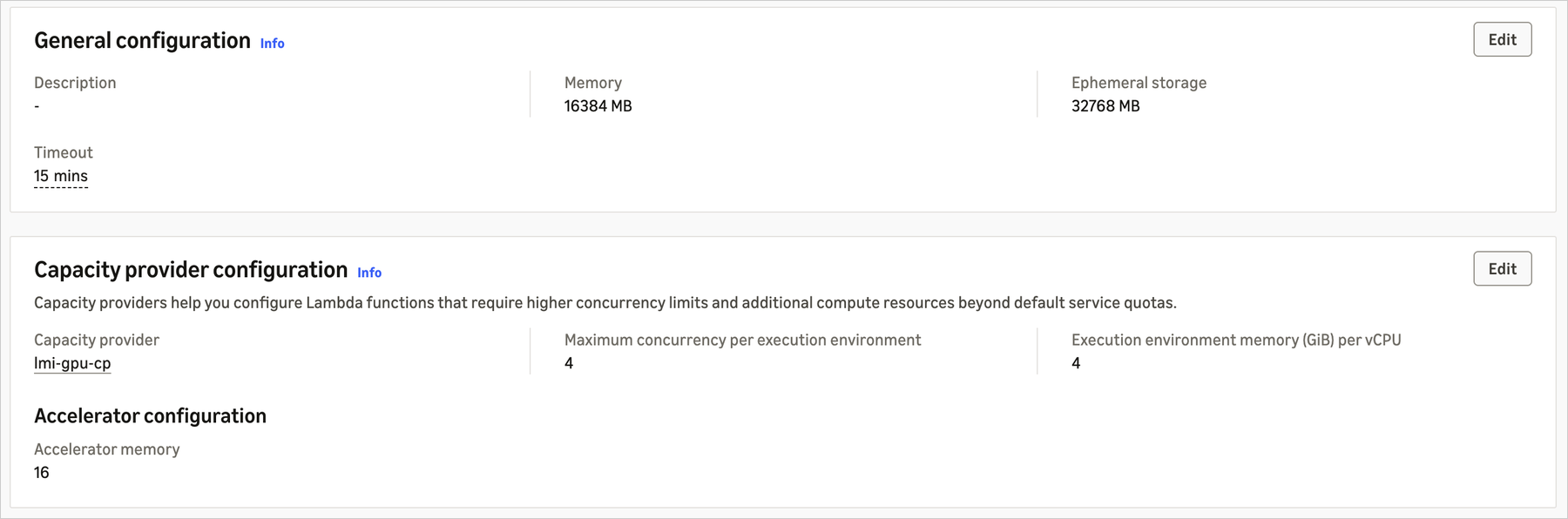
The new Lambda implementation introduces "concurrency packing." By allowing up to 48 concurrent requests per execution environment and enabling multiple functions to share the same GPU resources, AWS has created a mechanism that drives utilization upward. This consolidation means that organizations only pay for the capacity they effectively use, as the underlying infrastructure scales automatically in response to event volume. The billing model, which combines the underlying EC2 instance fee with a 9.75 percent management premium, provides a predictable cost structure compared to the volatility of self-managed clusters.
Technical Specifications and Performance Metrics
The platform supports a robust range of configurations to accommodate diverse workloads. Key specifications include:
- Memory and Storage: Support for up to 32 GB of container image size and 32 GB of NVMe ephemeral storage, allowing for the deployment of substantial large language models (LLMs).
- Hardware Compatibility: Launch support for the Amazon EC2 G-series, specifically G4dn, G5, G6, G6f, Gr6, Gr6f, and G6e instances.
- Startup Optimization: The implementation of Seekable OCI (SOCI) lazy loading reduces startup times by up to 70%, a critical factor for serverless cold-start latency.
- Extended Timeouts: With execution timeouts of up to 90 minutes for asynchronous workloads, the platform is now capable of handling complex batch processing tasks, such as multi-step media transcoding or extended inference chains.
Practical Implementation: A Case Study in Efficiency
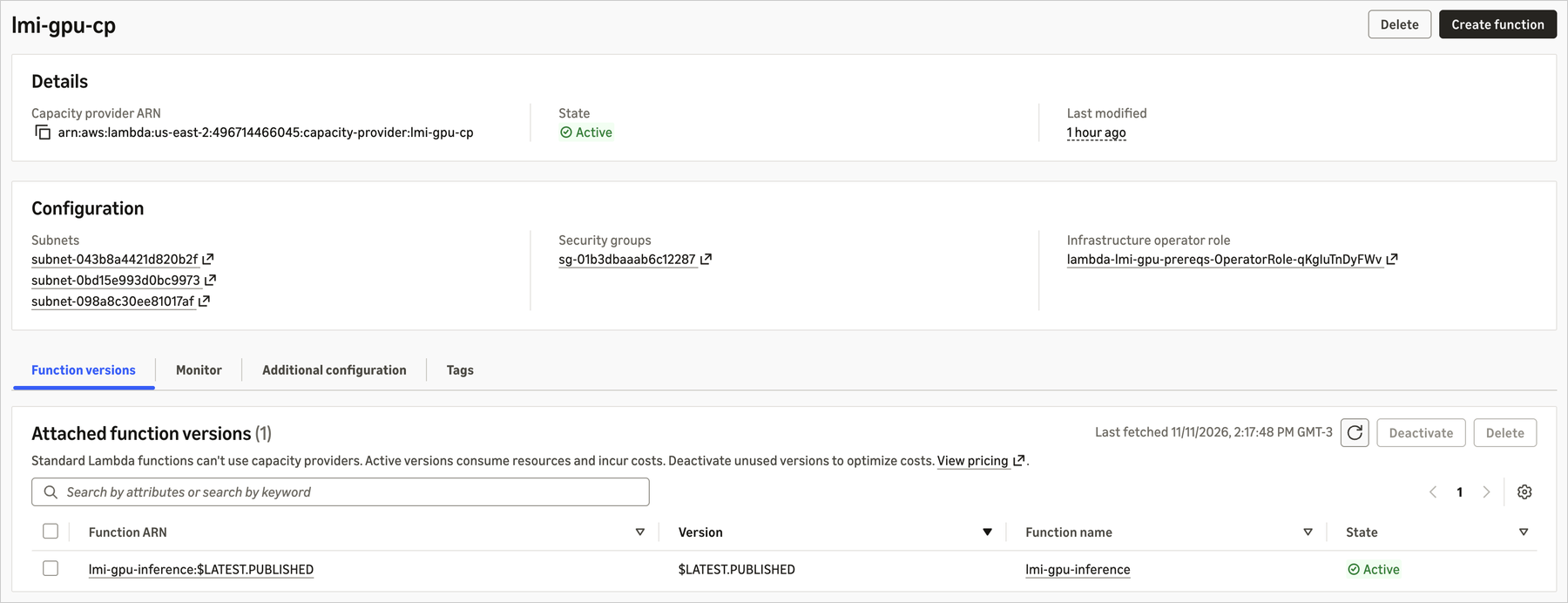
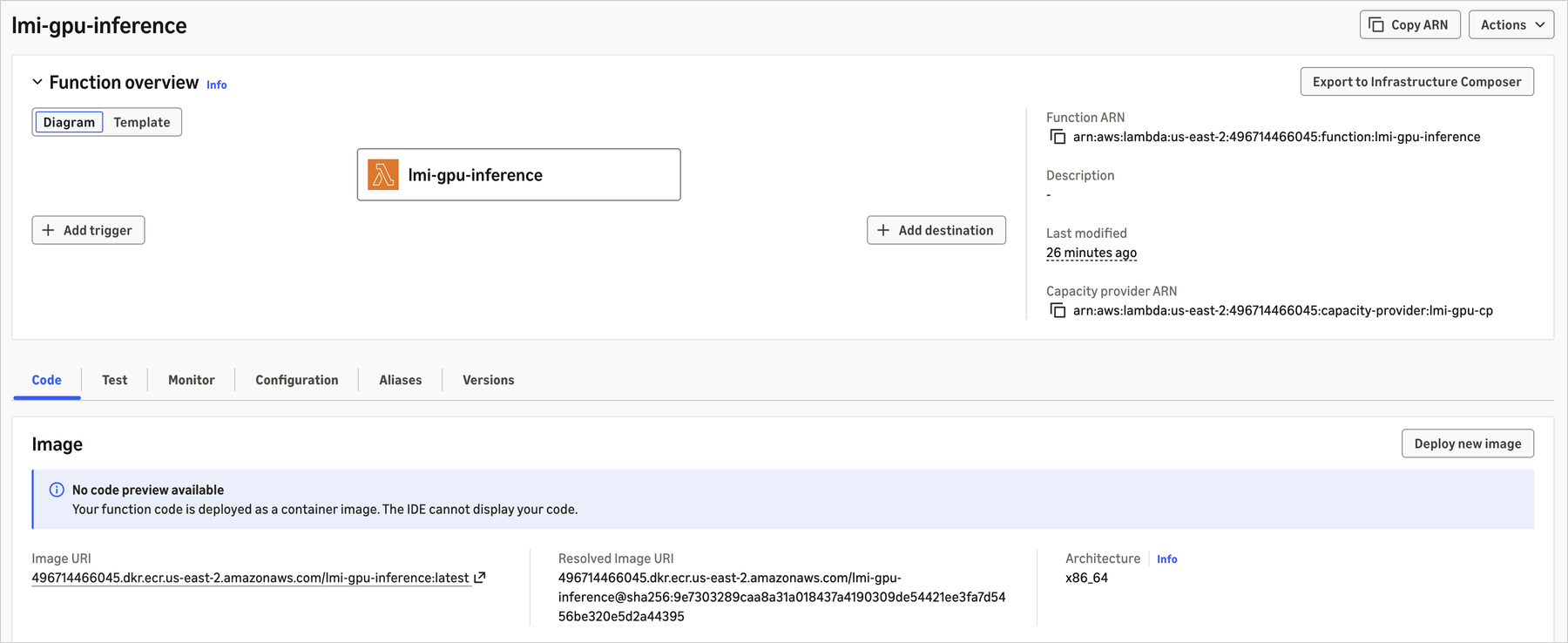
In a practical demonstration, developers can deploy a large language model—such as the Qwen2.5-1.5B-Instruct—using a standard vLLM base image. The workflow involves creating a capacity provider, which specifies the instance types and scaling constraints, and then building the container image. Because the environment is pre-configured with frameworks like PyTorch and the CUDA toolkit, the developer can bypass the traditional inference server coding process entirely.
By setting environment variables like MODEL_ID, the Lambda function automatically fetches the required model weights from a repository or an S3 bucket. Once deployed, the function acts as an OpenAI-compatible endpoint, allowing it to be integrated into existing applications with minimal refactoring. This "plug-and-play" capability for AI models is expected to accelerate the prototyping phase for businesses looking to integrate generative AI features into their software products.
Broader Implications for the AI Ecosystem
The introduction of this feature is not merely a convenience upgrade; it represents a strategic move to democratize AI infrastructure. By moving the "heavy lifting" of GPU management to the cloud provider, AWS is lowering the barrier to entry for smaller firms and startups that may lack the specialized DevOps expertise required to manage GPU fleets.
Industry analysts suggest that this will lead to a surge in "agentic" workflows, where small, specialized models perform specific tasks (such as document classification or summarization) triggered by simple events. As these functions become easier to deploy, the complexity of AI-driven applications is likely to increase, as developers can now chain multiple GPU-accelerated steps without worrying about the underlying cluster topology.
Observability and Monitoring
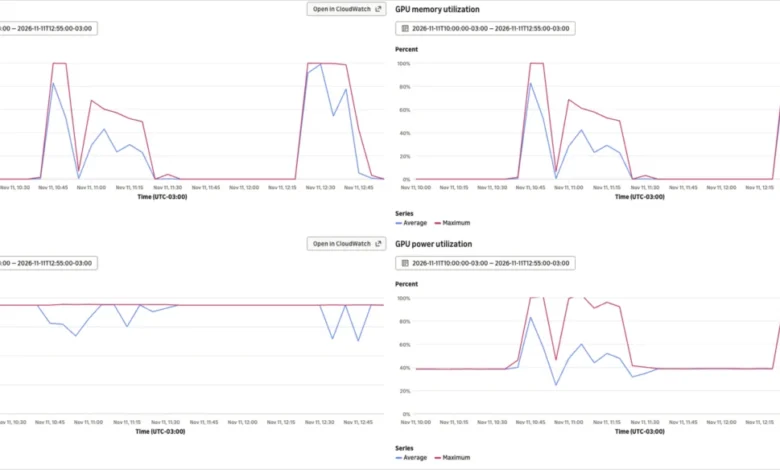
A common complaint regarding serverless AI has been the "black box" nature of performance monitoring. AWS has addressed this by surfacing GPU-specific metrics directly within Amazon CloudWatch. Users can now track GPU utilization, memory consumption, and power usage in real-time. This level of granularity is vital for fine-tuning performance. If a specific function is consistently hitting memory limits, or if a model is underutilizing its GPU, these metrics provide the empirical evidence needed to optimize resource allocation or adjust concurrency settings.
Conclusion and Future Outlook
As the demand for AI-driven functionality continues to outpace the availability of specialized engineering talent, the trend toward managed GPU environments is set to accelerate. The integration of GPU-accelerated functions into AWS Lambda marks a significant milestone in this trajectory.
For the enterprise, the benefits are clear: reduced time-to-market, lower total cost of ownership, and a more streamlined development lifecycle. While this release covers the most popular G-series instances, the roadmap suggests a continued expansion into even more powerful compute categories. As organizations continue to migrate their AI workloads from experimental environments to production, the reliability and scalability of the serverless model will undoubtedly become the standard for modern cloud architecture. By removing the friction from high-performance computing, AWS has cleared the path for a new wave of serverless-native intelligence, effectively turning the cloud into a programmable, elastic supercomputer accessible to every developer.