The Rise of Data Contracts: Ensuring Trust, Reliability, and AI Readiness in Enterprise Analytics

In the fast-evolving landscape of modern corporate technology, organizations are increasingly turning to agentic artificial intelligence to drive digital transformation and strategic decision-making. However, the success of these advanced AI initiatives relies entirely on the accessibility of well-discoverable, processable, and accurate business data. In large enterprises, this vital information is rarely centralized; instead, it is generated across disparate departments, with distinct teams maintaining specialized domain knowledge. Consequently, building meaningful enterprise analytics or deploying sophisticated data applications requires aggregating these scattered sources. Within this complex integration process, establishing foundational trust in the data has emerged as a paramount challenge for data engineers and chief data officers alike.
To understand the operational hurdles of modern data management, consider the hypothetical case of Alex, a data engineer at a multinational insurance corporation. Tasked with developing a customer insights application to predict the likelihood of policyholders purchasing supplemental coverage, Alex discovers a promising dataset within the corporate data warehouse. Yet, basic discovery is insufficient for production-grade engineering. Critical questions immediately arise regarding the dataset’s structural integrity: Are the schemas stable, or will tomorrow’s upstream update break the application? When was the information last refreshed? Are missing values anomalies or expected absences? Furthermore, governance questions loom large regarding data lineage, compliance standards, and regulatory adherence.
Traditionally, answering these questions required manual audits, informal Slack inquiries, or reliance on outdated documentation. When human analysts face ambiguity, they pause to investigate or consult colleagues. Autonomous AI agents, however, operate under entirely different operational paradigms. Industry experts note that AI agents inherently treat every data value as absolute truth. Where uncertainty slows human workflows down, a lack of metadata clarity causes autonomous agents to generate confidently erroneous results. This systemic vulnerability rapidly erodes human trust in automated systems, creating a counterproductive feedback loop. To bridge this gap, organizations are rapidly adopting data contracts—formalized, machine-readable agreements that establish explicit semantic, structural, and operational expectations between data providers and consumers.
The Architectural Evolution and Standardization of Data Contracts
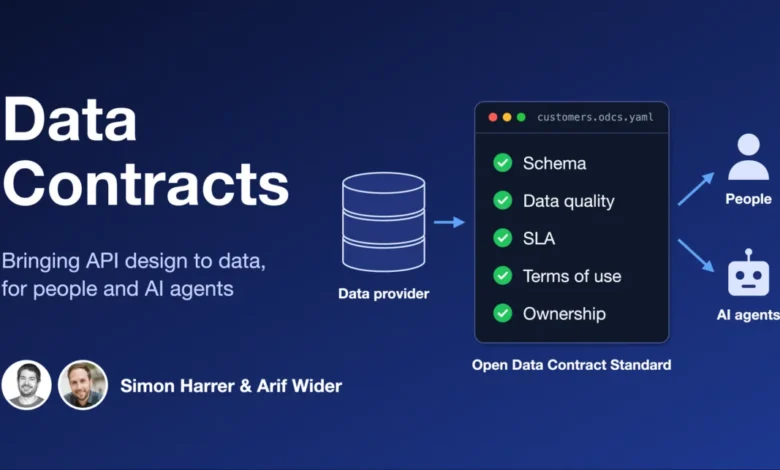
A data contract functions fundamentally as a binding agreement that defines the shape, quality, and service levels of a dataset offered by a provider. At its core, it outlines technical schemas—whether for relational tables, event streams, or object storage payloads—while incorporating rigorous validation rules and service-level agreements (SLAs). In recent years, the industry has gravitated toward open-source standardization to avoid proprietary vendor lock-in. The de facto standard for this practice is the Open Data Contract Standard (ODCS), a specification governed by the Bitol project under the auspices of the Linux Foundation. Recognized by industry technology radars and supported by comprehensive JSON schemas, ODCS provides a standardized YAML-based framework to declare everything from primary keys and data classifications to statistical quality constraints and freshness SLAs.
Within an ODCS-compliant contract, data providers can mandate precise quality thresholds, such as requiring that a specific column maintain less than one percent null values, or that a database table uphold a minimum row count threshold. Furthermore, operational guarantees are codified through measurable metrics, such as stipulating that records be updated within a strict 24-hour window. These contracts are typically housed within enterprise Git repositories alongside pipeline source code and CI/CD configurations, ensuring that data changes are treated with the exact same software engineering rigor applied to traditional application codebases.
Operationalizing Contracts: From CI/CD Pipelines to Data Marketplaces
The true utility of data contracts is realized when they are actively enforced through automated engineering workflows rather than left as passive documentation. Modern data infrastructure integrates contract validation directly into Continuous Integration and Continuous Delivery (CI/CD) pipelines. Utilizing command-line utilities such as the Data Contract CLI—which currently records over one million monthly downloads—engineering teams can automate validation stages. Tools can lint contract files against compliance standards, run automated breaking change detections against prior versions, and execute real-time integration tests against production environments before any code is deployed to production.
This automated enforcement directly impacts the broader data ecosystem, particularly within corporate data marketplaces. In these internal enterprise app stores, data contracts serve as the definitive "product details page" for corporate assets. When a consumer or an AI agent seeks to utilize a dataset, the contract provides transparent insight into its provenance, schema, operational reliability track record, and explicit terms of use. Upon reviewing these terms, a consumer can formally request access, triggering a bilateral access agreement that defines the requesting party, the intended processing purpose, and the duration of access. Once approved by the data provider, the underlying platform provisions temporary, governed access, replacing informal access grants with auditable governance compliance.
Implications for Agentic AI and Spec-Driven Development
The proliferation of data contracts carries profound implications for the advancement of agentic AI systems. As organizations deploy AI agents capable of generating data pipelines and answering complex ad-hoc analytical queries, data contracts act as vital guardrails. For instance, in spec-driven development paradigms, an AI coding agent can ingest a data contract alongside internal organizational skills to automatically generate fully functional data pipelines, using the contract itself as a continuous validation feedback loop.
Moreover, data contracts eliminate the semantic ambiguity that plagues natural language querying tools, often referred to as "chat with your data" applications. By embedding explicit business definitions, column semantics, and verified query statements into the AI context block of a contract, organizations provide agents with the exact instructions needed to query databases accurately. This prevents agents from making incorrect assumptions about table joins, monetary units—such as storing premiums in cents rather than whole currency units—or regulatory constraints.
Strategic Outlook and Industry Adoption
As organizations navigate the complexities of decentralized data architectures, such as data mesh and data products, the integration of the Open Data Contract Standard and the Open Data Product Standard (ODPS) is becoming a core competency for digital enterprises. Industry analysts project that data contracts will soon achieve the same ubiquitous status for data engineering that OpenAPI established for RESTful microservices.
Adopting data contracts requires a cultural shift toward enterprise data ownership, transforming passive data custodians into accountable product providers. While upfront implementation demands careful scoping—focusing initially on high-friction interfaces and critical production pipelines—the long-term organizational benefits are substantial. By enforcing automated quality checks, preempting breaking changes, and providing unambiguous metadata for autonomous agents, data contracts establish a scalable foundation of trust. In an era defined by automation and algorithmic decision-making, open and portable metadata standards ensure that enterprises retain absolute sovereignty over their most strategic digital assets.
Related posts: