When Math Met Light: How the Famous Smith Hat Monotile is Revolutionizing Optical Physics

An abstract mathematical shape that captivated scientists and geometry enthusiasts worldwide by solving a decades-old theoretical puzzle is now crossing disciplinary boundaries to reveal an entirely unexpected phenomenon in physics. Recent findings demonstrate that physical structures engineered around this unique geometric form can force light to organize into distinctive, chiral patterns. This breakthrough establishes a novel pathway for investigating how non-repeating, highly ordered geometry can profoundly influence optical behavior, potentially laying the groundwork for advanced light-manipulation technologies.
Published in a recent issue of Nature Communications, the study was spearheaded by a multidisciplinary team of researchers from the Institute of Industrial Science at The University of Tokyo, in close collaboration with several partner institutions. By translating a mathematical abstraction into tangible nanoscale hardware, the research team has unlocked a fresh intersection between aperiodic tiling theory and wave optics. When they illuminated these specially fabricated silicon nitride structures using laser light, the resulting diffraction effects deviated significantly from the established norms of conventional quasicrystals, signaling a departure in how scientists understand light-matter interactions under complex geometric constraints.
The Einstein Problem and the Quest for the Monotile
To understand the magnitude of this optical discovery, one must look back at the mathematical landscape that preceded it. For decades, mathematicians wrestled with what is formally known as the Einstein problem—derived not from the physicist Albert Einstein, but from the German word ein Stein, meaning "one stone." The fundamental question posed by this problem was deceptively simple: Can a single, specific geometric tile shape cover an infinite two-dimensional surface completely, without leaving any gaps or overlaps, and without ever creating a repeating pattern?
To contextualize this, humans have understood periodic tiling for millennia. Familiar patterns such as bathroom floor checkerboards, brick walls, and honeycombs rely on translational symmetry, meaning a fundamental unit cell repeats itself endlessly and predictably in multiple directions. In the 1960s and 1970s, pioneering mathematicians like Roger Penrose introduced aperiodic sets of tiles—most famously the Penrose tiles—which could tile a plane without repeating, but they required multiple distinct tile shapes working in tandem.
For nearly half a century, the hunt for a "monotile"—a single shape capable of achieving this feat entirely on its own—came up empty. That changed dramatically in 2023, when an international team of mathematicians and amateur enthusiasts, including David Smith, Joseph Myers, Craig Kaplan, and Chaim Goodman-Strauss, announced the discovery of the "hat" tile, now commonly referred to as the Smith hat. This 13-sided polygon successfully solved the Einstein problem by tiling a plane aperiodically. The mathematical community greeted the discovery with widespread acclaim, as it resolved a longstanding open question in spatial geometry.
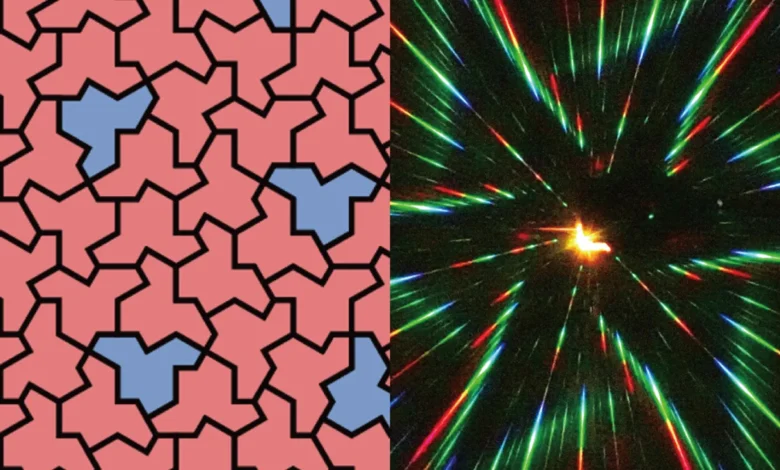
However, the theoretical implications of the Smith hat quickly attracted the attention of physicists. Lead author Yuto Moritake and his colleagues at The University of Tokyo wondered whether this abstract mathematical marvel might harbor hidden physical properties. "What is especially fascinating about the hat tile is that, although the resulting pattern appears irregular at first glance, it is actually constructed from the honeycomb lattice," Moritake notes. This underlying structural heritage prompted the team to investigate whether the monotile could orchestrate unique physical phenomena when scaled down to the nanometer level.
Translating Mathematics into Nanoscale Optical Architecture
Bridging the gap between a two-dimensional mathematical drawing and a functional optical medium required state-of-the-art nanofabrication techniques. The research team utilized electron beam lithography to etch nanoscale versions of the Smith hat aperiodic pattern onto high-purity silicon nitride films. Silicon nitride is widely favored in photonics for its high refractive index, broad transparency window, and compatibility with standard semiconductor manufacturing processes.
Once the physical structures were successfully fabricated, the researchers subjected them to rigorous optical testing. By directing coherent laser light through the silicon nitride samples, the team observed the resulting diffraction patterns—the bending and spreading of light waves as they encounter obstacles or apertures within the periodic or aperiodic lattice.
Instead of generating the standard diffraction rings or dots characteristic of periodic lattices, or the sharp, discrete tenfold or twelfth symmetry points typical of traditional quasicrystals, the Smith hat structures produced distinctive pinwheel-like diffraction patterns. These intricate, swirling optical signatures directly exposed the underlying chiral character of the aperiodic monotile structure.
In physics and chemistry, chirality refers to a geometric property of "handedness"—an object cannot be superposed onto its mirror image, much like a human left hand cannot be perfectly aligned with a right hand. While biological molecules like DNA and amino acids are famously chiral, engineering chirality into optical lattices at the nanoscale has been a persistent challenge for physicists seeking to manipulate polarized light. In this experiment, the unique spatial arrangement of the Smith hat monotile effectively transferred its lack of mirror symmetry onto the interacting light waves, causing the diffraction field itself to exhibit a robust chiral response.
"We found that the diffraction patterns themselves become chiral because the structure lacks mirror symmetry," explains senior author Masaya Notomi. "This kind of optical response is fundamentally different from that observed in conventional quasicrystalline materials."
Symmetry, Polarization, and Directional Light Response
The investigation went further than merely observing pinwheel diffraction. The researchers discovered that the optical behavior of the Smith hat structures was remarkably dynamic, shifting in response to the specific angle of incidence, direction, and polarization state of the incoming laser light.
To confirm that these phenomena were strictly tied to the geometry of the monotile pattern rather than fabrication artifacts, the research team analyzed mirrored versions of the physical structures. True to theoretical expectations, when the spatial geometry was reversed in a mirror image, the optical behavior and the handedness of the resulting diffraction patterns reversed as well. This direct correlation confirmed that the system exhibits a sophisticated form of symmetry-controlled optical behavior, where macroscopic or microscopic light propagation is strictly governed by the aperiodic arrangement of the underlying tiling.
"These results open a new direction of research on the fusion of quasiperiodic order and chirality," remarks Moritake. "Monotile patterns provide a platform for exploring optical phenomena that emerge from the interplay of symmetry, chirality, and aperiodicity."
Broader Implications for Advanced Optical Technologies
While the research remains grounded in fundamental physics, the implications for applied science and engineering are substantial. The ability to control light through aperiodic, chiral geometries offers engineers a new toolkit for manipulating electromagnetic waves without relying on conventional bulk optics.
In modern photonics, there is an escalating demand for compact, highly efficient devices capable of manipulating light polarization, routing optical signals, and filtering specific wavelengths for telecommunications, quantum computing, and optical sensing. Traditional devices often depend on birefringent crystals or complex metamaterials that can be difficult to manufacture at scale. The use of monotile-inspired nanoscale patterns could theoretically streamline the production of planar optical components that manipulate circular polarization with high precision.
Furthermore, this study highlights an ongoing, highly fruitful trend in modern science: the unexpected utility of pure mathematics in addressing physical problems. Historically, theoretical developments in mathematics—such as non-Euclidean geometry or matrix algebra—have frequently preceded major revolutions in physics by decades or even centuries. The transition of the Smith hat from an abstract paper-and-pencil solution to the Einstein problem into an active platform for controlling laser diffraction underscores how interdisciplinary exploration continues to expand the boundaries of human knowledge.
As research groups around the world begin to examine other newly discovered monotiles—such as the "spectre" tile that followed the Smith hat—the field of aperiodic photonics is poised for rapid expansion. By wedding the rigorous constraints of spatial tiling theory with the dynamic capabilities of modern nanophotonics, scientists are stepping into an era where geometry dictates not just how spaces are filled, but how light itself behaves.
Related posts: