AWS Unveils Enhanced Custom Event Bus for Amazon EventBridge to Revolutionize Enterprise Event-Driven Architecture

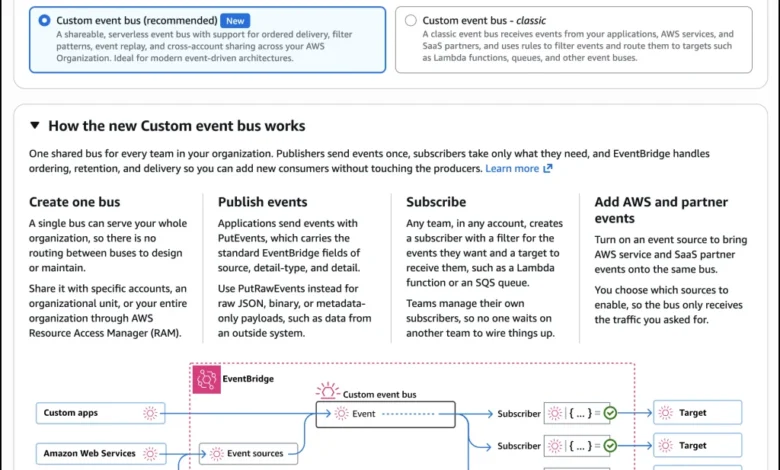
In a significant shift for organizations managing large-scale serverless environments, Amazon Web Services (AWS) has announced the launch of an enhanced custom event bus for Amazon EventBridge. This new architecture is designed to simplify the complex web of cross-account routing that has historically burdened platform teams using multi-account AWS strategies. By providing a centralized, shared event backbone, the update addresses long-standing challenges related to operational overhead, event ordering, and the compounding costs of intricate bus-to-bus configurations.
The Evolution of Event-Driven Complexity
The rise of serverless computing over the past decade has fundamentally altered how enterprises build software. Event-driven architectures, characterized by the asynchronous exchange of data, have become the standard for decoupled, scalable applications. However, as organizations move from a single team managing a single account to large-scale, multi-account enterprises, the infrastructure required to route these events has become increasingly fragile.
Previously, AWS best practices dictated that each team within an organization should operate within its own siloed AWS account for security and billing isolation. To facilitate communication between these accounts, developers were forced to implement a mesh of cross-account rules and bus-to-bus configurations. This approach, while effective in the short term, created a "spaghetti" of infrastructure. Platform teams found themselves struggling with limited visibility into event lineage, and developers were forced to build "workarounds" to ensure event ordering—a critical requirement for sensitive applications like logistics tracking or financial transaction processing.
A New Architectural Paradigm
The enhanced custom event bus marks a departure from the classic EventBridge model. By allowing a single, centralized event bus to be shared across an entire AWS organization, AWS is effectively flattening the architecture. This shift allows platform teams to deploy a primary event backbone once, rather than provisioning redundant routing layers for every new project.

Key features of this enhancement include:
- Ordered Delivery: By utilizing an
EventGroupId, developers can now guarantee the sequence of events. This eliminates the need for complex, custom-coded logic or the injection of intermediate message queues to maintain data integrity. - Subscriber Resource: The introduction of a dedicated "Subscriber" resource simplifies the management of filtering, retries, and dead-letter queues. Previously, these settings were fragmented across multiple resources, increasing the potential for configuration drift.
- Content-Based Deduplication: To address the "at-least-once" delivery model, the new bus includes native deduplication. By hashing event payloads, EventBridge can now identify and discard duplicate events within a five-minute window, providing developers with "exactly-once" delivery semantics without requiring manual idempotency tokens.
- Advanced Transformation: The integration of JSONata allows for real-time reshaping of event payloads, enabling developers to map data to downstream requirements without the need for additional compute resources like Lambda functions for simple transformation tasks.
Economic Impact and Pricing Realignment
One of the most notable aspects of this announcement is the transition to a new pricing model. In the legacy "classic" bus architecture, costs could spiral as a result of cumulative routing charges incurred during cross-account data transfers. The new model shifts toward a throughput-based approach, where publishers pay for ingestion and subscribers pay for delivery.
This change is expected to provide greater cost predictability for organizations. By eliminating the "routing tax" associated with moving events between multiple buses, AWS is incentivizing a more centralized and streamlined approach to event distribution. Financial analysts following the cloud infrastructure sector suggest that this move is a direct response to enterprise customers seeking more transparent cost allocation metrics, particularly as they scale their serverless footprint into the thousands of accounts.
Implementation and Migration Strategy
AWS has confirmed that the "classic" custom event bus will remain fully supported, ensuring that existing workloads remain stable. The enhanced bus is an opt-in feature, allowing organizations to migrate at their own pace.
The implementation process leverages AWS Resource Access Manager (RAM). By defining an organization, an organizational unit, or specific IAM roles as principals, administrators can grant access to the bus without writing complex cross-account policy documents. This integration significantly lowers the barrier to entry for platform engineers, reducing the time required to onboard new teams to the shared event backbone.

Technical Implications for Data Integrity
The introduction of synchronous invocation for targets such as AWS Lambda represents a critical evolution in how EventBridge handles reliability. In previous iterations, developers often relied on Amazon SQS (Simple Queue Service) as a buffer to ensure that events were processed successfully. With the enhanced bus, the ability to confirm successful processing before acknowledging the event reduces the architectural footprint of a typical event-driven pipeline.
Furthermore, the capability to deserialize Apache Avro or Protocol Buffers directly at the bus level is a boon for high-performance applications. By allowing the bus to understand the payload schema, subscribers can filter events based on granular data points within the payload, rather than relying on high-level metadata. This reduces unnecessary traffic and ensures that downstream consumers are only awakened when relevant data arrives.
Industry Context and Future Outlook
This update arrives at a time when the "Platform Engineering" movement is gaining significant momentum. Organizations are increasingly looking to provide their internal developers with "golden paths"—standardized, secure, and pre-configured infrastructure templates. The enhanced custom event bus serves as a foundational component of these paths, providing a reliable, managed, and scalable message fabric.
Industry observers note that this development reflects the broader maturity of the serverless market. As enterprises move beyond initial adoption and into large-scale operation, the focus has shifted from simple connectivity to governance, observability, and cost control. By providing a centralized point of control, AWS is effectively shifting the responsibility of "event routing" from the application developer to the platform, where it can be managed with global policies.
Availability and Regional Rollout
The enhanced custom event bus is currently available in several major regions, including US East (N. Virginia and Ohio), US West (Oregon), and multiple European and Asia-Pacific locations. AWS intends to continue the global rollout throughout the coming quarters.
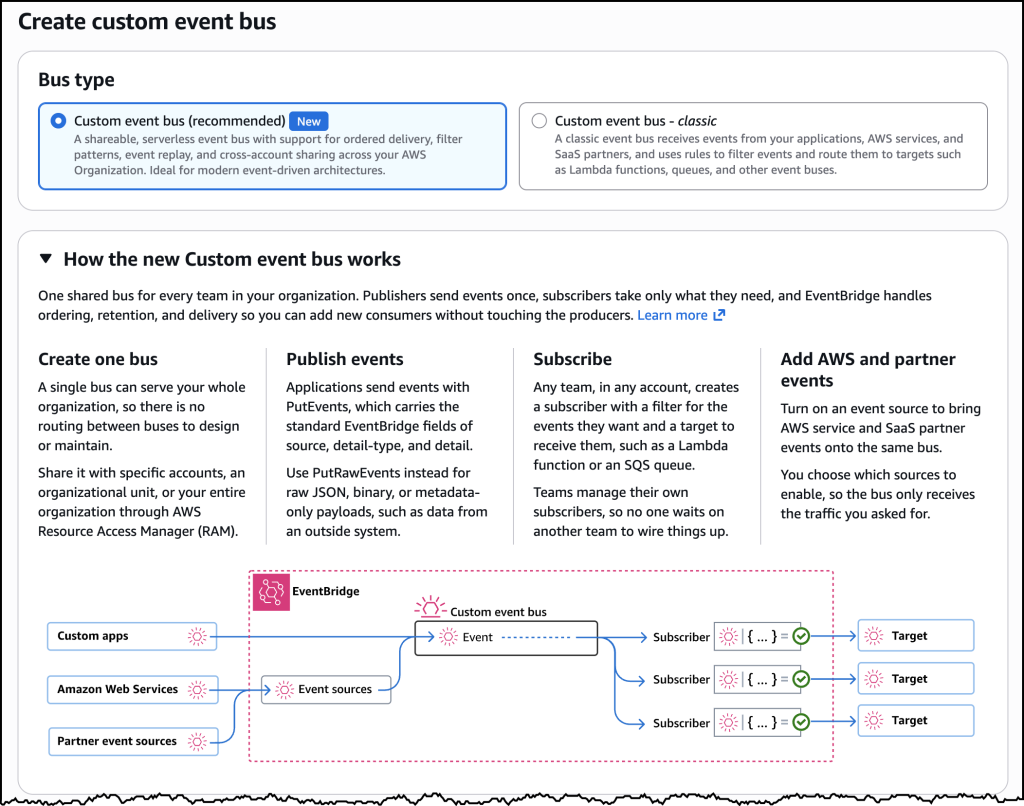
For organizations currently managing fragmented event architectures, the move toward a centralized bus offers a clear path to reducing technical debt. While the migration to this new architecture requires planning, the long-term benefits—namely reduced infrastructure complexity, lower operational costs, and the elimination of custom-built ordering logic—present a compelling case for adoption. As the industry continues to push the boundaries of what is possible in a serverless environment, tools like the enhanced Amazon EventBridge bus are likely to become the standard for large-scale enterprise integration.
By centralizing the event backbone, AWS is not only simplifying the developer experience but is also reinforcing its commitment to providing robust, enterprise-grade tools that can handle the scale and complexity of the modern digital landscape. As more organizations adopt this model, it is expected that the industry will see a rise in more sophisticated, highly responsive event-driven applications that are capable of operating with a level of efficiency and reliability that was previously only possible with legacy, monolithic message brokers.