NASA Nancy Grace Roman Space Telescope Set to Revolutionize Exoplanet Discovery with Unprecedented Active Coronagraph Technology

The National Aeronautics and Space Administration (NASA) is preparing for the highly anticipated launch of the Nancy Grace Roman Space Telescope, a mission that promises to redefine the boundaries of observational astronomy. Scheduled for deployment as early as the end of next month, the observatory represents a monumental leap in the search for celestial bodies beyond our solar system. Central to this mission is the deployment of the first space-bound "active" coronagraph, a sophisticated instrument engineered to perform one of the most difficult optical feats in science: the deliberate suppression of starlight to reveal the hidden worlds orbiting distant suns.
By effectively "erasing" the overwhelming glare of a star, the Roman Space Telescope will provide astronomers with the capability to capture the first direct images of planets similar to those in our own solar system. This technological milestone is widely viewed by the scientific community as the essential precursor to future missions aimed at photographing Earth-like, habitable worlds. Brandon Creager, the lead mechanical engineer for the instrument at NASA’s Jet Propulsion Laboratory (JPL), characterizes the mission as a "critical stepping stone" in the ultimate quest to find "Earth 2.0."
The Legacy of Nancy Grace Roman and the Wide-Field Vision
The telescope is named in honor of Dr. Nancy Grace Roman, NASA’s first chief of astronomy, often referred to as the "Mother of Hubble" for her pivotal role in the development of the Hubble Space Telescope. Carrying forward her legacy of expansive cosmic exploration, the Roman Space Telescope features a 300-megapixel wide-field camera. This instrument is designed to capture images approximately 100 times larger than the widest exposures possible with Hubble, while maintaining a comparable level of resolution.
This vast field of view is not merely a matter of scale; it represents a fundamental shift in how astronomers survey the universe. Javier Viaña, a research scientist at Harvard University whose projects were selected for the telescope’s inaugural year of observation, describes the transition as moving from "interviewing a handful of people" to "conducting a global census." The telescope’s primary wide-field mission is twofold: to investigate the nature of dark matter and dark energy, which together constitute the vast majority of the universe’s mass-energy content, and to identify approximately 100,000 new exoplanets through gravitational microlensing—a process where the gravity of a foreground planet distorts the light of a more distant star.
Engineering the Active Coronagraph: A New Paradigm in Optics
While coronagraphs have been utilized in space before—notably on the Hubble and James Webb Space Telescopes—previous versions have relied on "passive" or stationary systems. These instruments use a fixed mask to block starlight, a method often compared to using one’s thumb to block a flashlight while searching for a firefly. While the central bulb is hidden, stray light and glare can still leak around the edges, obscuring the faint signal of the planet. In the vacuum of space, even the most minute imperfections in a telescope’s mirrors or coatings can scatter light into "speckles" that mimic the appearance of a planet or hide a real one entirely.
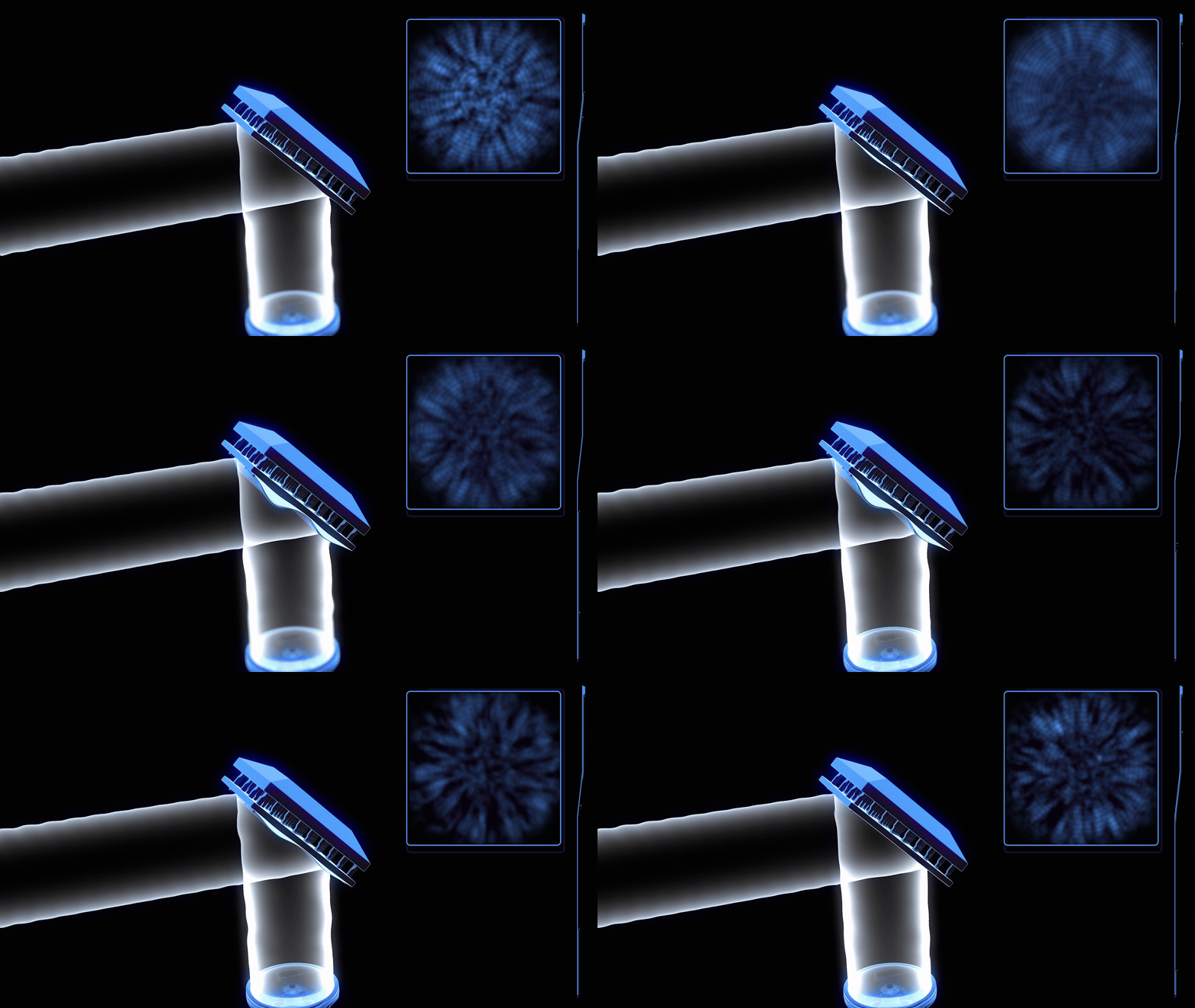
The Nancy Grace Roman Space Telescope addresses this challenge through "active wavefront control." Before each observation, the coronagraph will measure the residual, unwanted light and actively suppress it. This is made possible by two deformable mirrors located within the instrument. Each mirror is backed by a 48-by-48 grid of actuators—tiny mechanical pistons—that sit beneath a thin, flexible sheet of glass.
When a specific voltage is applied, these actuators contract or expand, subtly sculpting the mirror’s surface. The precision required for this task is staggering. Each patch of the mirror can be adjusted in increments as small as 10 picometers—roughly one-tenth the diameter of a hydrogen atom. According to Ilya Poberezhskiy, the project systems engineer at JPL, this allows the mirrors to cancel out incoming waves of unwanted light in a manner analogous to noise-canceling headphones, which use destructive interference to eliminate background sound.
Silicon Grass and Light Traps
Beyond the deformable mirrors, the Roman Space Telescope employs a series of advanced masks and patterned plates to guide photons. One of the more innovative features is the use of "silicon grass." This consists of a dense thicket of microscopic, needle-like spikes etched onto the surface of certain masks. These spikes are designed to absorb photons that would otherwise bounce around the internal machinery of the telescope.
"Once the light gets into there, it never gets out," Poberezhskiy explains. This light-trapping technology ensures that only the faint, reflected light from a planet reaches the final detector, significantly reducing the "noise" that has traditionally plagued direct imaging efforts. The combination of active mirrors and light-absorbing masks is expected to improve the sensitivity of the telescope by a factor of 1,000 compared to current space-based coronagraphs.
Targeting Mature Gas Giants and "Alien Jupiters"
The primary target of the Roman coronagraph is a class of planets that has remained largely invisible to direct imaging: mature gas giants. To date, most exoplanets that have been photographed are "young" planets—massive, hot bodies several times the size of Jupiter that still glow with the heat of their formation. Because they emit their own infrared radiation and orbit far from their host stars, they are relatively easy to distinguish from stellar glare.
Roman, however, is designed to see "true Jupiter analogues." These are mature planets that have cooled over billions of years and are primarily visible because they reflect the light of their parent stars. These planets are typically located closer to their stars, making them much harder to isolate. By collecting reflected starlight directly from the planet itself, Roman moves beyond inferring a planet’s existence through its gravitational pull on a star (the "wobble" method).
Meredith MacGregor, a professor of astronomy at Johns Hopkins University, emphasizes the significance of this shift: "We’re not looking at the star… We are actually looking at the planet, and that is super powerful." This direct observation allows for the use of spectroscopy to analyze the chemical composition of a planet’s atmosphere, providing clues about its formation history and potential habitability.
Timeline and Mission Chronology
The development of the Nancy Grace Roman Space Telescope has been a multi-decade endeavor. Originally conceived as the Wide-Field Infrared Survey Telescope (WFIRST), the project underwent several redesigns to incorporate more advanced technology, including the active coronagraph.
- Early 2010s: The mission was identified as the top priority for the Decadal Survey in Astronomy and Astrophysics.
- 2016: NASA officially moved the project into the formulation phase.
- 2020: The telescope was formally named after Nancy Grace Roman.
- 2021–2023: Critical design reviews and the integration of the Wide Field Instrument and Coronagraph Instrument were completed at JPL and Goddard Space Flight Center.
- 2024: Final testing and launch preparations.
Following its launch, the telescope will undergo a rigorous commissioning phase. Engineers will test the coronagraph’s ability to "dig" a "dark doughnut"—a region of suppressed starlight around a target star—and maintain that darkness as the spacecraft maneuvers and experiences temperature fluctuations in the harsh environment of space.
Broader Implications and the Path to Habitable Worlds
The data generated by the Roman Space Telescope is expected to be overwhelming in its volume and complexity. "I think people will legitimately still be working on Roman data for decades," says MacGregor. While the first images of an "alien Jupiter" may appear only as a small cluster of pixels rather than a high-definition globe, the spectroscopic data contained within those pixels will be transformative.
The success of the Roman mission is critical for the future of the Habitable Worlds Observatory (HWO), a proposed mission currently in the conceptual stages at NASA. The HWO aims to identify and characterize Earth-like planets orbiting sun-like stars. To do so, it will need to suppress starlight that is 10 billion times brighter than the planet it seeks to find. The active wavefront control technology being pioneered by Roman is the direct technological ancestor of the systems that will be required for the HWO.
As the launch date approaches, the engineering and scientific teams reflect on the magnitude of the project. For Brandon Creager, who has been dedicated to the instrument since 2018, the achievement is personal as much as it is professional. "Not too many people get to say, ‘I built something and it’s taking a picture of a planet that’s at a star that’s 50 light-years away,’" he remarks.
The Nancy Grace Roman Space Telescope stands as a testament to human ingenuity and the persistent drive to understand our place in the cosmos. By mastering the "vanishing trick" of starlight, NASA is not just launching a telescope; it is opening a window into a new era of planetary discovery, where the tiny dots of light in the darkness become recognizable, individual worlds.
Related posts: