MIT Engineers Unlock Insect-Level Agility in Tiny Flying Robots With Advanced AI Controller

In the high-stakes arena of disaster response, every second counts. When earthquakes, structural collapses, or industrial disasters occur, emergency personnel are frequently delayed by the sheer peril of navigating unstable ruins. Larger robotic drones, while immensely useful for aerial surveillance, are often too bulky to pass through narrow fissures, fallen ductwork, or shattered windows. For years, engineers have envisioned a new class of micro-scale flying machines capable of mimicking nature’s most adept flyers—insects—to slip through these tight constraints. Until recently, however, these aerial microrobots remained painfully sluggish, structurally fragile, and limited to rudimentary flight paths.
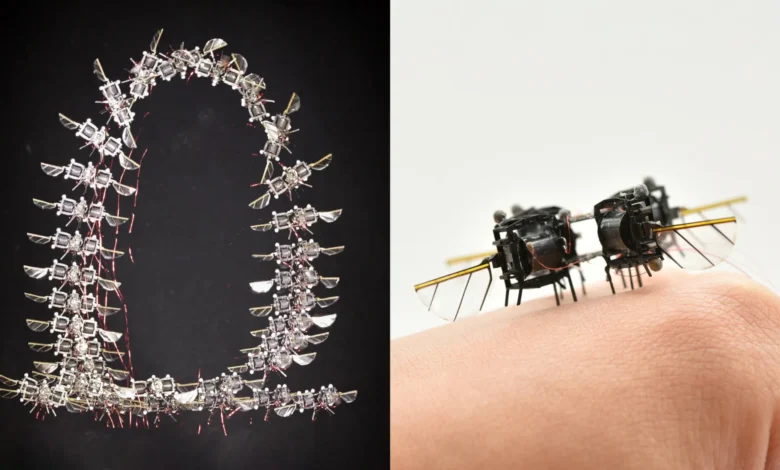
That technological barrier has finally begun to give way. A multidisciplinary team of researchers at the Massachusetts Institute of Technology (MIT) has successfully engineered a breakthrough artificial intelligence-based controller that endows an insect-scale flying robot with unprecedented speed, precision, and physical agility. By combining a two-part computational framework with robust hardware advancements, the MIT researchers have supercharged a micro-robot roughly the size of a cassette tape, enabling it to execute demanding aerial maneuvers including rapid-fire body flips and precise evasive braking, all while resisting unpredictable wind disturbances. Published in the journal Science Advances, the milestone marks a monumental step toward realizing fully autonomous robotic swarms capable of threading through the rubble of collapsed infrastructure to save human lives.
The Evolution of Micro-Robotics: From Slow Crawlers to High-Speed Fliers
The quest to build functional flying microrobots has occupied labs worldwide for over a decade. While natural insects effortlessly navigate gale-force winds, evade predators, and negotiate cluttered environments with split-second reflexes, their artificial counterparts have historically struggled to achieve even basic dynamic stability. Traditional aerial microrobots typically suffered from low payload capacities, slow forward velocities, and rigid control schemes that required extensive manual tuning by human operators.
For more than five years, the Soft and Micro Robotics Laboratory at MIT—headed by Kevin Chen, an associate professor in the Department of Electrical Engineering and Computer Science (EECS) and co-senior author of the study—has methodically chipped away at these limitations. Earlier phases of Chen’s research focused heavily on physical durability and power transmission. The team previously developed a remarkably resilient micro-robot measuring about the size of a microcassette and weighing less than a standard paperclip. This physical iteration incorporated larger flapping wings driven by advanced soft artificial muscles. These synthetic muscles are capable of contracting at rapid rates to produce exceptionally fast wingbeat frequencies, supplying the raw mechanical thrust necessary for sustained lift.
Yet, as the hardware matured, a distinct bottleneck emerged in the software. The micro-robot’s controller—effectively acting as its onboard brain—was simply not sophisticated enough to harness the physical capabilities of the new wing architecture. Because the aerodynamics governing ultra-lightweight flight are profoundly complex and subject to rapid, chaotic fluctuations, designing a controller that could maintain stability while commanding aggressive maneuvers presented a staggering computational challenge. A system powerful enough to calculate these fluid dynamics in real time would typically demand massive computing infrastructure, far too heavy for a robot weighing a fraction of a gram to carry.
Cracking the Code: A Two-Tier AI Architecture
To conquer the computational paradox, Chen’s laboratory joined forces with the research group of Jonathan P. How, the Ford Professor of Engineering in the Department of Aeronautics and Astronautics at MIT and a principal investigator in the Laboratory for Information and Decision Systems (LIDS). The collaborative effort yielded a novel, two-step AI-driven control framework specifically tailored to bridge the gap between heavy computational planning and real-time execution.
The first tier of the control architecture employs a model-predictive controller. This sophisticated mathematical framework utilizes a dynamic model of the robot to anticipate how the machine will react to various inputs, mapping out the optimal sequence of actions required to safely trace a designated trajectory. While this planning phase demands significant computational resources, it excels at organizing high-level, aggressive maneuvers such as sharp turns, dramatic changes in body pitch, and intricate aerial flips. Crucially, the model-predictive planner also factors in the physical limitations of the robot’s actuators, factoring in maximum force and torque thresholds to prevent the machine from over-exerting itself and crashing.
Executing consecutive body flips represents one of the most punishing tests of dynamic stability in robotics. To successfully perform one somersault immediately followed by another, the micro-robot must decelerate with absolute precision, bleeding off kinetic energy so that it initiates each subsequent rotation under optimal conditions. Minor cumulative errors during high-speed loops typically compound exponentially, resulting in catastrophic crashes.
To translate this high-level mathematical expertise into real-time flight commands, the researchers utilized a technique known as imitation learning. By training a deep-learning policy on the expert outputs of the model-predictive controller, the team successfully distilled the complex planning data into a streamlined, high-speed neural network policy. This policy acts as the robot’s rapid decision-making engine during flight, processing real-time position data and instantaneously translating it into precise commands for thrust force and torque. The methodology allowed the researchers to bypass the traditional computational bottlenecks that previously crippled real-time control in micro-aerial systems.
Empirical Results: Quadrupling Speed and Defying Turbulence
The integration of the two-tier control architecture yielded dramatic, quantifiable improvements in the micro-robot’s operational performance. Laboratory evaluations revealed staggering performance metrics when compared against the laboratory’s previous operational baselines:
- Speed: The insect-scale flying machine achieved an approximate 450 percent increase in forward velocity, flying roughly 447 percent faster than older iterations.
- Acceleration: The robot registered a roughly 250 percent increase in acceleration capabilities, surging forward with explosive responsiveness.
- Trajectory Tracking: Despite active wind disturbances deliberately introduced to knock the robot off course, the machine maintained remarkable trajectory adherence, successfully completing 10 consecutive somersaults in just 11 seconds while remaining within a tight 4-to-5-centimeter corridor of its planned flight path.
Furthermore, the research team successfully programmed the robot to execute a specialized biological movement known as a saccade. In the natural world, flying insects utilize saccades to pitch their bodies sharply, rapidly transition to a new spatial position, and then counter-pitch to bring themselves to a dead stop. This aggressive braking and acceleration maneuver serves a dual purpose for biological insects: it allows them to rapidly reorient themselves while simultaneously clearing their visual fields to process environmental data.
For the MIT team, mastering the saccade is not merely an academic exercise in biomimicry; it is an essential stepping stone toward fully autonomous visual navigation.
Broader Implications and Future Horizons
The successful demonstration of insect-level speed and agility in a micro-scale robotic platform opens a transformative frontier across multiple engineering and emergency response disciplines. Traditional quadcopter drones, while remarkably effective in open environments, face severe spatial restrictions when deployed in enclosed, cluttered, or unstable spaces. Collapsed concrete frameworks, industrial piping networks, mineshafts, and post-earthquake rubble fields present extreme navigation hazards where a standard quadcopter’s rotor blades would immediately strike obstacles and cause a crash.
By contrast, an insect-scale robot driven by soft artificial muscles and advanced AI control frameworks can safely graze against walls, bounce off debris, and slip through millimeter-wide gaps without sustaining terminal damage. The addition of onboard cameras and micro-sensors—the primary objective for the next phase of the research initiative—will fundamentally change how these machines operate.
Equipping microrobots with miniaturized visual systems will eventually liberate them from external motion-capture camera arrays currently required in laboratory settings, allowing them to operate completely untethered in the open world. Moreover, researchers envision a future where autonomous swarms of these robotic insects communicate and coordinate their movements, collectively mapping out dangerous environments, locating trapped survivors, and relaying vital structural data to human rescue workers waiting outside.
The implications extend far beyond disaster response. Industrial inspections of complex machinery, jet engine interiors, nuclear reactor cores, and hazardous chemical containment units could all be revolutionized by resilient, hyper-agile microrobots capable of inspecting microscopic cracks and structural fatigue points long before they cause catastrophic failures. Environmental monitoring, agricultural crop pollination assistance, and covert surveillance represent additional sectors ripe for disruption as micro-robotics matures.
As the scientific community digests the findings published in Science Advances, the MIT research team emphasizes that the breakthrough signals a fundamental paradigm shift in robotics engineering. By demonstrating that high-performance, computationally intensive control architectures can be successfully translated into efficient, real-time AI frameworks suited for ultra-lightweight hardware, the team has shattered long-held assumptions regarding the limits of micro-machine agility.
Funding for this pioneering research was provided by a coalition of premier scientific organizations and academic entities, including the National Science Foundation (NSF), the Office of Naval Research, the Air Force Office of Scientific Research, MathWorks, and the Zakhartchenko Fellowship. With hardware and software now marching in lockstep, the realization of intelligent, insect-like robotic companions patrolling the world’s most perilous spaces is no longer a distant science-fiction trope—it is rapidly becoming an engineering reality.
Related posts: