Forrester Study Reveals Microsoft Azure Databricks Delivers a Staggering 331% Return on Investment and Sub-Six-Month Payback Period

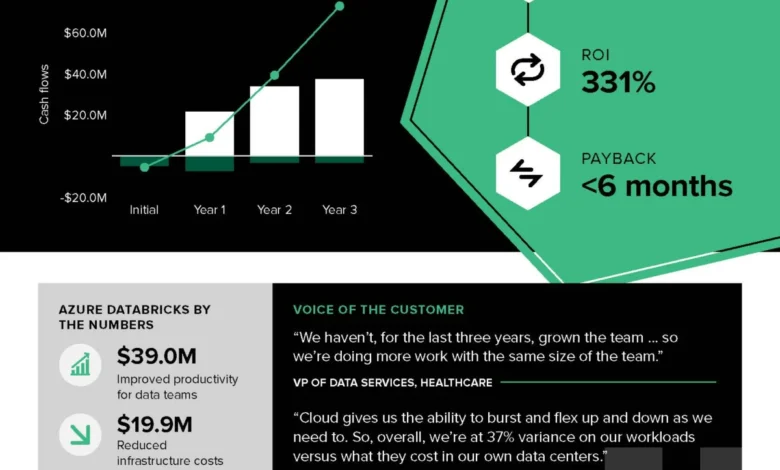
Microsoft Azure Databricks, the deeply integrated data and AI platform co-engineered by Microsoft and Databricks, is demonstrating significant and measurable business value for organizations, according to a comprehensive Total Economic Impact™ (TEI) study commissioned by Microsoft and conducted by Forrester Consulting. The findings, released in June 2026, indicate that a composite organization utilizing Azure Databricks achieved a remarkable 331% return on investment (ROI) over a three-year period, with a net present value (NPV) of $58.1 million and an impressive payback period of less than six months.
This study underscores the strategic advantage of a first-party integration between Databricks and the Azure cloud ecosystem. Unlike solutions that might be bolted on or require extensive custom integration, Azure Databricks is presented as a native Azure service. This native status allows for seamless incorporation into existing Microsoft tools, identity management systems, and governance frameworks that organizations already employ. The "built-in, not bolted on" philosophy, as described by Microsoft, signifies a unified engineering effort, a shared integration roadmap across Microsoft’s data and AI portfolio, and a consolidated go-to-market strategy. This alignment translates into a singular operational experience, a unified billing process, and a singular support channel for customers. For technical teams, this translates to deeper native integrations and enhanced performance. For the business, the implications are a reduction in costs, mitigation of risks, and an accelerated path to realizing tangible value from their data initiatives.
The strategic partnership between Microsoft and Databricks has been a driving force behind an accelerated integration roadmap and continuous optimization efforts aimed at improving performance. However, the crucial question for decision-makers has consistently been about the quantifiable business value derived from these advancements. The Forrester TEI study was specifically designed to address this critical inquiry.
The Core Findings of the Forrester Total Economic Impact™ Study
Forrester Consulting engaged with existing Azure Databricks customers to construct a composite organization for the purpose of modeling the platform’s economic impact. This composite entity was characterized as a $6 billion company operating within a regulated industry, managing approximately 10 petabytes of data.
Prior to adopting Azure Databricks, this hypothetical organization’s data landscape was described as fragmented, costly to maintain, unreliable at scale, and difficult to govern effectively. The implementation of Azure Databricks yielded transformative results. Over a three-year period, the composite organization realized $75.6 million in quantified benefits, against an investment of $17.5 million, culminating in a net present value of $58.1 million.
The study identified four primary areas where this substantial value was generated:
- Productivity Gains: This category encompasses improvements in efficiency for data engineers, data scientists, and business analysts. Streamlined workflows, automated tasks, and easier access to data empower these professionals to complete projects faster and more effectively.
- Cost Savings: Reductions in infrastructure costs, operational expenses, and the elimination of redundant tooling contribute significantly to the overall financial benefits. The native integration of Azure Databricks within the Azure ecosystem often leads to optimized resource utilization and a simplified IT management overhead.
- Revenue Enhancement: By enabling faster access to insights and facilitating more sophisticated data-driven decision-making, Azure Databricks can directly contribute to increased revenue streams through improved product development, targeted marketing, and enhanced customer experiences.
- Risk Mitigation: Enhanced data governance, improved compliance capabilities, and greater data security contribute to reducing financial and reputational risks. In regulated industries, this aspect can be particularly critical.
Beyond the financially quantified benefits, Forrester also highlighted several other advantages that, while not directly priced in the study, are critical to the platform’s value proposition. These include the deep native integration with other Azure services, the accelerated time-to-insight, broader access to data for a wider range of users, and robust governance facilitated by Unity Catalog. These elements are seen as foundational to the overall return experienced by organizations.
Unpacking the Sources of Value: The Power of First-Party Integration
The substantial returns documented in the Forrester study are intrinsically linked to Azure Databricks’ identity as a true first-party Azure service. The co-engineering efforts between Microsoft and Databricks ensure that the platform is not merely compatible with Azure but is deeply embedded within its infrastructure and services. This deep integration effectively eliminates many of the common pain points associated with data platforms, such as the need for additional data copies, the procurement and management of disparate tooling, and the significant effort required for custom integrations. These factors often inflate costs and slow down project timelines in other environments.
A compelling illustration of this integrated value is the synergy between Azure Databricks Genie and Microsoft Copilot Cowork. This integration allows organizations to infuse their business context and leverage AI-driven intelligence directly within the familiar tools their teams already utilize. Azure Databricks Genie empowers individuals to query their lakehouse using natural language, and this capability has been extended to platforms like Microsoft Teams, Microsoft 365 Copilot, and most recently, Copilot Cowork. Within Copilot Cowork, Genie grounds tasks in trusted data through Genie Ontology. Crucially, every response is scoped by Unity Catalog, ensuring that users only access data they are permitted to see, thereby maintaining strong governance while enabling intelligent workflows. This seamless flow of information and intelligence directly into the user’s daily work is a significant driver of productivity and cost efficiency, even if not explicitly priced as a standalone benefit in the study.
The depth of this integration extends across the entire Azure Databricks platform and its surrounding Azure services. This includes:
- Azure Active Directory Integration: Seamless authentication and authorization, leveraging existing enterprise identity management.
- Azure Virtual Network Integration: Enhanced security and network control for data workloads.
- Azure Blob Storage and Azure Data Lake Storage Integration: Optimized data access and management for large-scale data lakes.
- Azure Synapse Analytics Integration: Enables hybrid analytical processing and unlocks advanced analytics capabilities.
- Azure Machine Learning Integration: Streamlined MLOps lifecycle management for AI models.
- Microsoft Power BI Integration: Accelerated insights and data visualization directly from the lakehouse.
- Azure Monitor and Azure Security Center Integration: Comprehensive monitoring, logging, and security posture management.
These integrations, while not always individually itemized in cost-benefit analyses, are fundamental to the productivity and cost efficiencies that were quantitatively assessed in the Forrester study. They represent the architectural advantages that translate into real-world financial gains.
Validation Through Independent Benchmarking
Beyond the economic impact study, the performance and efficiency of Azure Databricks have also been validated by independent third-party benchmarks. Principled Technologies, a reputable independent research firm, conducted a decision-support benchmark, akin to the industry-standard TPC-DS, on a 10-terabyte dataset. The results demonstrated a clear performance advantage for Azure Databricks. In a single query stream scenario, Azure Databricks completed queries up to 21.1% faster than Databricks on AWS (when autoscale was disabled). Furthermore, when running four concurrent query streams, Azure Databricks achieved results more than nine minutes faster than its competitor. This indicates that the platform’s architecture and optimization within the Azure environment contribute to superior speed and efficiency, which are critical factors in maintaining cost-effectiveness and delivering timely insights as data volumes and query complexity increase.
The Tangible Implications for Organizations
The decision to adopt a data and AI platform is a strategic, long-term commitment. For organizations considering their options, Azure Databricks presents a cohesive and reinforcing ecosystem. The deep integrations directly contribute to the cost savings quantified by Forrester, while the platform’s inherent performance capabilities ensure that these savings are sustained and scaled as data usage grows. This is all built upon the solid foundation of a first-party partnership, where both Microsoft and Databricks engineering, product roadmaps, and support structures are aligned behind the customer’s data estate.
The value proposition of Azure Databricks is not merely a marketing claim; it is a rigorously measured outcome. The demonstrated three-year ROI of 331% and a payback period of under six months provide a compelling financial case for its adoption. This strong economic performance, coupled with its robust technical capabilities and seamless integration into the Microsoft ecosystem, is why an increasing number of teams are choosing to build and manage their data and AI initiatives on Azure Databricks.
The implications for businesses are far-reaching. Organizations can expect to:
- Accelerate Innovation: By providing faster access to data and powerful analytical tools, Azure Databricks empowers teams to develop and deploy new data-driven products and services more rapidly.
- Optimize Operational Efficiency: Streamlined workflows, automated processes, and reduced IT overhead contribute to significant cost savings and allow IT departments to focus on strategic initiatives rather than routine maintenance.
- Enhance Decision-Making: Democratized access to reliable, governed data enables more informed and timely decision-making across all levels of an organization, leading to better business outcomes.
- Strengthen Governance and Security: The platform’s robust governance features, including Unity Catalog, ensure data security, compliance, and controlled access, mitigating risks inherent in complex data environments.
- Future-Proof their Data Strategy: As a first-party Azure service with a shared integration roadmap with Microsoft’s broader data and AI portfolio, Azure Databricks offers a pathway for continuous innovation and adaptation to evolving technological landscapes.
In conclusion, the Forrester Total Economic Impact™ study provides concrete evidence of the substantial business value that Microsoft Azure Databricks delivers. The combination of deep native integration, robust performance, and a strategic partnership between Microsoft and Databricks positions Azure Databricks as a leading platform for organizations looking to unlock the full potential of their data and drive significant, measurable business growth.
Explore Further: