Beyond the Connectome: Rethinking Artificial Memory Through the DOOMFLY Paradigm

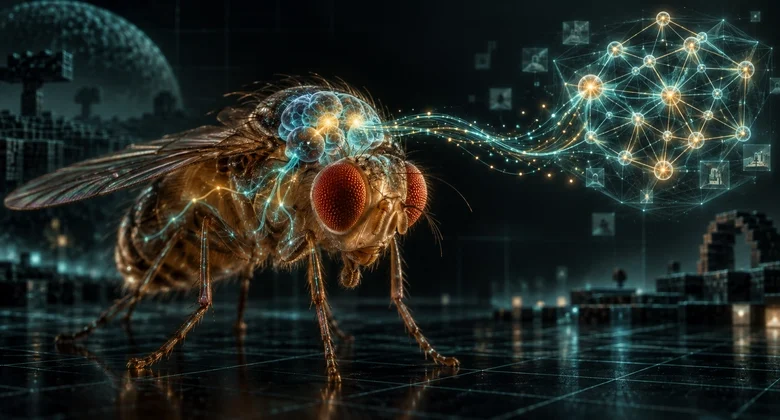
Google Research and its scientific collaborators have achieved a landmark milestone in computational biology by successfully mapping the entire nervous system of a male fruit fly (Drosophila melanogaster). This feat, which documents approximately 166,700 neurons and 125 million synaptic connections, represents the most complex neural circuit ever reconstructed. However, the academic achievement has quickly been eclipsed by a provocative experimental project known as DOOMFLY, which seeks to test the limits of simulated cognition by interfacing this biological blueprint with the vintage video game Doom.
While the experiment uses a digital model of the fly’s brain rather than a living specimen, the project highlights a critical philosophical and technical divide in how modern artificial intelligence handles memory. As researchers move toward more autonomous systems, the debate has shifted from how machines store data to how they experience "resonance"—a state where memory influences behavior without the explicit, mechanical retrieval processes currently defining LLM (Large Language Model) agents.
The Architecture of the Fly Brain
The mapping of the Drosophila connectome was not merely a feat of imaging; it was a triumph of electron microscopy and automated image segmentation. The project, often referred to as the FlyWire project, took years of international collaboration to complete. By capturing the precise location and connectivity of every neuron, researchers have provided a "wiring diagram" that serves as the foundation for the DOOMFLY project.
In this model, the "brain" is a dynamic software environment. It does not rely on the symbolic logic or structured queries typical of modern software. Instead, it operates on a feedback loop of sensory input, internal neural state, and motor activity. The DOOMFLY project strips away the "agentic" layers—the system prompts, the tool definitions, and the JSON-based memory searches—that characterize today’s AI, proposing instead that true memory should act as a subtle modulation of the nervous system.
The Problem with Modern AI Memory
Current AI architecture relies heavily on retrieval-augmented generation (RAG) or similar frameworks. When an LLM "remembers" something, it executes a function: it observes an event, saves it as a vector, and then queries that vector space when a similar prompt arises.

Critics of this approach argue that this is not memory, but rather a sophisticated database lookup. Human memory, by contrast, is involuntary and associative. An olfactory trigger can elicit a vivid, decades-old memory without a conscious "search" command being issued. The neural state is modulated by past experience, making certain reactions more likely or certain perceptions more vivid. The DOOMFLY project posits that if artificial systems are to achieve a form of "individuality," they must move away from the "search and retrieve" model and toward a "resonance" model.
Chronology of the Experiment
The development of the DOOMFLY initiative can be broken down into three distinct phases:
- The Mapping Phase (2020–2024): Google Research and the FlyWire Consortium complete the high-resolution mapping of the male fruit fly connectome. This provided the necessary dataset for neuro-computational modeling.
- The Integration Phase (Mid-2024): Developers began porting the connectome data into a simulation environment capable of executing game-state logic. This required translating biological firing patterns into actionable motor outputs within the Doom engine.
- The Resonance Testing Phase (Current): The current stage of the experiment involves isolating the "memory" layer from the "action" layer. Researchers are testing whether an external, persistent graph of memories—which never explicitly issues commands—can influence the fly’s survival rate in the game environment by modulating its neural thresholds.
Technical Implications of Resonance vs. Retrieval
The core hypothesis of the DOOMFLY experiment is that memory should function as a bias, not a command. If the memory system is programmed to "turn left," it ceases to be a memory and becomes a hard-coded script. Instead, the memory system in this experiment functions by adjusting the ease with which certain neural populations fire.
By observing the state of the game, the memory system alters the "current neural state" of the simulation. If the fly has previously encountered a specific obstacle, the memory system modulates the synaptic weights or firing thresholds. When that obstacle appears again, the network is already predisposed to a specific reaction. The brain itself produces the behavior, but the memory has shaped the terrain of possibility.
This approach introduces the concept of "behavioral identity." By resetting the brain but retaining the memory module, researchers can measure how much of the fly’s "personality"—its distinct tendencies and reaction patterns—persists across different instances of the same neural architecture.
Broader Scientific Impact
The implications for artificial general intelligence (AGI) are profound. If memory can be divorced from explicit query structures, machines might develop a more fluid, organic sense of continuity. This has implications for robotics, where constant, low-latency adaptation is required, as well as for the broader understanding of neuroscience.

"The goal is not to create consciousness," noted one project contributor, speaking on the condition of anonymity as the peer-reviewed results are finalized. "The goal is to quantify individuality. We want to know if we can transplant a ‘history’ into a ‘blank’ brain and see that brain adopt the habits of the previous one. If the behavioral identity is measurable, we have a concrete metric for what memory actually does in a system."
Official Responses and Academic Reception
While the mainstream scientific community has hailed the connectome map as a landmark achievement, the DOOMFLY experiment remains a subject of intense debate. Traditional computational neuroscientists warn that a "simulated" brain is not a brain, and that the translation of synaptic activity into game behavior involves significant assumptions about how Drosophila neurons actually process sensory information.
Furthermore, ethicists are observing the project with interest, noting that as we get closer to replicating the dynamics of a biological nervous system, the lines between "simulation" and "artificial life" begin to blur. While the current model is limited in scope, the move toward "resonance-based" memory could provide a blueprint for creating agents that are more adaptive and less reliant on external, developer-defined prompts.
Future Outlook
The second part of the DOOMFLY initiative is expected to release the underlying codebase, control parameters, and quantitative data. This will allow the research community to verify the hypothesis that memory can function as a purely internal modulator.
As artificial intelligence continues to evolve, the distinction between "smart software" and "autonomous entity" will likely rely on these deeper questions of memory and state. If DOOMFLY proves that a system can learn, retain, and exhibit individuality through passive resonance rather than active retrieval, it may force a total redesign of how we build memory into the next generation of AI agents. The experiment serves as a reminder that the most efficient memory systems in nature do not query a database—they simply remember by being.