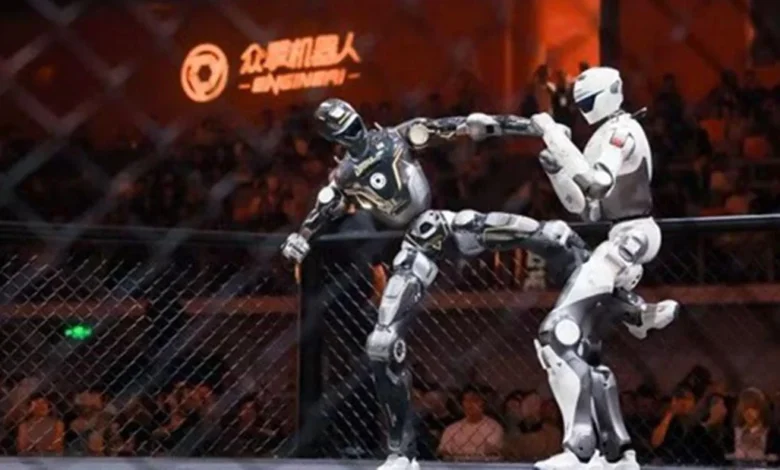
A decade ago, the exhilarating spectacle of human-controlled fighting robots clashing in a ring was largely confined to the silver screen, epitomized by the 2011 Hollywood blockbuster Real Steel. That cinematic vision, where actor Hugh Jackman navigated the intricacies of robot pugilism, has now transitioned from imaginative narrative to tangible reality in Shenzhen, China. On Thursday evening last week, the Shenzhen Nanshan Cultural and Sports Center became the stage for the inaugural Ultimate Robot Knock-out Legend (URKL) event, a groundbreaking competition that has irrevocably altered the landscape of robotics and sports entertainment. This marks a significant milestone, precisely 15 years after Real Steel first ignited the public imagination, demonstrating a remarkable acceleration in technological prowess and commercial ambition.
The URKL, spearheaded by EngineAI, a pioneering robotics firm based in Shenzhen, represents the zenith of humanoid robot combat. This isn’t merely a demonstration; it’s a full-fledged, no-holds-barred competition designed to push the boundaries of robotic engineering and performance. The opening skirmish of the URKL tournament pitted the sleek, white humanoid robot, White Eagle, against its formidable black counterpart, Matador. The atmosphere was electric, punctuated by the roars and cheers of an enthralled audience as the two mechanical titans exchanged blows. The intensity of the bout culminated in a dramatic fashion, with White Eagle emerging victorious after decisively severing Matador’s head – a spectacle that left no doubt about the high-stakes, high-impact nature of these futuristic contests.
All robots participating in the URKL are standardized, utilizing EngineAI’s advanced T800 model. Standing at an imposing 1.73 meters (approximately 5 feet 8 inches), these humanoid machines are engineered for dynamic combat. Their capabilities extend far beyond simple movements, encompassing complex actions such as powerful uppercuts, agile spin kicks, and critically, the ability to self-recover and rise after being knocked down. EngineAI proudly asserts that its T800 robots incorporate sophisticated posture control systems, dynamic perception capabilities, and advanced impact absorption mechanisms, all crucial for sustaining and delivering high-intensity combat. These features are not just impressive feats of engineering; they are vital components that enable the robots to mimic human-like agility and resilience in the face of brutal physical engagement.
The significance of the event was underscored by the presence and enthusiastic remarks of renowned actor Donnie Yen, celebrated globally for his mastery of martial arts in films like Ip Man. Yen, delivering a keynote speech, articulated the awe felt by many: "Today is the first time I have watched real robots fight. Witnessing this historic breakthrough firsthand truly feels different. The precision of the machines and their movements are extraordinary." His words resonate with the sentiment that this is more than just a competition; it is a historical moment where humanity’s technological aspirations are vividly brought to life.
Zhao Tongyang, CEO of EngineAI, articulated the company’s ambitious vision for the URKL. The primary objective, he stated, is to commercially promote robot fighting events, thereby creating a robust platform that actively supports and accelerates robotics research and industrialization. "We want to use this competition to drive research and development within the industry. This event provides input for technology, and technology will then drive the industry," Tongyang explained. This statement encapsulates a strategic feedback loop: the demands of competitive robot combat compel innovations in AI, mechanics, and materials science, which in turn fuel broader advancements and commercial applications across the robotics sector. This symbiotic relationship positions URKL not merely as entertainment, but as a critical incubator for future technological breakthroughs.
The inaugural URKL tournament has attracted 32 teams from across the globe, all competing with the standardized T800 robots, ensuring a level playing field where strategic programming and operational skill are paramount. The robots are judged across four critical categories: effective attack, body stability, defense and evasion capabilities, and overall durability. This comprehensive scoring system evaluates not just brute force, but also the finesse, resilience, and strategic intelligence programmed into each combatant, fostering a holistic approach to robotic design and performance optimization.
The Genesis of Humanoid Robot Combat: From Fiction to Engineering Challenge
While the concept of fighting robots has been a staple of science fiction for decades, the journey to real-world humanoid combat has been fraught with complex engineering challenges. Unlike the destructive vehicular combat seen in popular shows like BattleBots or Robot Wars, which often focus on weaponized chassis and armor, humanoid robot fighting requires a far more intricate balance of agility, stability, and intelligent locomotion. The bipedal nature of the T800, its ability to stand, balance, move dynamically, and recover from falls, represents a monumental leap in robotics. Engineers must contend with issues such as real-time balance control, sophisticated inverse kinematics for fluid motion, durable yet lightweight materials, and powerful actuators capable of generating combat-level forces, all while managing power consumption and heat dissipation.
The inspiration from Real Steel is undeniable, yet the real-world implementation necessitates overcoming physics and material limitations that Hollywood special effects can bypass. The T800’s claimed "posture control, dynamic perception, and impact absorption" features are crucial for replicating the dynamic, reactive combat seen in films. Posture control relies on advanced sensor fusion (gyroscopes, accelerometers, force sensors) and real-time feedback loops to maintain balance. Dynamic perception allows the robot to "see" and react to its opponent’s movements and environmental changes, often employing LiDAR, cameras, and proximity sensors coupled with AI algorithms for threat assessment and target acquisition. Impact absorption, meanwhile, requires innovative material science and mechanical design, possibly incorporating compliant elements or specialized dampeners to protect internal components from repeated concussive forces.
EngineAI’s Vision and Shenzhen’s Role in Global Robotics
EngineAI’s decision to host URKL in Shenzhen is no coincidence. Shenzhen, often dubbed China’s "Silicon Valley," is a global epicenter for hardware innovation, manufacturing, and technological development. Its ecosystem supports rapid prototyping, access to skilled labor, and a dense network of suppliers and collaborators. This environment provides EngineAI with a fertile ground to not only develop advanced robots like the T800 but also to quickly iterate and scale its operations. The city’s aggressive push for technological advancement, backed by significant government investment and policy support, aligns perfectly with EngineAI’s mission to commercialize robot sports and drive industrial growth.
CEO Zhao Tongyang’s strategy of using competitive events to fuel R&D reflects a common paradigm in high-tech industries, akin to how motorsports drive automotive innovation or space races accelerate aerospace technology. The intense demands of robot combat—requiring robust design, precise control, adaptive AI, and resilient materials—will naturally push the boundaries of current robotics technology. Each match becomes a real-world testbed, generating invaluable data on robot performance, failure points, and areas for improvement, which can then be fed back into the design and engineering process. This iterative cycle is vital for rapid technological maturation.
China’s Ascendancy in Robotics and AI
The URKL event is a microcosm of China’s broader national strategy to become a global leader in artificial intelligence and robotics. Initiatives such as "Made in China 2025" and the "Next Generation Artificial Intelligence Development Plan" explicitly outline ambitions to dominate key high-tech sectors, including advanced robotics. The government has poured billions into research and development, fostering a vibrant ecosystem of startups, universities, and research institutions dedicated to AI and robotics.
According to market research, the global robotics market is projected to grow significantly, with estimates placing its value well into the hundreds of billions of dollars by the end of the decade. China is not just a consumer but a major producer and innovator in this space. Its vast manufacturing capabilities, combined with a rapidly expanding pool of highly skilled engineers and researchers, position it uniquely to drive the next wave of robotic innovation. Humanoid robotics, in particular, represents a frontier with immense potential, not only for entertainment but also for applications in logistics, healthcare, hazardous environments, and even domestic assistance. The T800 and the URKL demonstrate China’s commitment to pushing these boundaries, showcasing its capabilities on a global stage.
Broader Implications and Future Trajectories
The Ultimate Robot Knock-out Legend holds profound implications across several sectors:
-
Catalyst for Robotics R&D: The immediate and most direct impact is on research and development. The highly competitive nature of URKL will inevitably drive innovations in areas critical for advanced robotics:
- Dynamic Balance and Locomotion: Developing algorithms and hardware that allow robots to maintain balance during complex maneuvers and impacts, and to recover quickly from falls.
- Advanced AI for Combat Strategy: Programming robots to perceive opponents, predict moves, and execute adaptive strategies in real-time.
- Materials Science: Creating lighter, stronger, and more shock-absorbent materials for robot construction.
- Actuator Technology: Designing more powerful, efficient, and precise motors and joints.
- Human-Robot Interaction: Improving control interfaces for human operators, making them more intuitive and responsive.
-
Emergence of a New Entertainment Frontier: Robot combat has the potential to evolve into a globally recognized sport, akin to esports. The visual drama, the technological marvel, and the competitive narrative are highly appealing. Future developments could include:
- Global Leagues and Tournaments: Establishing an international circuit with professional teams and significant prize pools.
- Enhanced Fan Engagement: Utilizing augmented reality (AR) and virtual reality (VR) to provide immersive spectator experiences, allowing viewers to see robot telemetry, internal damage, or even view fights from the robot’s perspective.
- Media Rights and Sponsorships: Attracting major broadcasting deals and corporate sponsorships, further legitimizing the sport.
- Gambling Markets: The competitive nature could also lead to regulated betting markets, adding another layer of engagement.
-
Educational Impact and STEM Inspiration: Events like URKL are powerful tools for inspiring the next generation of engineers, scientists, and programmers. Witnessing sophisticated robots in action can ignite interest in STEM fields, encouraging students to pursue careers in robotics, AI, and related disciplines. Universities and schools might integrate robot combat challenges into their curricula, fostering practical skills and innovative thinking.
-
Economic Impact: The commercialization of robot sports could create a new industry vertical, generating jobs in robotics design, manufacturing, event management, media production, and support services. It will also attract significant investment capital, driving economic growth in associated sectors.
-
Societal Acceptance and Familiarity with Robotics: As robots become more commonplace in entertainment, public familiarity and acceptance of advanced robotics in daily life will likely increase. This can help bridge the gap between public perception and the reality of robotic capabilities, fostering a more informed discourse about their role in society. While the T800 is a combat robot, the underlying technologies for balance, perception, and control are transferable to service robots, industrial robots, and even prosthetics, paving the way for broader integration of intelligent machines into human society.
Stakeholder Perspectives and the Spectator Experience
Donnie Yen’s reaction underscores a fundamental aspect of the URKL’s appeal: the sheer wonder of seeing advanced robotics perform in a dynamic, unpredictable environment. His awe at the "precision of the machines and movements" highlights the technical artistry involved. For robotics engineers, URKL offers a unique platform to test their creations under extreme conditions, providing invaluable data and pushing the boundaries of what’s currently achievable. Investors, observing the burgeoning interest and commercial potential, are likely to view EngineAI and the broader robot sports sector as a promising new frontier.
For the general public, the URKL provides a thrilling, visceral experience. The drama of the White Eagle vs. Matador bout, culminating in a decisive "knock-out" via decapitation, speaks to a primal fascination with competition and technological prowess. This is not just a demonstration of technology; it’s a genuine contest with winners and losers, moments of triumph and defeat, and an unfolding narrative that captivates audiences. The immediate and clear outcome of a robot being incapacitated adds a layer of unambiguous excitement that resonates deeply with sports enthusiasts.
In conclusion, the Ultimate Robot Knock-out Legend in Shenzhen stands as a landmark event, seamlessly blending the futuristic visions of science fiction with the cutting-edge realities of contemporary robotics. EngineAI, through the URKL and its advanced T800 robots, is not just launching a new form of entertainment; it is actively shaping the future of robotics R&D, commercialization, and public engagement. This initiative firmly positions China at the vanguard of a new technological and entertainment frontier, demonstrating how competitive platforms can serve as powerful engines for innovation, inspiring a new generation to explore the boundless possibilities of artificial intelligence and advanced robotics. The era of humanoid robot combat has officially begun, promising a future where the lines between imagination and reality continue to blur, driven by ingenuity and competitive spirit.