Microsoft Azure Databricks Delivers Unprecedented Value, According to Independent Forrester Study

Microsoft Azure Databricks, the native integration of the Databricks Lakehouse Platform within the Microsoft Azure ecosystem, is delivering significant, measurable business value, according to a recent Total Economic Impact™ (TEI) study commissioned by Microsoft and conducted by Forrester Consulting. The report quantifies the substantial return on investment (ROI) and financial benefits realized by organizations leveraging Azure Databricks, highlighting its seamless integration, enhanced performance, and robust governance capabilities.
The core advantage of Azure Databricks lies in its status as a first-party Azure service. This "built-in, not bolted on" approach means that Databricks is deeply co-engineered with Microsoft, sharing a unified integration roadmap across Microsoft’s comprehensive data and AI stack. This strategic alignment translates into a streamlined experience for customers, offering a single point of contact for go-to-market strategies, billing, and support. For technical teams, this translates to deeper native integration and optimized performance. For the business, it signifies reduced costs, mitigated risk, and accelerated time-to-value for data initiatives.
The strategic partnership between Microsoft and Databricks has fostered an accelerated integration roadmap and continuous optimization for enhanced performance. However, decision-makers consistently seek concrete evidence of the business value derived from these advancements. To address this critical question, Microsoft commissioned the Forrester TEI study, which specifically examined the economic impact of Azure Databricks.
Forrester Study Reveals Astonishing Returns for Azure Databricks Users
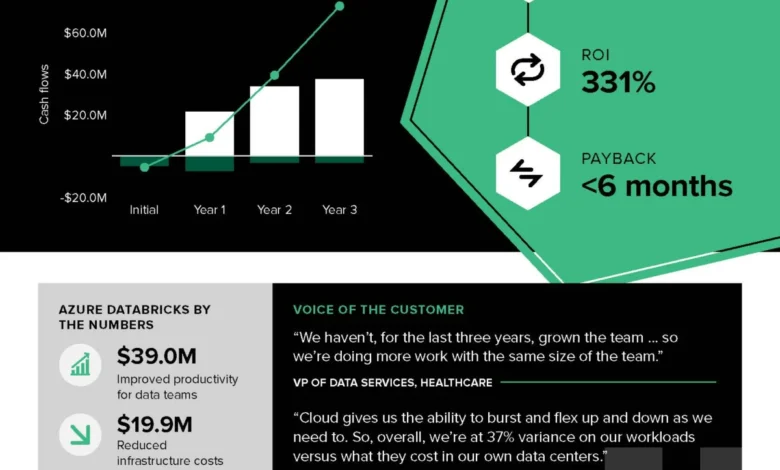
The findings of the Forrester TEI study are striking. A composite organization, representative of interviewed customers, achieved a remarkable three-year ROI of 331%. This translated into a net present value (NPV) of $58.1 million, with the initial investment being recovered in less than six months. The study’s key metrics underscore the platform’s potent financial impact:
- 331% Return on Investment (ROI) over three years.
- $58.1 million in Net Present Value (NPV) over three years.
- Payback Period of less than six months.
These figures are based on a commissioned study conducted by Forrester Consulting on behalf of Microsoft in June 2026. The results represent a three-year projection for a composite organization derived from interviewed customers and may not be typical, with actual results expected to vary.
Deep Dive into the Study’s Methodology and Findings
Forrester Consulting interviewed several Azure Databricks customers to construct a composite organization for modeling the impact. This representative entity was described as a $6 billion company operating within a regulated industry, managing approximately 10 petabytes of data.
Prior to adopting Azure Databricks, this composite organization’s data estate was characterized by fragmentation, high costs, unreliability at scale, and significant governance challenges. The implementation of Azure Databricks led to a dramatic transformation, generating an estimated $75.6 million in benefits against $17.5 million in costs over the three-year period, culminating in the aforementioned $58.1 million NPV.
The study identified four primary sources of value that contributed to these impressive financial outcomes:
- Increased Revenue from New Products and Services: By enabling faster data analysis and the development of data-driven products, Azure Databricks empowered the composite organization to accelerate innovation and capitalize on new market opportunities, leading to an estimated $32.3 million in new revenue.
- Reduced Operational Costs: Streamlining data processing, eliminating redundant infrastructure, and optimizing resource utilization led to significant cost savings. The study estimated $25.3 million in reduced operational expenses over three years.
- Enhanced Operational Efficiency: Improved productivity for data teams through better tooling, automation, and collaboration contributed to substantial efficiency gains, valued at $13.5 million.
- Reduced IT Infrastructure Costs: Consolidating data management on a single, scalable platform, and leveraging Azure’s native capabilities, resulted in an estimated $4.5 million in savings on IT infrastructure.
Beyond these quantifiable benefits, Forrester also highlighted several significant advantages that were not directly priced but are critical to the overall value proposition. These include the native integration with other Azure services, the acceleration of insight generation, broadened access to data across the organization, and robust data governance facilitated by Unity Catalog. These qualitative benefits lay the groundwork for the tangible returns that were quantified in the study.
The Genesis of Value: Seamless Integration and Native Azure Service
The substantial returns identified in the Forrester study can be attributed to a singular, overarching factor: Azure Databricks’ position as a true first-party Azure service. Its co-engineered nature by Microsoft and Databricks ensures seamless integration with the tools and workflows that data teams already utilize. This eliminates the costly and time-consuming overhead associated with managing extra data copies, disparate tooling, and complex integration efforts that are often encountered with other solutions.
A prime example of this deep integration is the Azure Databricks Genie functionality, which seamlessly connects with Microsoft Copilot for Microsoft 365. This integration allows organizations to inject their unique business context and build upon existing intelligence directly within the familiar tools their teams use daily. Genie empowers any user to query the lakehouse using natural language. This capability is now accessible within Microsoft Teams, Microsoft 365 Copilot, and the more recently announced Copilot Cowork. In these environments, Genie grounds tasks in trusted data through Genie Ontology, ensuring that every answer is precisely scoped by Unity Catalog according to user permissions. This ensures that valuable intelligence flows into daily workflows without compromising data governance.
This depth of integration extends across the entire Azure Databricks platform, fostering a cohesive and efficient data ecosystem. Forrester acknowledged these integrations as critical drivers of productivity and cost benefits, even if they were not individually priced.
Performance Prowess: Validated by Independent Benchmarks
Beyond the economic benefits, the performance of Azure Databricks has also been rigorously tested and validated. Independent research firm Principled Technologies conducted an industry-standard decision-support benchmark, similar to TPC-DS, on a 10-terabyte dataset. The results demonstrated Azure Databricks’ superior performance compared to Databricks on AWS.
In the benchmark tests, Azure Databricks completed a single query stream up to 21.1% faster than its AWS counterpart (when autoscale was disabled). Furthermore, it ran four concurrent query streams more than nine minutes faster, showcasing its ability to handle complex workloads with remarkable efficiency and speed. This performance advantage is crucial for organizations that rely on timely insights to drive critical business decisions.
Implications for Businesses: A Strategic Decision for Long-Term Success
The decision of which data and AI platform to adopt is a strategic one with long-term implications. Azure Databricks offers a compelling proposition where its various components work in synergy to reinforce each other. The deep integrations directly contribute to the cost savings quantified by Forrester. The platform’s robust performance ensures that these gains are sustained and scalable as data volumes and usage grow.
Crucially, all of these benefits are built upon a unified foundation: a first-party partnership that guarantees the combined engineering expertise, roadmap alignment, and support of both Microsoft and Databricks. This ensures that organizations have a reliable and future-proof platform for their data estate. The measured ROI of 331% with a payback period of under six months is not merely a marketing claim; it is a testament to the tangible value that Azure Databricks delivers. This compelling economic case is a significant reason why numerous teams are choosing to anchor their lakehouse strategies on Azure Databricks.
The study serves as a powerful endorsement for organizations looking to modernize their data infrastructure, accelerate their AI initiatives, and unlock significant business value. By consolidating data management, enhancing analytics capabilities, and fostering seamless integration with existing Microsoft tools, Azure Databricks empowers businesses to not only keep pace with the evolving data landscape but to lead within it. The clear financial returns and operational efficiencies highlighted by the Forrester TEI study provide a strong foundation for strategic investment decisions in the realm of data and artificial intelligence.
Exploring the Azure Databricks Ecosystem Further
Organizations interested in understanding the full scope of Azure Databricks’ capabilities and its impact on their specific business needs can explore a wealth of resources. This includes delving into the detailed findings of the Forrester Total Economic Impact™ study, which offers a comprehensive breakdown of the methodology, assumptions, and results. Further exploration into the specific integrations, such as Azure Databricks Genie and its synergy with Microsoft Copilot, can illuminate how natural language querying and AI-powered insights can be embedded into daily workflows. Examining the technical benchmarks and performance comparisons provides objective data on the platform’s speed and efficiency. Additionally, understanding the governance features, particularly Unity Catalog, is crucial for organizations operating in regulated industries or those with strict data access requirements. These resources collectively paint a complete picture of why Azure Databricks is emerging as a dominant force in the data and AI landscape, offering a clear path to innovation, efficiency, and substantial financial returns.