React Native 0.86 Debuts with Enhanced Android 15 Support and Transition to the Independent React Foundation

The React Native development team has officially announced the release of version 0.86, a milestone update that emphasizes platform modernization and structural governance shifts. This latest iteration arrives with comprehensive support for Android 15’s edge-to-edge display requirements, significant enhancements to the developer toolset, and a landmark transition of the framework’s source code to a new organizational home under the React Foundation. Marking the second release since version 0.83 to feature no user-facing breaking changes, React Native 0.86 reinforces a strategic pivot toward stability and predictable upgrade cycles for the global mobile development community.
The Migration to the React Foundation
Perhaps the most significant structural change accompanying the 0.86 release is the relocation of the React Native repository. Previously housed under the "facebook" GitHub organization, the repository—along with associated projects such as React, Metro, Yoga, and the React Native website—has officially moved to the "react" organization. This migration is more than a simple administrative change; it represents the framework’s formal transition to the React Foundation.
The React Foundation is an independent entity established to provide long-term stewardship of the React ecosystem. By moving away from a corporate-branded repository, the project signals its evolution into a community-led, neutral infrastructure. This move is designed to foster a more inclusive environment for contributors and corporate partners alike, ensuring that the framework’s future is dictated by collective ecosystem needs rather than the priorities of a single entity.
While the change is philosophically significant, the transition has been engineered for minimal friction. GitHub has implemented automatic redirects for all existing URLs, issues, and pull requests. Developers and maintainers do not need to update their remote configurations immediately, though new clones and references are encouraged to use the updated "react" organization paths.
Navigating Android 15’s Edge-to-Edge Mandate
From a technical standpoint, the centerpiece of React Native 0.86 is its robust handling of Android 15’s "edge-to-edge" display mode. With the release of Android 15, Google has increasingly enforced a layout where applications utilize the entire screen real estate, including the areas behind the status bar and navigation bar. This shift aims to provide a more immersive user experience but presents significant challenges for developers whose layouts may be obscured by system interface elements.
React Native 0.86 introduces comprehensive fixes to ensure apps behave correctly on Android 15+, even in scenarios where the edge-to-edge mode is enforced by the operating system rather than explicitly enabled by the developer via Gradle properties. The update addresses several critical edge-to-edge issues, including the management of the edgeToEdgeEnabled property. These fixes ensure that the framework’s internal layout engine correctly calculates safe areas, preventing UI components from being clipped or overlapping with system icons.
This focus on Android 15 compatibility is a proactive response to the fragmentation of the Android ecosystem. By baking these fixes into the core of 0.86, the React Native team is shielding developers from the complexities of OS-level display changes, allowing them to maintain visual consistency across a wide array of devices without manual, platform-specific overrides.
Enhancing the Developer Experience: DevTools and Emulation
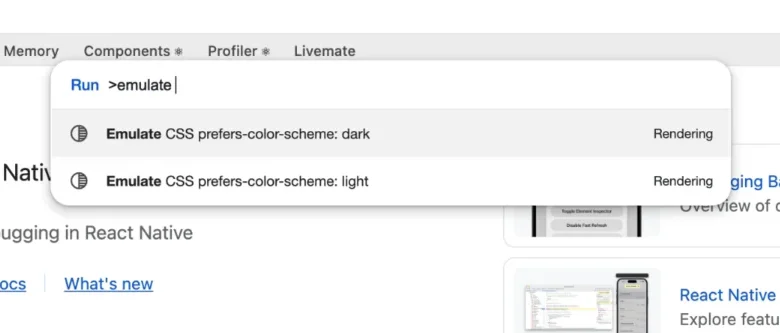
In addition to platform-specific updates, React Native 0.86 introduces significant improvements to its debugging suite. The React Native DevTools now support light and dark mode emulation through the Emulation.setEmulatedMedia command. This feature addresses a common pain point in mobile development: the need to manually toggle system-wide settings on a physical device or emulator to test appearance-based logic.
By utilizing the Command Palette (accessible via cmd/ctrl + shift + P), developers can now trigger a temporary switch in the app’s color scheme directly from the DevTools interface. This emulation mirrors the functionality found in modern web browser inspectors, allowing for rapid iteration of themed styles. The switch is designed to be non-persistent, resetting automatically once the DevTools session is disconnected, which prevents accidental configuration changes during standard testing.
A Philosophy of Stability: The "Zero Breaking Changes" Milestone
A recurring theme in recent React Native releases is the commitment to a seamless upgrade path. Following the precedent set by version 0.83, version 0.86 contains no user-facing breaking changes. This reflects a matured release philosophy where the core team prioritizes the "upgradeability" of the framework.
For organizations managing large-scale codebases, the absence of breaking changes significantly reduces the cost and risk associated with staying current. Developers currently running version 0.85 are expected to be able to migrate to 0.86 without modifying their application code. This predictability is crucial for enterprise-level adoption, where long-term maintenance and stability often outweigh the demand for radical new experimental features.

The team has also clarified its versioning policy, distinguishing between internal architectural shifts—such as the ongoing rollout of the "New Architecture"—and the public APIs that developers interact with daily. While internal refactors continue, the public surface area remains stable.
Technical Deep Dive: JSI and Web Spec Alignment
Under the hood, React Native 0.86 continues to refine its underlying architecture. The release includes several updates aimed at aligning the framework’s runtime more closely with Web specifications. This alignment is vital for developers who utilize React Native for cross-platform projects (such as React Native Web), as it ensures that JavaScript behavior remains consistent whether the code is running in a browser or a native mobile environment.
Furthermore, the JavaScript Interface (JSI) has received several new APIs. JSI is the C++-based interface that allows the JavaScript engine to communicate directly with native modules without the need for a serialized "bridge." The new APIs added in 0.86 make this interface more capable, providing native module authors with more granular control over memory management and data transfer. These improvements are part of a broader effort to optimize performance and reduce the overhead of cross-language communication in the New Architecture.
Other notable technical changes in this release include:
- Rendering and Layout: Refinements to the Yoga layout engine to improve the speed and accuracy of flexbox calculations.
- Accessibility: Enhanced support for screen readers and accessibility labels, ensuring that apps built with 0.86 meet modern inclusivity standards.
- Android Networking: Improvements to how the framework handles network requests on Android, including better integration with standard system libraries to prevent memory leaks and improve request reliability.
Community Contribution and Project Chronology
The development of React Native 0.86 was a massive collaborative effort. The release comprises over 596 commits from 97 individual contributors. This high level of community involvement underscores the health of the ecosystem following its transition to the React Foundation. The core team highlighted several community members who provided significant contributions, particularly in the areas of Android display logic and C++ infrastructure.
In the context of the framework’s history, 0.86 arrives at a pivotal time. The project has spent the last several years transitioning from the legacy "Bridge" architecture to the "New Architecture" (comprising TurboModules and Fabric). As this transition nears completion, the focus has shifted from rebuilding the foundation to refining the developer experience and ensuring compatibility with the latest mobile operating systems.
Impact on the Ecosystem and Future Outlook
The release of React Native 0.86 is expected to have a stabilizing effect on the mobile development landscape. By providing a clear, breaking-change-free path to Android 15 support, the React Native team is helping developers stay ahead of Google’s Play Store requirements without the typical "upgrade fatigue" associated with major framework versions.
For the broader ecosystem, the move to the React Foundation is a signal of maturity. It places React Native on a similar footing to other major open-source projects managed by foundations, such as those under the Linux Foundation or the Apache Software Foundation. This structural independence is likely to attract further investment from diverse tech companies who may have been hesitant to contribute to a project so closely tied to a single corporate competitor.
Upgrading and Availability
The React Native team recommends that all developers currently on versions 0.83, 0.84, or 0.85 begin the transition to 0.86. To facilitate this, the "React Native Upgrade Helper" remains the primary tool for identifying the specific configuration and dependency changes required between versions.
With the launch of 0.86, version 0.83 has officially moved to an "unsupported" status, in line with the project’s support policy which generally covers the latest three stable releases. For developers utilizing the Expo ecosystem, React Native 0.86 will be available through the expo@canary release channel, with a stable integration expected in the next major Expo SDK release.
New projects can be initialized using the latest CLI command:
npx @react-native-community/cli@latest init MyProject --version latest
As the mobile industry moves toward more immersive, edge-to-edge experiences and more robust cross-platform standards, React Native 0.86 positions itself as a reliable, modern, and community-governed tool for the next generation of mobile application development.