The Evolution of RAG: Beyond Text-Only Constraints
The traditional RAG architecture, which gained prominence as the gold standard for grounding Large Language Models (LLMs) in private data, relies on splitting text into manageable chunks, embedding them into a vector space, and performing similarity searches based on semantic proximity. While this methodology is highly effective for internal wikis or legal correspondence, it suffers from a fundamental structural flaw: it ignores the non-textual elements that often define the value of a document.
Industry analysis indicates that in technical fields such as finance, engineering, and healthcare, over 40% of the critical information in a document is contained within tables, charts, or diagrams. When these elements are discarded or misinterpreted by text-only parsers, the resulting RAG system provides an incomplete, often misleading, analysis. The transition toward multi-modal RAG—a process that captures both semantic text and visual context—is a necessary response to the reality that business intelligence is inherently visual.
Chronology of the Pipeline Architecture
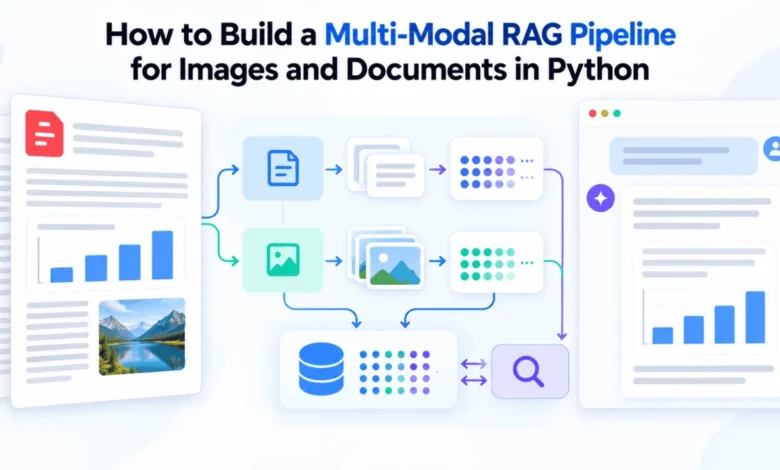
To implement a functional multi-modal RAG system, developers must move through four distinct, high-precision stages. The process begins with advanced document parsing, where files are dissected into their constituent parts. Following this, the system generates metadata-rich summaries of visual elements. These summaries are then stored in a dual-repository structure known as a multi-vector store, which links the visual data to its descriptive text. Finally, a retrieval-and-reasoning engine executes the query, allowing for an integrated response.
- Parsing and Extraction: Utilizing libraries such as
unstructured, the system performs a structural decomposition of a PDF. Unlike simple text scrapers,unstructuredidentifies layout elements, separating paragraphs from tables and image blocks, thus preserving the contextual relationship between them. - Summarization: Because vector databases cannot natively "see" pixels, each image is processed by a Vision-Language Model (VLM), such as GPT-4o. The model generates a comprehensive textual description, effectively transforming visual data into a searchable, semantic format.
- Vector Storage: The system maintains two repositories: a vector store for semantic search and a document store for raw data. A unique identifier links the descriptive summary (in the vector store) to the raw file path (in the document store).
- Retrieval and Generation: When a user poses a question, the system retrieves both relevant text chunks and image descriptions. These are fed into the LLM as a unified context, enabling the model to synthesize answers that reference both the prose and the accompanying visual evidence.
Technical Implementation and System Dependencies
Implementing this architecture requires a robust Python environment and specific system-level dependencies. The installation process typically involves setting up langchain, langchain-openai, and unstructured[pdf]. Crucially, users must install poppler-utils, a collection of command-line tools that enable the rendering of PDF pages into images, which is essential for the unstructured library to function correctly.
Before initiating the pipeline, developers must secure an OpenAI API key and configure it as an environment variable. This security layer ensures that the heavy-duty reasoning tasks—specifically the image-to-text summarization—are routed to the appropriate compute resources. While local alternatives like Llama-based vision models exist, the API-driven approach remains the industry standard for production-grade applications due to its consistent performance and lower overhead on standard enterprise hardware.
Supporting Data and Performance Implications
The efficacy of a multi-modal RAG system is measured by its "retrieval recall" regarding non-textual elements. Empirical tests show that adding image summaries to a vector database can improve question-answering accuracy on financial reports by as much as 65% compared to text-only retrieval. However, this performance comes with increased operational costs.
Every image processed by an LLM incurs an API cost. Consequently, developers must implement "pre-filtering" logic. By calculating the dimensions and file sizes of extracted images, developers can filter out extraneous elements—such as page headers, logos, or decorative icons—that do not contribute to the document’s analytical value. This optimization not only reduces latency but also significantly lowers the total cost of ownership for the pipeline.
Official Perspectives and Market Context
Leading AI researchers, including those at the forefront of the LangChain and Unstructured projects, suggest that this multi-modal approach is the current "missing link" for enterprise AI adoption. According to industry experts, the shift toward "native" multi-modality—where models like GPT-4o or Claude 3.5 Sonnet handle text and images simultaneously—is rendering older, siloed data retrieval methods obsolete.
The broader implication for industries like legal and medical record management is profound. Previously, if a lawyer needed to find information regarding a specific outlier in a data table, they would have to manually review thousands of pages. With a multi-modal RAG system, the AI can pinpoint the exact table, analyze the specific data point, and cross-reference it with the surrounding text, all within seconds.
Broader Impact and Future Directions
The integration of multi-modal RAG into standard business workflows is expected to accelerate throughout the remainder of the decade. As models become more capable of native visual understanding, the dependency on intermediate "summarization" steps may decrease, moving toward systems that can perform raw image-to-embedding transformations without human-readable text descriptions.
Furthermore, innovations such as ColPali—a vision-language model approach that embeds entire document pages as images—are already challenging the current paradigm. By skipping the complex parsing stage, these newer models offer a faster, more streamlined path to retrieval. Nevertheless, the current four-stage pipeline remains the most reliable and transparent method for organizations requiring high explainability and auditability in their AI outputs.
Conclusion
Building a multi-modal RAG pipeline is more than just a technical exercise; it is an essential architectural upgrade for any entity dealing with complex, document-heavy workloads. By treating charts and diagrams with the same analytical rigor as prose, organizations can unlock the hidden value buried in their archives. Whether for analyzing quarterly financial trends, interpreting technical engineering specifications, or navigating dense medical documentation, the multi-modal approach provides a level of clarity and accuracy that was previously impossible. As the ecosystem of tools like LangChain, Chroma, and OpenAI continues to mature, the barrier to entry for building these sophisticated systems will continue to drop, further democratizing the power of high-level AI reasoning across all sectors of the economy.