Walmart Introduces New AI Agent Tools to Give Shoppers Greater Control Over Autonomous E-Commerce Purchases

As artificial intelligence continues to reshape the digital retail landscape, retail giant Walmart is taking proactive steps to ensure that consumers remain firmly in the driver’s seat. The world’s largest traditional retailer is rolling out a suite of governance and technical tools designed to let customers oversee, regulate, and establish rigid boundaries for AI agents operating on their behalf. The strategic initiative spans both core Walmart channels and Sam’s Club operations, aiming to foster consumer trust in the nascent ecosystem of autonomous shopping.
The announcement comes at a pivotal moment for the e-commerce industry. While technological advancements have made it increasingly feasible for autonomous algorithms to browse, compare, and purchase goods, consumer hesitation remains a formidable barrier. By introducing dedicated profile management systems and secure developer gateways, Walmart is positioning itself as a trusted ecosystem for automated commerce, addressing security anxieties head-on while simultaneously preparing its vast marketplace of third-party sellers for the AI-driven future of product discovery.
Bridging the Gap Between Automation and Consumer Trust
The core of Walmart’s new strategy focuses on transparency and authorization. Historically, transactions executed by third-party digital assistants or proprietary AI shopping tools—such as Walmart’s in-house Sparky agent or integrations with external platforms like OpenAI’s ChatGPT, Google’s Gemini, and Meta’s Muse—would blend seamlessly into a customer’s standard order history, often creating confusion or leaving consumers unaware of how specific items were added to their cart.
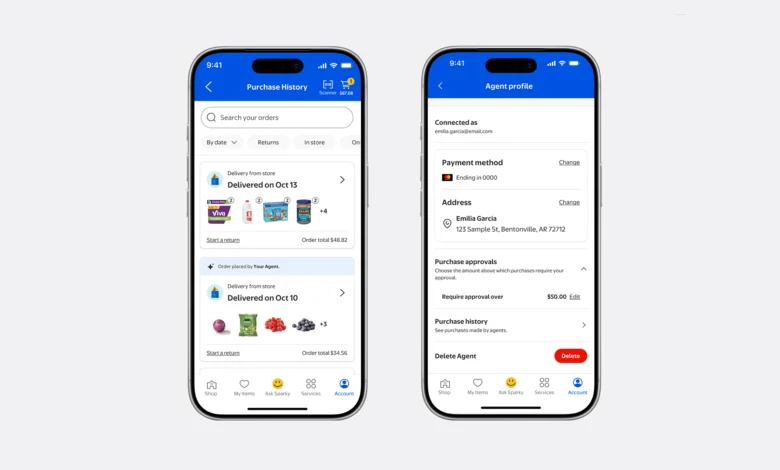
To resolve this ambiguity, Walmart is launching specialized Agent Profiles within the coming weeks. According to Daniel Danker, Walmart’s executive vice president of AI acceleration, product, and design, these profiles will operate as dedicated sub-accounts linked directly to a primary user account. This architectural separation allows shoppers to clearly delineate autonomous purchases from human-driven orders.
Crucially, the profiles introduce flexible oversight mechanisms. Consumers can elect to review and manually approve every individual transaction initiated by an AI agent, or they can establish preset spending limits—such as thresholds capped at $50, $100, or $200—allowing trusted routines to execute automatically while halting any outliers for human intervention. Furthermore, Walmart’s updated terms dictate that agents must present standard pricing and transparent fee structures, mirroring the exact conditions a human shopper would encounter.
Addressing Market Hesitation and Security Concerns
Walmart’s emphasis on strict guardrails is heavily underscored by broader consumer sentiment data. Despite the tech sector’s enthusiasm for autonomous workflows, mainstream adoption remains exceptionally low. Research published in August by payments technology provider NMI surveyed 1,000 U.S. adults regarding AI shopping habits, revealing that a mere 11% of respondents had actually utilized an AI assistant to complete a financial transaction.
More tellingly, the survey highlighted a profound demand for oversight: 70% of consumers explicitly stated that they require the ability to review or override an AI purchasing decision before checkout, while only 10% expressed willingness to surrender full budgetary control to an algorithm.
Recognizing these vulnerabilities, Walmart’s new compliance framework imposes strict behavioral rules on AI agents. Under the updated protocols, algorithms are explicitly barred from acting outside the explicit instructions of the user, accessing unauthorized private data, or acquiring raw payment card information. Agents are strictly prohibited from adding, modifying, or storing alternative payment methods. Should an unintended purchase slip through due to a miscommunication or software error, Walmart’s standard return policies apply, while offending AI applications that breach terms of service face immediate bans from the platform. However, the retailer notes that data shared directly with external third-party applications remains governed by those respective platforms’ independent privacy policies.
Streamlining Backend Infrastructure with the Agent Gateway
Beyond consumer-facing controls, Walmart is overhauling the underlying mechanics of how autonomous software interacts with its digital catalog. Traditionally, AI agents have relied on web-scraping interfaces and browser emulation to navigate retail sites—a methodology designed for human users that is notoriously slow, prone to rendering errors, and frequently susceptible to breaking down mid-transaction.
To eliminate these inefficiencies, Walmart is developing the Agent Gateway. Powered by the Model Context Protocol (MCP)—an open standard initially developed by Anthropic to bridge AI applications with external tools and data sources—the gateway provides a direct, highly optimized API-style connection for software agents.
The infrastructure is designed to facilitate the complete purchasing lifecycle, encompassing product discovery, cart management, checkout execution, and order tracking. Notably, the architecture incorporates privacy-preserving features. For example, the gateway can securely assist an AI agent in locating a customer’s preferred brand of milk or household staples based on past behavior without exposing the user’s broader, more sensitive transaction history to the third-party application. The gateway is slated for a limited beta rollout targeting select corporate partners and software developers.
Implications for Walmart Marketplace Sellers and Product Discovery
The structural shift toward agentic commerce is already altering how consumers discover goods, carrying massive implications for the millions of merchants operating within the Walmart Global Marketplace. Data shared by Walmart executives illustrates how consumer behavior is evolving; at a financial technology conference in March, Danker revealed that vitamin and protein supplements represented the top two product categories purchased via Walmart integrations on ChatGPT. Crucially, these transactions frequently originated from broad conversational queries rather than targeted, keyword-specific product searches.
This transition from traditional search-bar queries to conversational discovery represents a paradigm shift for digital retail. Manish Joneja, senior vice president of Walmart Global Marketplace and Fulfillment Services, notes that agentic commerce holds the potential to level the playing field, allowing lesser-known brands and niche products with low baseline consumer awareness to surface dynamically if they match a shopper’s contextual needs.
At the same time, the rise of autonomous shopping raises the bar for merchant compliance. Because AI agents rely on hard data rather than visual marketing or brand loyalty, the accuracy of product listings, competitive pricing transparency, reliable inventory availability, and dependable fulfillment timelines become critical success factors. To prepare its vendor ecosystem, Walmart is actively collaborating with marketplace sellers to enhance catalog data quality, ensuring that product descriptions are optimized for machine comprehension and algorithmic recommendation.
Broader Industry Context and Competitive Landscape
Walmart’s latest initiatives reflect its aggressive positioning within the North American e-commerce hierarchy. Ranked No. 2 in Digital Commerce 360’s Top 1000 Database—which tracks the region’s largest online retailers by annual revenue—Walmart is leveraging its immense logistical scale to set early industry standards for agentic governance. Additionally, the company holds the No. 37 position in Digital Commerce 360 and ReFiBuy’s specialized AI Commerce Rankings, signaling its commitment to integrating machine intelligence across supply chain, sales, and consumer touchpoints.
As artificial intelligence matures from a novelty feature into an active participant in retail transactions, the success of autonomous commerce will likely hinge on consumer confidence. By balancing technological efficiency with rigorous oversight mechanisms, spending caps, and secure data gateways, Walmart is attempting to construct a blueprint for safe agentic retail—one that reassures cautious shoppers while opening lucrative new avenues for brand discovery and digital commerce.