Evaluating Social Media Traffic Patterns For Technical Publications In An Era Of Platform Fragmentation

The modern digital landscape for independent software development thought leaders has undergone a profound structural shift over the past decade, moving away from centralized microblogging utilities toward a highly fragmented ecosystem of proprietary networks and decentralized protocols. Martin Fowler, a prominent author, international speaker, and advocate for software development methodologies whose primary insights have long been published on his eponymous platform, martinfowler.com, has released his latest empirical assessment regarding social media engagement metrics. Analyzing data captured between mid-June and September 2026, the findings offer a transparent, quantitative look at how technical content propagates across four distinct networks: LinkedIn, X (formerly Twitter), the Fediverse via Mastodon, and Bluesky.
For nearly two decades, digital distribution strategies for independent publishers relied heavily on singular dominant channels. Fowler’s initial foray into social media distribution began on Twitter in 2008, serving as a reliable engine for notifying his readership base of newly published architectural essays and refactoring guidelines. However, following significant ownership changes and corporate transformations at major social platforms—colloquially referenced in technical circles as the "muskover"—the microblogging landscape fractured. Authors and independent creators were forced to diversify their outreach to maintain visibility among disparate reader communities. Today, Fowler maintains an active manual distribution pipeline across four commercial and open networks, alongside traditional RSS feeds, which he notes remains his personal method of choice for tracking content updates.
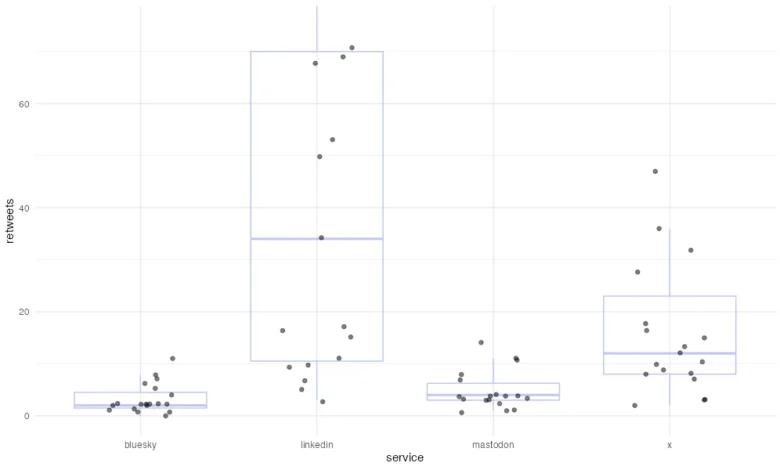
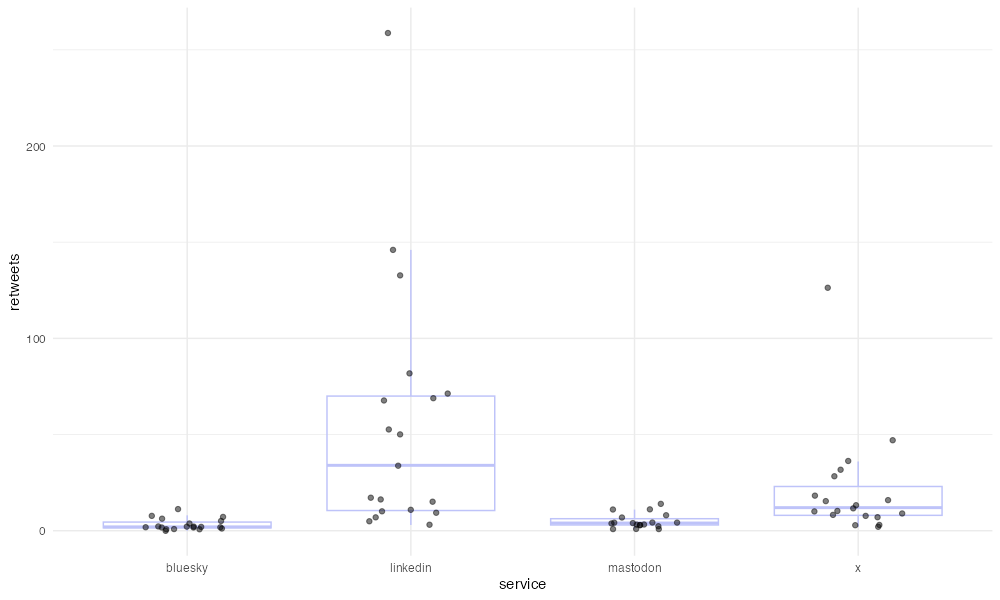
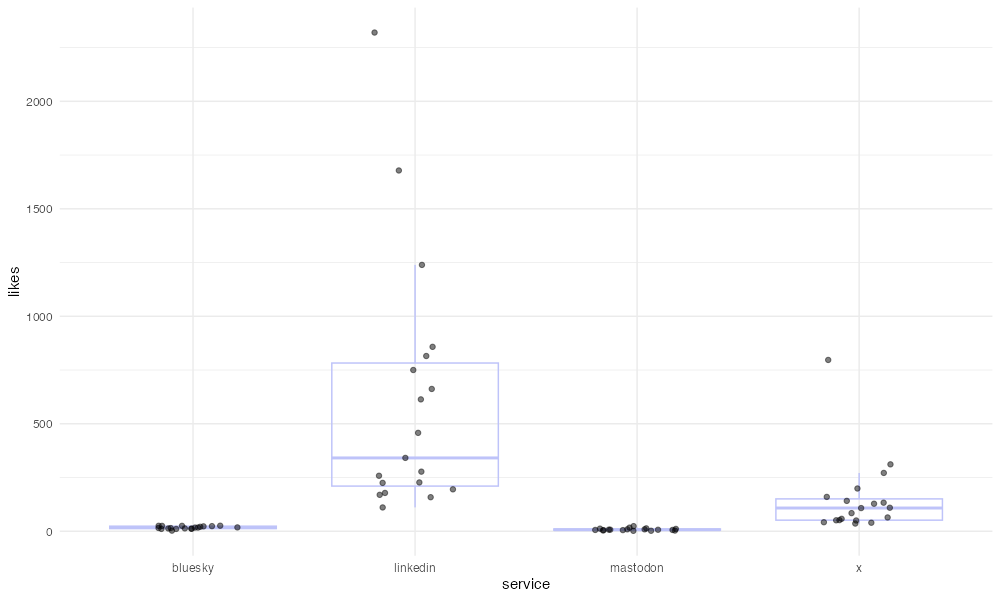
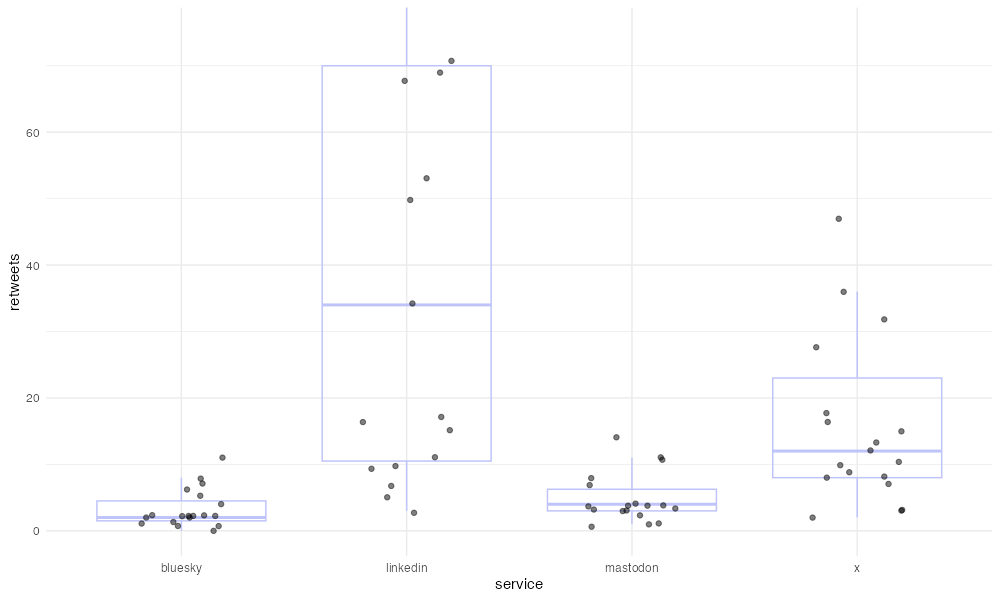
To evaluate the efficiency of this multi-platform approach, a rigorous statistical review was conducted utilizing 19 individual content announcements posted over a roughly three-month window concluding in September 2026. Rather than relying on simple arithmetic averages—which are frequently criticized by data scientists for obscuring underlying distributions and skewing outliers—the analysis pairs strip charts with box plots. This methodological choice enables observers to simultaneously review every individual post as a discrete data point alongside critical statistical summaries, specifically the median and interquartile ranges.
Engagement Metrics and Platform Rankings
The empirical data reveals a stark hierarchy regarding user interaction metrics, categorized primarily by retweets, likes, and direct replies. Among these indicators, retweets are assigned the highest analytical value, as they represent an active endorsement by a user prompting their own network to consume the material.
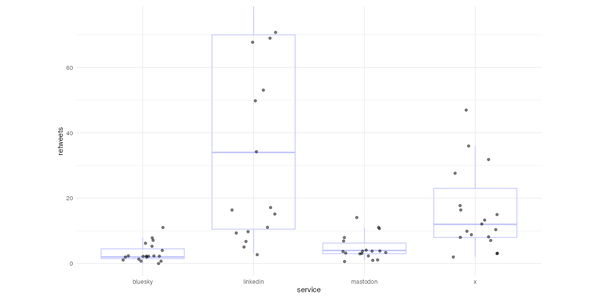
When isolating retweet data through a localized zoom of core engagement numbers, LinkedIn emerges as the undisputed frontrunner. The platform’s distribution algorithms and professional audience demographics consistently yield higher interaction volumes than any competing network. X secures a distant second place, though its performance metrics demonstrate a notable contraction compared to historical baselines; notably, the upper quartile of X’s engagement figures falls beneath the median engagement level observed on LinkedIn.
Conversely, the decentralized and emerging networks register minimal traction by comparison. Both Bluesky and Mastodon record engagement distributions whose upper quartiles sit below the lower quartile of X. Between the two open-protocol options, Mastodon exhibits marginally higher interaction volumes than Bluesky within this specific technical publishing cohort, though both remain fractional when measured against their corporate counterparts.
Chronological Evolution and Year-Over-Year Shifts
Contextualizing these 2026 metrics requires examining longitudinal data compiled from previous platform audits, most notably a comparable study conducted by Fowler in early 2025. A comparative box plot analysis tracking retweet performance between early 2025 and mid-2026 highlights a shifting tide in audience attention and platform vitality.
Over the intervening eighteen months, LinkedIn has consolidated its position, experiencing modest growth in median engagement for technical announcements. In direct contrast, X has suffered a pronounced downward trajectory in interaction metrics for professional software development content. The most dramatic movement, however, appears in the metrics for Bluesky, which experienced a severe contraction in engagement volume over the same period, declining from initial adoption curiosity to negligible interaction levels for this specific publishing tier.
Website Traffic Generation Versus Social Distribution
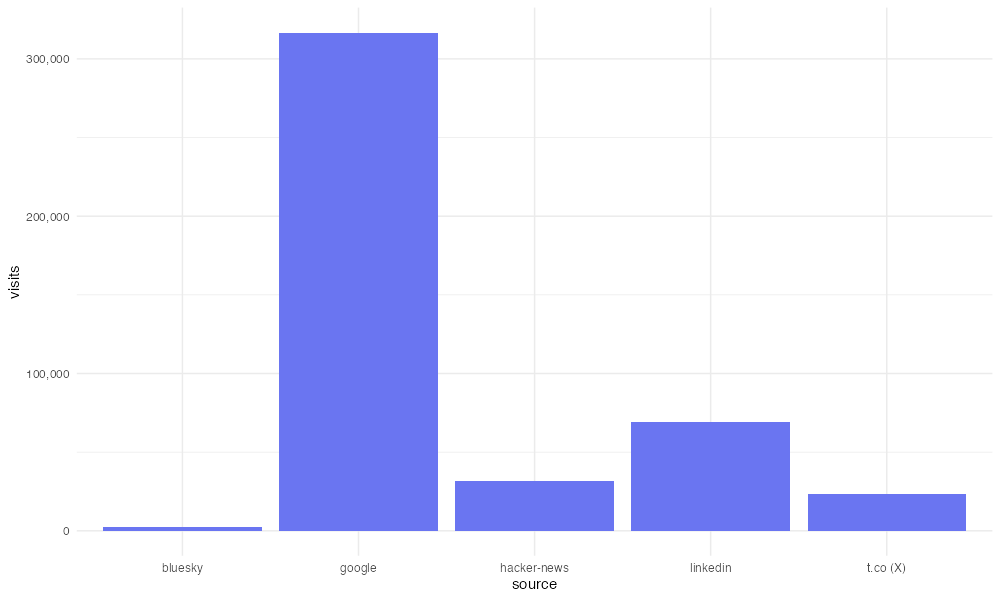
While social media engagement serves as an immediate barometer of audience interaction, the fundamental purpose of digital distribution for an independent publishing platform remains the generation of qualified inbound traffic to source articles. Web analytics data collected across the ninety-day window leading up to September 7, 2026, provides definitive insight into how social referrals translate into actual readership.
The macro-level referral patterns mirror the social engagement rankings closely. LinkedIn functions as the primary social referral engine, outperforming X by a wide margin. Bluesky generates a negligible fraction of inbound visitors, while referral traffic from Mastodon remains so statistically sparse that it barely registers on standard analytical charts.
However, a broader examination of martinfowler.com’s aggregate traffic reveals that social media referral channels represent only a minor fraction of overall site discovery. Organic search engines—predominantly Google—dwarf social media referrals, driving approximately 300,000 visits during the measured timeframe. Yet, even this substantial search engine volume constitutes a fraction of the broader platform ecosystem, which recorded approximately 1.7 million total visits over the same ninety-day period. Direct navigation, bookmarking, and RSS aggregators continue to serve as vital lifelines for independent technical publications, insulating creators from the algorithmic whims of third-party platforms.
Implications of Open Protocols Versus Walled Gardens
The empirical disparity between high-engagement commercial platforms and low-engagement open protocols presents content creators with a strategic dilemma. From a purely utilitarian perspective focused on maximizing reach and reader engagement, the data provides a compelling argument for discontinuing manual announcements on low-yield networks such as Bluesky and Mastodon. Maintaining multiple publishing pipelines requires ongoing manual labor, including copy-pasting text, formatting links, and handling minor cross-platform adjustments.
Despite the unfavorable quantitative metrics, foundational considerations regarding platform architecture and philosophy often override pure statistical optimization. Open platforms and decentralized protocols—such as the Fediverse—align closely with the foundational ethos of the open-source software movement, which has historically championed interoperability, data portability, and resistance to corporate monopolization. Consequently, publishers frequently choose to maintain a presence on open networks as a deliberate stance against the reliance on closed "walled gardens" governed by opaque algorithmic controls and shifting corporate monetization strategies.
Industry Analysis and Future Outlook
The publishing trends observed on martinfowler.com reflect a broader maturation and fragmentation phase across the digital media landscape. As traditional social media networks increasingly gatekeeper content behind algorithmic feeds designed to maximize internal platform retention rather than outbound web traffic, independent publishers face diminishing returns on manual social distribution.
Observers in digital media and software publishing suggest that the future of technical content dissemination will likely rely less on manual multi-homing across declining microblogging platforms and more on direct, protocol-driven syndication. RSS feeds, atom syndication, and developer-centric aggregators continue to demonstrate superior resilience against corporate platform churn.
Ultimately, the 2026 data underscores a pragmatic reality for independent thought leaders: while commercial professional networks like LinkedIn currently command the highest volume of active technical engagement, the long-term sustainability of independent publishing relies on diversified discoverability, robust organic search visibility, and direct reader relationships facilitated by open web standards. As platform dynamics continue to evolve, ongoing empirical audits of traffic and engagement will remain essential tools for navigating the shifting digital terrain.