In September 1958, Bank of America executed one of the most audacious—and reckless—experiments in the history of consumer finance: the mass distribution of sixty thousand unsolicited, pre-activated credit cards to the residents of Fresno, California. This initiative, which became infamously known as the "Fresno Drop," bypassed traditional credit vetting entirely, resulting in immediate and widespread fraud, delinquency rates exceeding twenty percent, and significant institutional embarrassment. Yet, despite the operational chaos, the experiment succeeded in solving the "cold-start" problem of network effects, effectively seeding the infrastructure that would eventually evolve into the global colossus known as Visa.
The Genesis of the Payment Network
The fundamental challenge of a two-sided payment network is the chicken-and-egg dilemma. Consumers are unwilling to carry a payment tool that merchants do not accept, and merchants are unwilling to invest in terminal infrastructure for a payment tool that few customers possess. Prior to the Fresno Drop, the Diners Club, founded in 1950, attempted a manual, localized solution. Frank McNamara’s approach involved a boutique strategy: manually recruiting two hundred New York City restaurants to accept a charge card, then selling that convenience to wealthy clientele. While successful as a proof of concept, the Diners Club model relied on analog, paper-based settlement and was geographically constrained.
Bank of America’s innovation was to abandon the boutique approach in favor of brute-force ubiquity. By flooding a specific city with cards, the bank forced merchants into a position where refusing the plastic meant losing significant revenue. This forced the rapid adoption of merchant-side infrastructure, proving that a network’s value is derived not from the card itself, but from the speed and ubiquity of the underlying communication fabric.
Dee Hock and the Architecture of Cooperation
By the late 1960s, the licensing model for the BankAmericard had decentralized into a fragmented, chaotic landscape. Hundreds of banks were issuing cards with disparate terms and inconsistent acceptance policies, creating a high-risk environment for fraud and settlement failures. The system was on the verge of total collapse when Dee Hock, a visionary branch manager, proposed a radical restructuring.
Hock argued that the network required a neutral governance structure rather than a top-down corporate mandate. He championed the formation of a cooperative—a member-owned entity where competing banks agreed to operate under universal, non-negotiable rules. This structure ensured that any card issued by any member institution would be accepted by any merchant connected to the network, regardless of the bank involved. In 1976, this entity was formally rebranded as Visa. Hock’s "cooperative" model remains the gold standard for global payment networks, maintaining the delicate balance where members compete for customers while simultaneously collaborating on the integrity of the underlying utility.
The Mechanics of the Two-Second Transaction
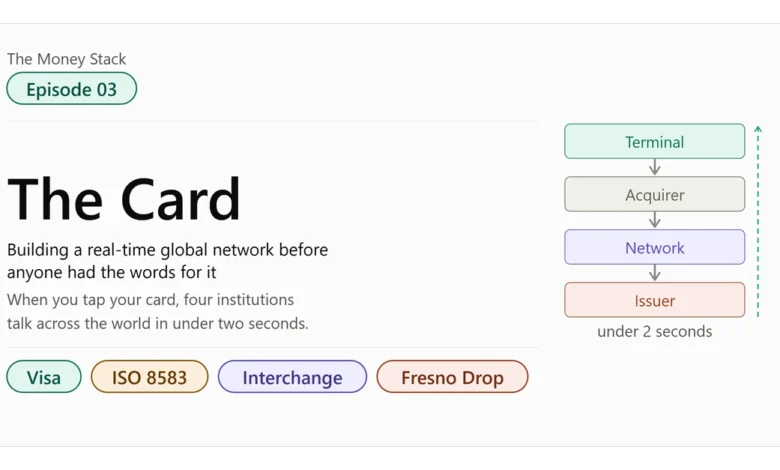
Modern payment networks operate with remarkable, if often invisible, complexity. When a consumer taps a card at a terminal, a sophisticated chain of events is triggered, often spanning multiple continents, and resolves in under two seconds. The sequence follows a rigorous technical protocol:
- Capture: The terminal extracts card data and a cryptographic "authorisation request cryptogram." This cryptogram, generated by the card’s chip using a secure key, validates the physical presence of the card without exposing sensitive underlying data.
- Transmission: The acquirer—the merchant’s bank—reformats this data into an ISO 8583 message, a standardized binary format that transmits the transaction amount, date, and primary account number to the card network.
- Verification: The network routes the message to the issuer, the consumer’s bank. In milliseconds, the issuer evaluates the transaction for fraud, availability of credit, and consistency with historical spending patterns.
- Authorisation: The issuer sends an approval or decline back through the network, reaching the terminal almost instantly.
It is a common misconception that this "green light" represents a movement of funds. In reality, the authorisation process only confirms a hold on funds—a promise of future payment. The actual movement of capital occurs through a separate, batch-processed system called "clearing and settlement," which typically happens overnight. This temporal gap between authorization and settlement explains why refunds or hotel incidental holds take several business days to reconcile.
The Economic Engine: Interchange and Incentives
The global appetite for credit cards is sustained largely by the interchange fee—the percentage of each transaction paid by the merchant to the issuing bank. This fee is the primary economic incentive that justifies the credit risk and fraud liability assumed by the issuer.
The interchange model has fueled the proliferation of rewards programs, including airline miles, cashback, and exclusive lounge access. These perks are not philanthropic; they are funded by the interchange fee generated from every swipe. This has created a long-standing tension between retailers and card networks. Merchants, who effectively subsidize these rewards, have engaged in decades of litigation against issuers and networks, arguing that the fees are anticompetitive and artificially inflated. Despite these challenges, the economic model remains robust, as consumer demand for convenience and rewards continues to drive adoption.
The Arms Race of Security
The evolution of payment security is essentially an arms race between network architects and fraudsters. Historically, the magnetic stripe was the primary vulnerability, as it contained static data easily captured by skimming devices. The transition to EMV (Europay, Mastercard, and Visa) chip technology shifted the defense toward dynamic cryptography, where each transaction generates a unique, single-use token.
As physical security improved, the "attack surface" migrated to digital commerce. The growth of "card-not-present" transactions necessitated new layers of defense, such as tokenization, where the actual account number is never shared with the merchant, but is replaced by a digital surrogate. Despite these advancements, each new layer of security introduces a new point of potential exploitation, forcing constant, rapid innovation in network security protocols.
The Digital Shift and the Integration Era
By the turn of the millennium, Visa and its counterparts had established one of the world’s most resilient and efficient distributed systems. However, the rise of the internet fundamentally disrupted this physical-centric model. With the removal of the physical card and terminal, the established security handshake—the "chip-to-reader" verification—became obsolete.
The industry found itself at a crossroads where the legacy rails were sufficient for scale but inadequate for the emerging digital interface. The companies that successfully bridged this gap, such as PayPal and later Stripe, were not banks but software-first organizations. They recognized that the true value of a payment network in the 21st century was not merely the underlying infrastructure, but the integration layer—the simplicity of the API and the ease with which developers could weave payments into digital products.
The shift from the "Fresno Drop" to the current era of invisible, software-defined payments highlights a broader trajectory in financial history: the transition from physical trust and brute-force distribution to algorithmic trust and seamless digital integration. While the governance structures pioneered by Dee Hock continue to provide the necessary stability for global commerce, the future of the network lies in its ability to adapt to a world where the "shop" is no longer a physical destination, but a ubiquitous, instantaneous digital interaction. As the industry looks toward the next wave of financial evolution, the core lesson of the Fresno Drop remains relevant: a network is only as valuable as the number of participants who can access it with ease, reliability, and security.