Amazon Web Services expands Amazon EBS capabilities with cross-account volume cloning for enhanced data mobility and security.

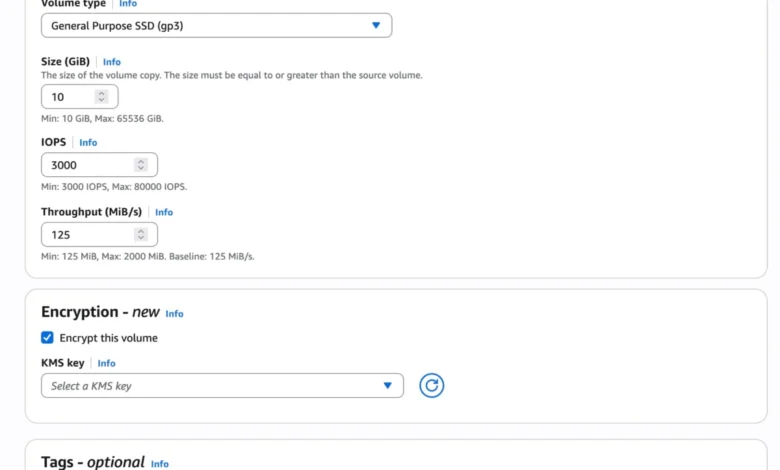
The evolution of cloud infrastructure management took a significant step forward as Amazon Web Services (AWS) announced the expansion of its Elastic Block Store (EBS) Volume Clones feature. This update allows users to create instantaneous, point-in-time copies of EBS volumes across disparate AWS accounts, a development that addresses long-standing challenges regarding environment synchronization, data migration, and security isolation. By integrating AWS Resource Access Manager (RAM) into the cloning workflow, AWS has streamlined a process that previously required complex snapshot-and-copy procedures, providing enterprises with a more efficient mechanism for managing block-level storage across large-scale, multi-account architectures.
Chronology of EBS Volume Evolution
To understand the significance of this update, one must look at the progression of storage management within the AWS ecosystem. Initially, EBS storage was largely siloed within individual accounts, necessitating manual intervention or cumbersome scripts to move data between production and staging environments.
In 2024, AWS introduced Volume Clones, a breakthrough capability that allowed for instant, high-performance copies of EBS volumes within the same Availability Zone (AZ). Unlike traditional snapshots—which are stored on S3 and can take significant time to materialize into a volume—Volume Clones provide a near-instantaneous metadata-based copy that allows for immediate use.
The current update marks the logical conclusion of that roadmap: moving from internal cloning to cross-account capability. This transition responds to the industry-wide shift toward "Landing Zone" architectures and multi-account strategies, where organizations maintain separate AWS accounts for development, testing, and production to satisfy security and compliance requirements.
Technical Mechanics and Implementation
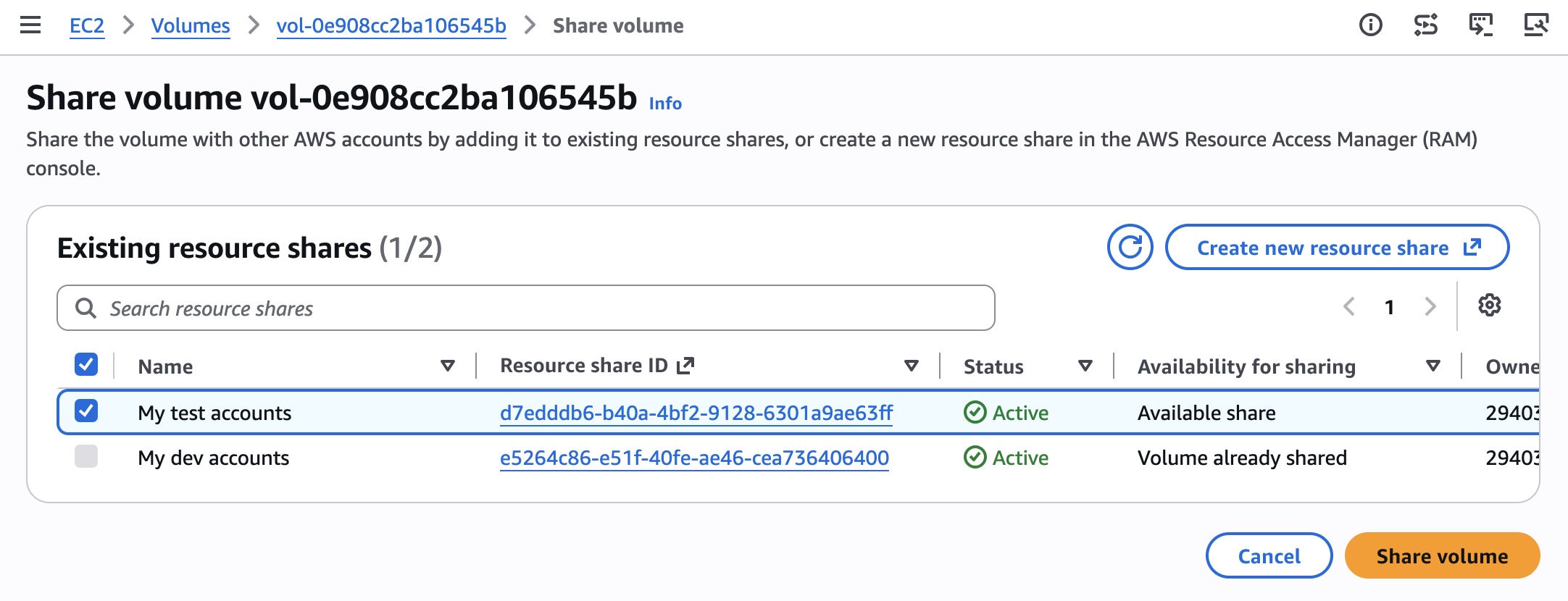
The new functionality leverages AWS RAM, a service designed to share AWS resources across accounts or within an AWS Organization. By using RAM as the orchestration layer, AWS ensures that security and access control remain governed by existing Identity and Access Management (IAM) policies.

The workflow for an administrator is divided into three distinct phases:
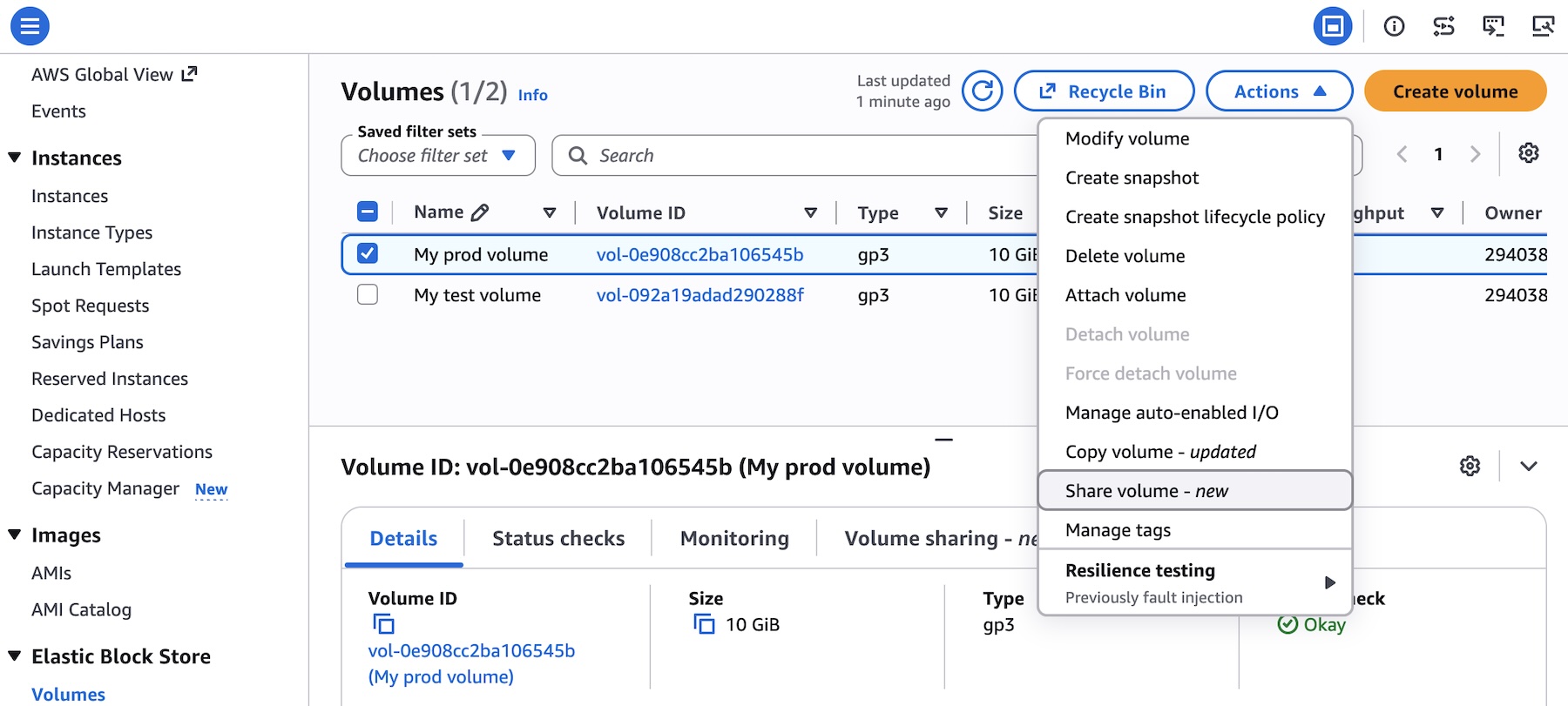
- Authorization: The owner of the source EBS volume initiates a "Share" request via the AWS RAM console. This creates a resource share that defines which target accounts are permitted to access the volume.
- Acceptance: The target account must explicitly accept the resource share invitation. This "opt-in" model is a critical security feature, ensuring that no data is moved into an environment without the target account owner’s consent.
- Cloning and Re-encryption: Once the share is established, the target user can invoke the "Copy volume" command. Crucially, this feature allows for the re-encryption of the data using an AWS Key Management Service (KMS) key specific to the target account. This is a vital requirement for organizations operating under strict regulatory frameworks, such as HIPAA or PCI-DSS, where production keys must never be exposed to non-production environments.
Data Mobility and Strategic Implications
The ability to clone volumes across accounts has profound implications for software development lifecycles (SDLC). In traditional cloud setups, "refreshing" a test environment with production data was a time-intensive process involving the creation of snapshots, sharing snapshots, and then restoring them into volumes. This process could take minutes or even hours depending on the size of the dataset.
With cross-account cloning, the time required to provision a production-like environment for debugging or performance testing is reduced to seconds. This "instant" availability enables:
- Improved Debugging: Developers can work on live production issues using real-world data without impacting the performance or availability of the actual production workload.
- Enhanced Security Testing: Security teams can clone production data into isolated, hardened accounts to conduct penetration testing or vulnerability assessments without the risk of exposing sensitive data in a shared development space.
- Efficient Patch Management: Teams can test infrastructure updates, OS patches, or database migrations on exact replicas of production storage, significantly reducing the probability of "it worked in dev but broke in prod" scenarios.
Analysis of Security and Compliance
From a security standpoint, the integration of AWS KMS is the most noteworthy aspect of this release. By allowing the target account to encrypt the clone with its own key, AWS effectively bridges the gap between data usability and data sovereignty. Even if an actor has access to the source volume’s snapshot, the data remains cryptographically protected once it transitions to the target environment.
Furthermore, because these clones are point-in-time, they provide a clean "snapshot" of the environment that is immutable relative to the original source. This is particularly useful for forensic investigations, where security analysts need a frozen copy of a compromised server’s disk to analyze the root cause of an incident without altering the original evidence.
Broader Industry Context
AWS’s move to simplify cross-account storage management reflects a broader trend in the cloud computing industry: the move toward "data-aware" infrastructure. As enterprises transition from monolithic architectures to microservices and multi-account models, the friction involved in moving data has become a primary bottleneck for DevOps velocity.
Competitors in the cloud space, such as Microsoft Azure and Google Cloud Platform (GCP), have also been iterating on their respective storage offerings to improve cross-project and cross-subscription data sharing. AWS’s decision to build this into the EBS layer directly—rather than relying on external storage migration services—suggests that they view storage mobility as a foundational requirement for modern enterprise operations.
Future Roadmap and Availability
This feature is currently rolling out across all AWS Regions that support standard EBS Volume Clones. AWS has indicated that users should consult the "AWS Capabilities by Region" portal for specific updates on regional support, as the global footprint of AWS infrastructure sometimes involves phased rollouts for newer services.
For developers and systems architects, the programmatic implementation of this feature is supported via the AWS SDKs and the AWS Command Line Interface (CLI). Additionally, the integration with AI-assisted coding tools, such as the AWS MCP (Model Context Protocol) Server, allows for the automation of these tasks. By using these plugins, teams can codify their environment-refreshing workflows, effectively turning complex multi-account infrastructure management into a repeatable, automated pipeline.

Conclusion
The extension of Amazon EBS Volume Clones to support cross-account operations represents a mature, well-integrated solution to a complex administrative problem. By prioritizing security through KMS re-encryption and administrative control through RAM, AWS has provided a robust toolset for organizations to enhance their development and testing agility. As businesses continue to scale their cloud footprints, the ability to safely and instantly move data between environments will likely become a cornerstone of efficient cloud operations. Organizations are encouraged to review their IAM policies and RAM configurations to ensure they are prepared to leverage this functionality effectively, while maintaining the rigorous security posture required in today’s digital landscape.