The United States Energy Storage Market Faces a Strategic Shift Amidst New Restrictions on Chinese Technology

The United States energy storage sector, a critical pillar in the nation’s transition toward a decarbonized grid, is currently navigating a period of profound regulatory upheaval. While the market has recently achieved record-breaking growth in the deployment of utility-scale battery energy storage systems (BESS)—essential for balancing the intermittency of wind and solar power—the federal government has implemented a series of aggressive policy measures aimed at decoupling this vital infrastructure from Chinese manufacturing. The latest and most significant of these actions, an executive order signed by the Trump administration in late August 2026, declares a national emergency that effectively bans the use of Chinese-manufactured components in grid-scale energy storage systems, marking a pivotal moment in the ongoing trade and security rivalry between the two global powers.
The Evolution of US-China Battery Policy: A Chronology
The current regulatory climate is the culmination of several years of legislative and administrative efforts to foster domestic production and reduce reliance on foreign supply chains.
- August 2022: The enactment of the Inflation Reduction Act (IRA) set the stage for a localized supply chain. The legislation introduced stringent requirements for tax credits, mandating that batteries and their mineral components be sourced, processed, or recycled in accordance with specific domestic or trade-partner-friendly geographic criteria.
- January 2026: In a significant escalation of economic pressure, the U.S. government increased Section 301 tariffs on imported lithium-ion batteries from 7.5% to 25%. This move was designed to dampen the price advantage of Chinese imports and incentivize domestic procurement.
- August 2026: The Trump administration issued a sweeping executive order declaring a national emergency to secure the bulk-power system. The order explicitly prohibits the installation of foreign-produced equipment—specifically targeting battery storage systems, inverters, and transformers—deemed to pose a national security risk.
- 2026–2030 Outlook: New legislative mandates require that, starting in 2026, at least 55% of the cost of materials for new energy storage projects must originate outside of China and other restricted nations to remain eligible for federal tax incentives.
Economic and Logistical Implications for the Grid
The immediate impact of the August 2026 executive order has been one of uncertainty. Industry analysts from BloombergNEF and Benchmark Mineral Intelligence have warned that the directive could trigger a slowdown in the deployment of new grid-connected projects. Developers are currently caught in a holding pattern, awaiting granular guidance from the Department of Energy, which is expected by the end of this year.
"An outright ban was a bit of a surprise, and it does create a bit of concern for domestic players in the US," notes Shan Tomouk, energy storage and energy lead for Benchmark Mineral Intelligence. The concern is not merely about the origin of the batteries, but the availability and cost-competitiveness of alternatives. Currently, China leads the global market in battery production due to decades of government-subsidized research, massive economies of scale, and highly optimized supply chains. Transitioning to domestic or non-Chinese imports, such as those from South Korea, involves a significant price premium that could render some planned projects economically unviable.
According to BloombergNEF analyst Isshu Kikuma, the "worst-case scenario" involves the cancellation of projects that can no longer meet the cost-benefit thresholds required for financing. While the order applies technically to existing plants, experts suggest it is highly improbable that the government would force the decommissioning of active, functional grid assets. Enforcing the order retroactively would effectively require the removal of a substantial portion of the nation’s current energy storage capacity, which would jeopardize grid reliability and stability.
The Domestic Manufacturing Pivot
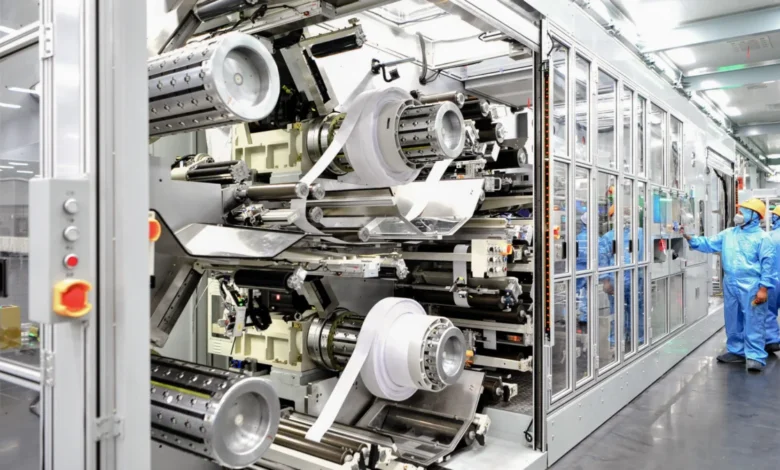
Despite the short-term headwinds, there is a clear strategic vision: creating a self-sufficient energy storage ecosystem by the early 2030s. The domestic landscape is already beginning to shift. Companies including LG Energy Solutions, Samsung SDI, Ford, and SK On are in the process of scaling up or bringing new manufacturing facilities online within the United States.
A unique catalyst for this transition is the recent softening of the electric vehicle (EV) market. As demand for passenger EVs has cooled relative to initial industry projections, several manufacturers have begun retooling factories—originally slated for high-density vehicle battery production—to manufacture stationary, grid-scale storage cells. This "ironic twist" provides a necessary supply bridge, allowing the domestic industry to pivot its output toward the urgent needs of the bulk-power system.
However, the cost disparity remains a primary obstacle. Data consistently shows that batteries produced domestically in the U.S. currently carry a significantly higher price tag than their Chinese counterparts. Even imports from alternative, non-restricted nations represent an increased cost structure. For the energy transition to proceed at the pace required to meet federal climate goals, policymakers face a delicate balancing act: maintaining the momentum of renewable energy adoption while simultaneously insulating the critical power grid from geopolitical supply chain vulnerabilities.
Analyzing the Strategic Trade-Off
The policy debate surrounding this executive order highlights a broader dilemma for Western nations: the trade-off between the immediate, low-cost deployment of green technology and the long-term goal of industrial sovereignty.
Proponents of the current administration’s policy argue that the risks associated with relying on a single, geopolitical rival for critical energy infrastructure are too great. They posit that the grid is a matter of national security, and dependence on Chinese-made inverters, transformers, and battery management systems could create "backdoor" vulnerabilities.
Conversely, critics suggest that forced localization at higher costs could inadvertently hinder the very decarbonization efforts the U.S. aims to accelerate. By limiting the availability of affordable battery technology, the cost of electricity could rise for the end consumer, and the transition away from fossil fuels could be delayed as storage-backed renewable projects become harder to finance.
Looking Toward 2030
The roadmap to 2030 suggests that while the United States has the potential to meet its internal demand for energy storage, the reality of full-scale production may lag. Even with new factories coming online, some facilities may struggle to reach full capacity in the immediate term, potentially pushing the point of complete domestic self-sufficiency into the mid-2030s.
The coming months will be critical. The Department of Energy’s forthcoming guidance will likely dictate which projects receive exemptions, how existing hardware is classified, and how the 55% material-cost threshold will be calculated. As the energy industry prepares for this new regulatory landscape, the focus remains on whether the U.S. can successfully nurture a domestic manufacturing base that is both resilient and capable of sustaining the rapid pace of grid modernization required for the coming decade. The balance between geopolitical security and the rapid, cost-effective deployment of clean energy remains the defining challenge of the American energy transition.
Related posts: