The Eerie Sound of Earth’s Magnetic Shield Collapsing During the Laschamps Excursion Reveals Ancient Planetary Turmoil

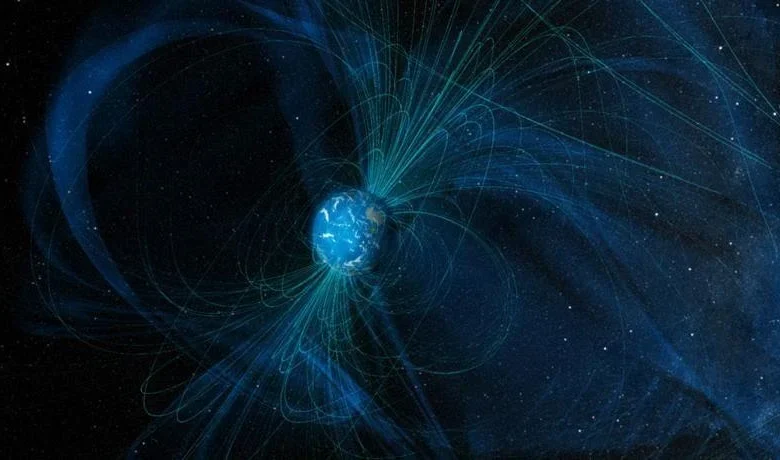
The rhythmic hum of Earth’s magnetic field is a fundamental, albeit silent, component of our planet’s habitability. While this invisible shield usually functions as a steady guardian against solar radiation, it has historically undergone violent, chaotic fluctuations. Scientists from the Technical University of Denmark (DTU) and the German Research Centre for Geosciences (GFZ) have recently translated the data of one of Earth’s most dramatic geomagnetic events—the Laschamps excursion—into an audio experience. By utilizing data from the European Space Agency’s (ESA) Swarm satellite constellation and geological records, researchers have reconstructed a soundscape that captures the turbulent collapse of our planetary defenses some 41,000 years ago.
The Laschamps Excursion: A Geological Snapshot
The Laschamps excursion refers to a transient deviation in Earth’s magnetic field that occurred approximately 41,000 years ago during the late Pleistocene. Unlike a full geomagnetic reversal, where the north and south magnetic poles swap positions permanently, an excursion involves a temporary shift in the orientation of the poles before they eventually migrate back to their original configuration.
During this period, the magnetic field did not just waver; it effectively collapsed. Data reconstructions indicate that the field strength plummeted to approximately 5% of its current intensity. This state of profound vulnerability persisted for roughly 250 years, followed by a period of about 440 years where the field remained in an anomalous, non-dipolar state. For nearly seven centuries, Earth’s primary defense mechanism against high-energy cosmic radiation was significantly compromised, leaving the atmosphere exposed to the harsh realities of the solar wind.
Sonification: Turning Data into Audible Reality
Because the magnetic field is inherently silent and invisible to human perception, the research team employed a technique known as sonification. This process involves mapping physical data points—in this case, fluctuations in magnetic intensity and orientation—into auditory parameters.
To create the haunting, metallic, and grinding sounds associated with the Laschamps excursion, scientists synthesized the magnetic data with organic recordings, such as the splintering of wood or the clashing of stones. This artistic and scientific synthesis was designed to make the abstract concept of geomagnetic instability accessible to the human ear. The resulting audio is not a recording of the past, but rather a digital translation of the physical records locked away in ancient volcanic rocks and deep-sea sediments.
ESA experts have likened the process to composing a musical score, where the “notes” are dictated by the volatile movements of the Earth’s molten iron core. This unique auditory representation allows researchers to perceive the rhythmic, yet erratic, nature of planetary magnetism in a way that traditional graphs and charts cannot capture.
The Mechanism Behind the Shield
To understand why the Laschamps excursion sounds the way it does, one must look toward the center of the planet. Earth’s magnetic field is generated by a process known as the geodynamo. Roughly 3,000 kilometers beneath our feet, the Earth’s outer core consists of molten iron and nickel in constant, turbulent motion.
As the Earth rotates, the convection of these liquid metals generates electric currents, which in turn produce the magnetic field. This field extends thousands of kilometers into space, forming the magnetosphere. When the flow of the molten core becomes unstable or disorganized, the magnetic field begins to weaken or wander. During the Laschamps event, it is hypothesized that the convection patterns in the outer core reached a point of extreme instability, causing the field to become chaotic and eventually lose its primary dipolar structure.
Evidence in the Ice and Sediment
The occurrence of the Laschamps excursion is not mere speculation; it is firmly rooted in paleomagnetic evidence. Scientists have utilized ice cores and sedimentary layers to identify the chemical signatures left behind by this period of weakness.
A primary indicator of the weakened shield is the concentration of beryllium-10 (10Be) isotopes. Beryllium-10 is formed when cosmic rays—high-energy particles originating from outside our solar system—interact with the atoms in Earth’s upper atmosphere. Under normal conditions, the magnetic field deflects the majority of these rays. However, when the magnetic shield weakens, more cosmic radiation penetrates the atmosphere, leading to a measurable increase in the production of beryllium-10.
By analyzing the concentration of this isotope in Greenland ice cores and deep-sea sediment cores, researchers have mapped a clear correlation between periods of low magnetic intensity and higher atmospheric radiation. This spike in beryllium-10 serves as a proxy for the intensity of the magnetic field at the time, providing a robust empirical foundation for the sonification project.
Historical Context and Frequency of Reversals
The Laschamps excursion is not a singular anomaly in the context of Earth’s deep time. According to records maintained by NASA, Earth has experienced approximately 183 magnetic reversals over the past 83 million years. The frequency of these events is highly irregular; some occurred millions of years apart, while others followed more closely.
For most of human history, the magnetic poles have been relatively stable. However, the current migration of the magnetic North Pole from the Canadian Arctic toward Siberia, coupled with the weakening of the South Atlantic Anomaly (a region where the magnetic field is significantly less intense), has prompted renewed interest in geomagnetic monitoring. Despite these trends, geophysicists emphasize that we are not necessarily on the precipice of a full-scale reversal. The current fluctuations are well within the range of known historical variation and do not yet mirror the extreme conditions documented during the Laschamps period.
Implications for Modern Technology and Society
The research into the Laschamps excursion holds significant implications for our modern, technology-dependent society. While the biosphere survived the event 41,000 years ago, our current civilization is significantly more vulnerable to space weather.
A collapse of the magnetic field in the modern era would expose Earth to increased solar particle events and galactic cosmic rays. This would pose a severe threat to satellite infrastructure, global communication networks, and the electrical power grid. The radiation levels at high altitudes would also increase, complicating air travel and potentially increasing the health risks associated with radiation exposure for the general population.
By creating the sonification of the Laschamps event, scientists are not merely providing a curiosity for the public; they are emphasizing the importance of monitoring our planet’s magnetic heartbeat. Understanding how the field behaved in the past provides a critical baseline for predicting how it might respond to future internal instabilities.
Future Research and Scientific Consensus
The project led by DTU and GFZ is part of a broader effort to integrate multi-disciplinary data into climate and geophysical modeling. As satellite missions like Swarm continue to provide high-resolution data on the magnetic field, our ability to interpret the behavior of the geodynamo improves.
The consensus among the scientific community is that the study of past geomagnetic excursions serves as a vital component in assessing planetary risk. While the sounds of the Laschamps excursion may strike the listener as ominous or foreboding, they are essentially the sounds of a dynamic planet in motion. The Earth’s magnetic field is not a static object but a living, breathing component of our world that has constantly evolved over billions of years.
Through the work of these researchers, we are reminded that our existence is shielded by forces far greater and more complex than we can see. The Laschamps excursion stands as a testament to the resilience of the Earth, providing both a historical warning and a profound look into the mechanics that keep our planet habitable. As we continue to probe the depths of the Earth’s core through data and sound, we move closer to a comprehensive understanding of the magnetic forces that dictate our future on this planet.