Introducing ZipWiki: Bridging the Gap Between Human Archives and AI Intelligence

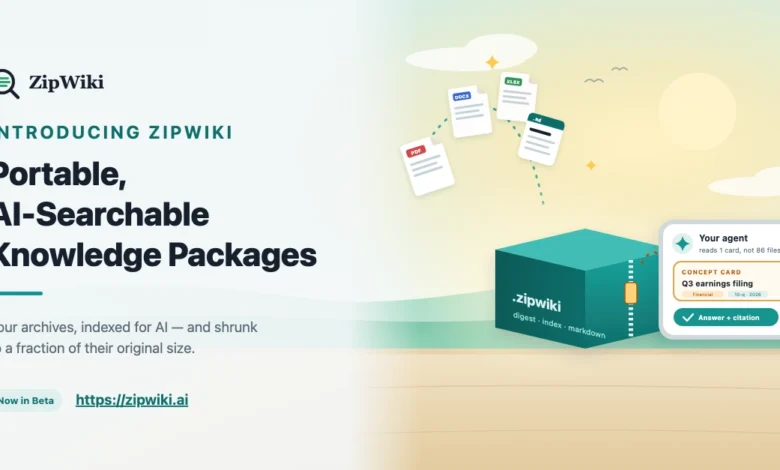
The rapid proliferation of Large Language Models (LLMs) and autonomous AI agents has created a significant friction point for modern enterprises: the "archive bottleneck." While businesses have spent decades digitizing records into ZIP-compressed folders—a format optimized for human storage and transport—these archives remain essentially opaque to artificial intelligence. When an AI agent encounters a standard ZIP file, it sees only filenames, lacking the contextual metadata required for efficient retrieval. NeoWare, the development team behind NeoZip, has officially introduced ZipWiki, a novel file format designed to transform static archives into intelligent, indexed, and portable knowledge bases that function seamlessly with modern AI architectures.
The Archive Bottleneck: Why Traditional ZIP Files Fail AI
For years, the ZIP format has been the industry standard for compressing and organizing massive volumes of data, ranging from clinical research and legal documentation to quarterly financial filings. This method excels at reducing the disk footprint of heterogeneous file types like PDFs, spreadsheets, and slide decks. However, the architectural philosophy of the ZIP format is fundamentally at odds with the operational requirements of AI agents.
To utilize information stored within a standard ZIP file, an AI agent typically must perform a series of resource-intensive tasks: download the archive, decompress the entire contents, ingest massive unstructured files into memory, and attempt to parse raw text. This process is not only time-consuming but also computationally expensive, often exceeding the context window limits of many current LLMs. Furthermore, repeated requests for information within the same archive necessitate redundant processing, leading to significant latency and increased token usage costs.
NeoWare’s Solution: Introducing the .zipwiki Format
ZipWiki is positioned as an evolution of the traditional archive. Unlike a cloud-based vector database or a proprietary SaaS platform that requires constant internet connectivity and complex infrastructure management, ZipWiki is designed to be an "embedded AI index." When a user converts a folder into a .zipwiki file, the system executes a single-pass read of the documents, extracts the relevant text, and generates a structured Smart Index directly within the container.
This approach ensures that the intelligence—the metadata and semantic pointers—travels with the data itself. Because the .zipwiki file maintains compatibility with standard unzipping tools, it preserves the human-readability of the original documents while simultaneously providing an optimized roadmap for AI agents.
Chronology and Development
The development of ZipWiki follows the team’s previous success with NeoZip, a project that focused on improving the underlying efficiency of data compression. Recognizing that the future of information management would be defined by machine interaction rather than human browsing, the NeoWare team pivoted toward creating an interoperable bridge between static storage and dynamic AI retrieval.
The current Beta release marks the culmination of months of engineering focused on the Model Context Protocol (MCP). By utilizing the MCP server, ZipWiki allows AI agents to "talk" to the archive without needing to unpack the entire payload. This selective reading capability represents a departure from traditional "load-everything-at-once" methodologies. The integration is supported by a command-line interface (CLI) tool, enabling seamless incorporation into automated CI/CD pipelines and developer workflows.
Technical Efficiency: Achieving a 100x Reduction in Footprint
One of the most compelling aspects of ZipWiki is its capacity for data miniaturization. In many corporate environments, archives are bloated with binary files that contain redundant or non-essential data. ZipWiki mitigates this by allowing users to link to external source documents—such as state law repositories or SEC filing databases—rather than packing the full binary inside the archive.
By separating the "knowledge layer" from the "storage layer," ZipWiki can effectively shrink the footprint of an archive by up to 99%. In practical terms, this allows an archive that might have once occupied several gigabytes to be reduced to a fraction of that size, with the AI still retaining the ability to cite specific concepts, sections, and source links. To ensure data integrity, the system employs CRC-32 verification, allowing the agent to validate the external original file against the recorded metadata.

The Shift Toward Sovereign Data Architecture
The broader implication of the ZipWiki model is a shift away from centralized, hosted AI databases toward decentralized, portable knowledge. Many organizations have been hesitant to upload sensitive proprietary data to third-party vector databases due to security and privacy concerns. Because ZipWiki keeps the index and the data within a single, shareable package, the control remains entirely with the user.
This "data sovereignty" approach means that a ZipWiki archive can be shared via email, synchronized across cloud services, or backed up to local cold storage, all while remaining instantly "query-ready" for any compatible AI model. This eliminates the need for expensive infrastructure maintenance or the ongoing costs associated with maintaining a live database connection for static datasets.
Industry Implications and Future Outlook
The emergence of tools like ZipWiki highlights a maturation in the AI ecosystem. Early AI implementation focused heavily on the capability of the models themselves, but as the technology moves toward production, the industry is increasingly focusing on the "data infrastructure" layer.
By standardizing the way AI agents interact with archived knowledge, ZipWiki could significantly influence how legal, medical, and financial firms handle their long-term records. If a firm can turn its entire library of past case law or clinical trial documentation into an AI-queryable format with minimal effort, the potential for faster, more accurate automated research increases exponentially.
Moreover, the use of open, standard-compliant formats suggests that NeoWare is prioritizing ecosystem interoperability. By building the system on existing standards and providing a CLI, the team is inviting developers to experiment with the format, which is a common strategy for establishing a new industry standard.
Challenges and Adoption
Despite the clear benefits, the adoption of any new file format faces inherent challenges. Integration into legacy enterprise software stacks often requires significant lead time and security validation. Furthermore, while the format is designed for efficiency, the quality of the "Smart Index" is inherently dependent on the quality of the source documents. If the original documents are poorly formatted, the index will be less effective, regardless of the container’s capabilities.
However, the team behind NeoWare appears to be addressing these hurdles by focusing on developer experience (DX). By providing a straightforward installation path and open-source documentation, they are lowering the barrier to entry for developers who are already managing large datasets and looking for ways to "AI-enable" their existing storage workflows.
Conclusion
ZipWiki is a pragmatic response to the reality of the AI-driven workplace. By acknowledging that the future of information retrieval must respect the portability and longevity of the file formats we already use, NeoWare has created a bridge between legacy data management and the future of autonomous intelligence.
As the Beta phase progresses, the industry will be watching to see how developers and enterprises utilize this format to solve the "blind box" problem of their massive archives. For those interested in exploring the technology, the tools are currently available at zipwiki.ai, with the team actively soliciting feedback on real-world use cases. The transition from passive storage to active, intelligent archives appears to be underway, and tools like ZipWiki are at the forefront of this transformation.