Data processing often hits a "memory wall" when the volume of information exceeds the available RAM of the system executing the task. For many developers, the transition from processing small, manageable log files to handling gigabyte-scale datasets is where conventional scripting practices fail. A common scenario involves a script that functions perfectly for months, only to crash with a MemoryError when log rotation settings change, suddenly forcing the system to ingest a multi-gigabyte file in a single operation. This failure highlights a fundamental mismatch between the "eager" evaluation patterns common in early-stage development and the reality of high-volume production environments.
The Anatomy of the Memory Crisis
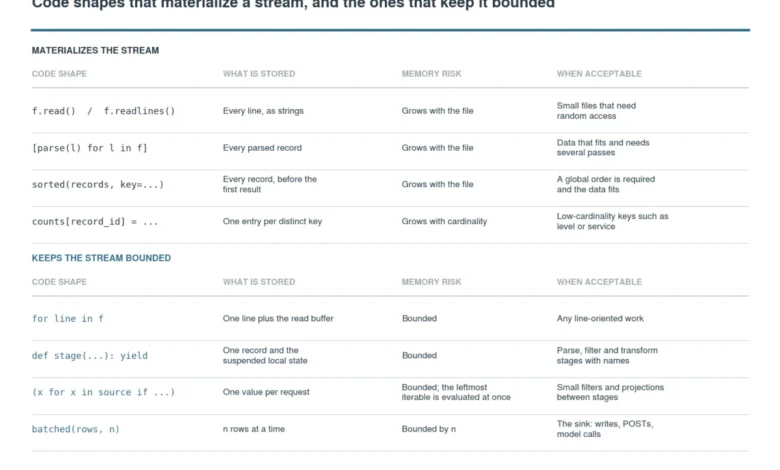
The primary culprit in these system failures is the creation of large, intermediate lists. When a developer writes code that loads an entire file into memory—often using methods like .readlines() or list comprehensions—the Python interpreter is forced to allocate space for every single record simultaneously. In the context of a 9 GB log file, this could easily require 20 GB or more of RAM, as Python objects carry significant overhead compared to raw text. If the processing pipeline consists of three sequential steps, each creating a new list, the memory consumption compounds, leading to an inevitable crash on standard enterprise hardware.
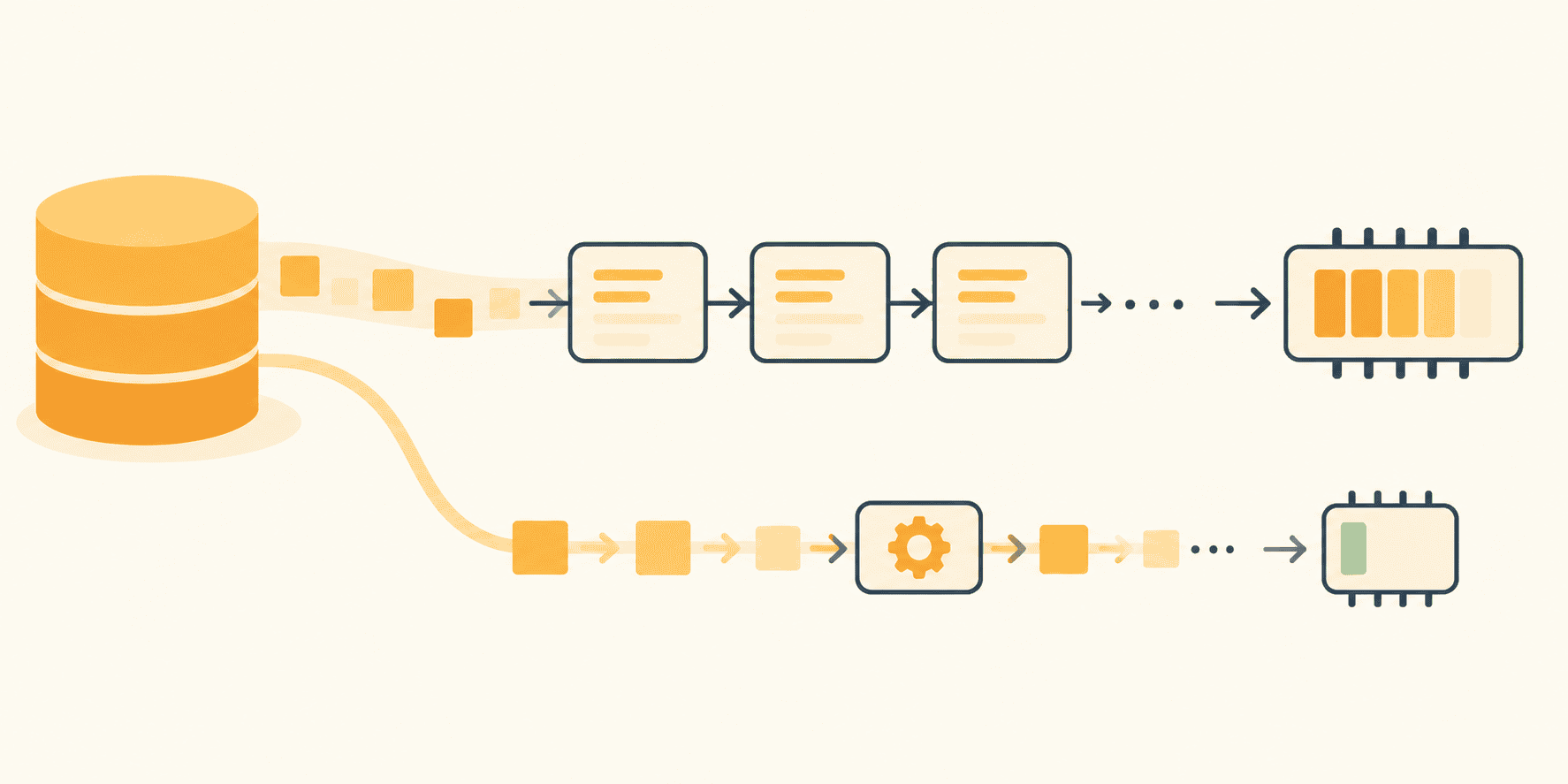
This issue is not a limitation of Python itself but a byproduct of how developers structure their data flow. For over two decades, Python has provided the machinery to handle data lazily. By utilizing iterators, generator functions, and generator expressions, developers can transform a "load-everything" architecture into a "pull-based" pipeline. In this model, data is processed one record at a time; once a record has passed through the filter and transformation stages, it is yielded to the final output sink, allowing the memory occupied by that specific record to be reclaimed by the garbage collector before the next item is processed.
The Iterator Protocol: A Foundation for Streaming
At the core of memory-efficient processing lies the iterator protocol, a subtle but powerful contract between the Python interpreter and the objects it handles. An iterable—such as a list, file object, or dictionary—is simply a collection that can produce an iterator. The iterator itself is the stateful "cursor" that keeps track of the current position within the data stream. When a for-loop executes, it implicitly calls the __iter__ method to retrieve this cursor and then repeatedly calls __next__ until a StopIteration exception is raised.
This mechanism is the key to scalability. Because the iterator only holds a reference to the current item and the internal pointer for the next, the memory footprint remains constant regardless of whether the source file is 10 KB or 10 TB. However, this forward-only nature requires discipline. Unlike a list, which can be indexed, sliced, and iterated over repeatedly, an iterator is exhausted once consumed. Developers who inadvertently call len() on a generator or attempt to iterate through it twice will find their data stream "empty." This behavior is not a bug but a feature designed to prevent the implicit materialization of data in memory.
Strategic Pipeline Architecture: From Files to Generators
Efficient data pipelines should be built in stages. The first stage should always leverage the standard library’s built-in file iterator. Simply iterating over an open file object—for line in f:—is one of the most efficient ways to handle line-oriented data in Python. It uses a buffered read mechanism that pulls small chunks from the disk into memory, ensuring that only a tiny fraction of the file exists in RAM at any given time.
Once the file reading is optimized, parsing and filtering logic should be abstracted into generator functions. By using the yield keyword, a function becomes a generator object. When called, it does not execute the function body; instead, it returns an object that pauses execution at the yield statement. When the caller requests the next item, the function resumes exactly where it left off, maintaining its local state. This allows for modular, testable code where each stage—reading, parsing, filtering, and projecting—can be isolated and verified independently.
For instance, one might define a parse_records function that yields dictionaries, followed by an only_level function that filters these records. By chaining these functions, the data flows like a conveyor belt. If the pipeline is correctly constructed, no more than a single record exists in memory at any point in the chain, drastically reducing the system’s peak memory usage.
The Role of Laziness and Generator Expressions
While generator functions are ideal for complex logic, generator expressions provide a concise syntax for simpler transformations. These are effectively the "lazy" cousins of list comprehensions. Replacing square brackets with parentheses transforms an eager list creation into a lazy generator. However, developers must be wary of where these expressions are defined. The leftmost iterable in a generator expression is evaluated immediately. If that iterable is a function call that itself performs heavy work, the performance gains of the generator expression will be negated at the moment of definition.
Tools within the itertools module, such as islice, chain, and takewhile, are essential for maintaining this lazy chain. islice, for example, allows for "sampling" a stream without consuming it in its entirety—an invaluable technique for testing pipelines. By running a five-row test through the entire pipeline, developers can verify the logic of the transformation without needing to process the full, multi-gigabyte dataset.
Managing the Sink: The Necessity of Batching
While the pipeline itself should be lazy, the final "sink"—the destination where data is written, such as a database, an API endpoint, or a new file—often requires batching. Writing to a database record-by-record is usually inefficient due to the overhead of network round-trips. Therefore, the boundary between streaming and materialization is where batching should occur.

Since the introduction of itertools.batched() in Python 3.12, this process has become standardized. This function groups items into small, fixed-size tuples, allowing the developer to control the "chunk size" of the output. Whether the input is a million or a billion records, the memory footprint is locked to the size of that batch. This is a critical distinction: the goal of streaming is not to avoid memory usage entirely, but to ensure that memory usage is bounded and predictable.
Verifying Results with Tracemalloc
The most effective way to validate a refactored pipeline is through rigorous measurement. The tracemalloc library provides a window into the Python memory allocator, allowing developers to track both current and peak memory usage. By comparing the peak memory of the original, eager script with the new, streaming version, the efficiency gains become quantifiable. In many cases, a script that previously peaked at 200 MB or more can be reduced to a few hundred kilobytes.
When peak memory does not drop as expected, it almost always points to "reference leakage." This occurs when a developer inadvertently keeps a reference to the entire stream—such as by passing the generator into a list() constructor or a sorted() function. A sorted() call is particularly dangerous because it fundamentally requires all elements to be present to determine their relative order. If a task requires global sorting or deduplication, the streaming model must be augmented with external tools (such as disk-based merge sorts) or approximated using streaming algorithms like HyperLogLog.
Broader Implications for Data Infrastructure
The transition to streaming architectures has profound implications for data engineering and machine learning. As datasets grow in complexity, the ability to process data in a continuous flow allows for more robust pipelines that can handle unexpected spikes in traffic or data size without manual intervention. This approach is not limited to log files; it is the standard for CSV exports, event streams from message queues, and the massive JSONL datasets used in modern machine learning fine-tuning.
By adopting a philosophy of "staged, lazy processing," developers can build systems that are not only memory-efficient but also highly readable and maintainable. A well-structured pipeline acts as a clear document of the data’s journey, from the initial file read to the final, batch-written output. When these principles are applied, the risk of a "MemoryError" becomes a relic of the past, replaced by resilient, scalable code that performs reliably regardless of the volume of input data. The goal of every data-oriented project should be to reach a point where the memory usage is a function of the chosen batch size, rather than a function of the total data scale.