TrustSink Attack Exposes Vulnerability in Cloud Identity Providers Through Rogue MFA Integration

Cybersecurity researchers have uncovered a sophisticated post-compromise attack technique that transforms legitimate multifactor authentication infrastructure into a silent credential-harvesting mechanism. Dubbed TrustSink by its discoverers at Varonis Threat Labs, the method exploits trust relationships inherent in modern cloud identity management systems, specifically targeting platforms that allow organizations to integrate third-party authentication services. While demonstrated using Microsoft Entra, security analysts warn that the underlying architectural vulnerability poses broader implications for any enterprise identity provider supporting external authentication extensions.
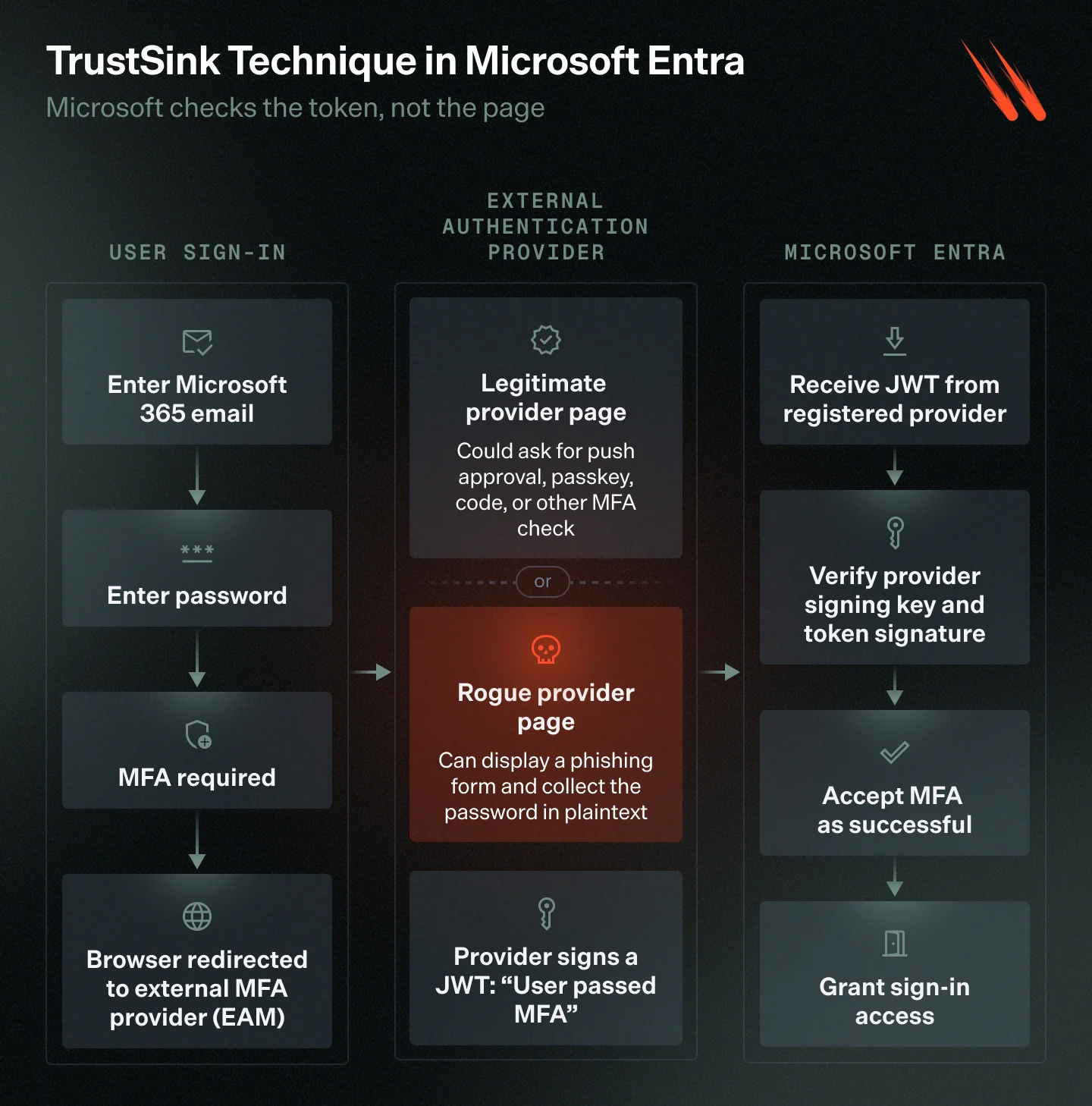
The technique relies on the misuse of External Authentication Methods (EAMs), a feature designed to offer businesses flexibility by permitting alternative third-party identity and security solutions to satisfy multifactor authentication requirements. Under normal operational circumstances, when an enterprise user provides their initial login credentials—such as a password—the identity platform redirects the authentication session to a registered external MFA provider to complete the secondary verification step. If the external provider validates the user and issues a properly signed token, the primary identity broker accepts this cryptographic proof, assumes the verification was successful, and grants access to the requested corporate resources.
However, Varonis Threat Labs demonstrated that an adversary who has already achieved high-level administrative access within a tenant can weaponize this extensible architecture. By registering a malicious external authentication provider, attackers can seamlessly inject themselves into the authentication workflow, capturing user credentials without triggering standard security alerts or causing login failures.
Anatomy of the TrustSink Attack Vector
The mechanics of a TrustSink attack hinge on administrative persistence and abuse of delegated trust. Because the technique requires modifying tenant-level authentication policies, it cannot serve as an initial access vector for breaching a network. Instead, an attacker must first compromise a highly privileged account, specifically one holding a Global Administrator or Authentication Policy Administrator role.
Once inside the administrative perimeter, the threat actor executes a sequence of configuration changes. They register a rogue external MFA provider, establish a corresponding application service principal, and grant the necessary consent within the target environment. From the perspective of the cloud identity provider, this rogue entity appears identical to any legitimate security solution.

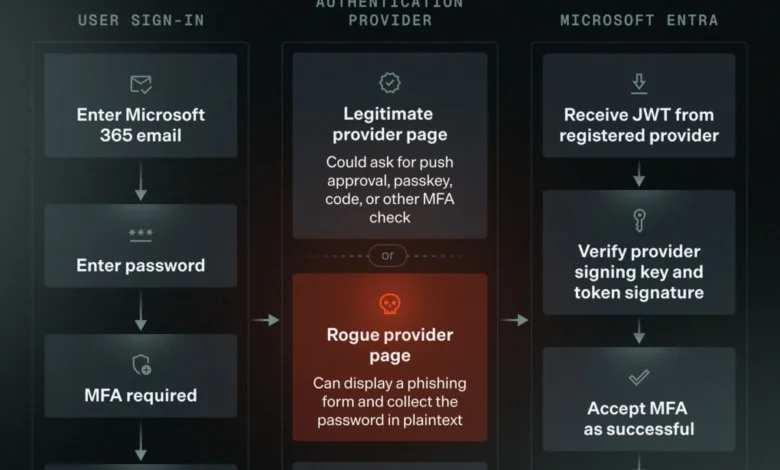
When a targeted victim attempts to log into their corporate account, the authentication sequence begins legitimately. The user navigates to the authentic login portal—such as Microsoft’s standard login page—and inputs their corporate email address and password. At this juncture, the primary identity broker recognizes that multifactor authentication is mandated and initiates a browser redirection to the configured external MFA provider.
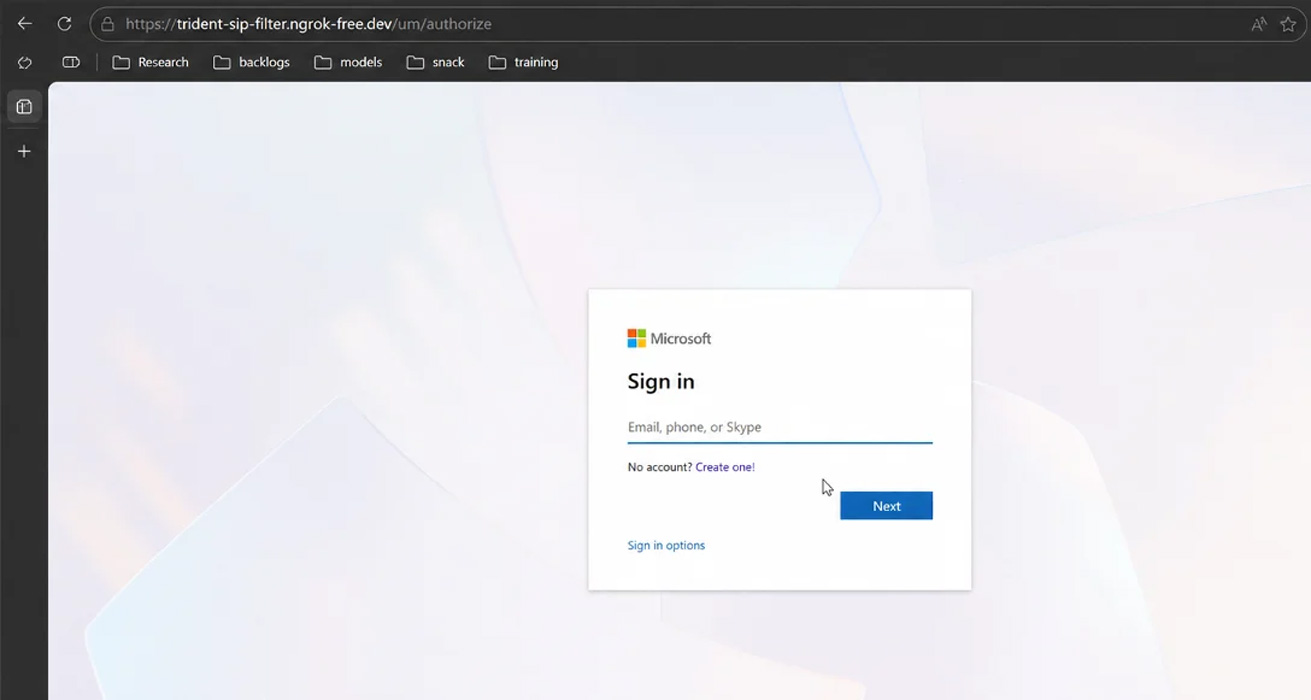
Rather than presenting a legitimate second-factor challenge, such as an authenticator app push notification or a hardware token prompt, the malicious provider displays an authentic-looking replica of the organization’s primary password login screen. Because this prompt appears precisely when the user expects to undergo an additional security verification step, it exploits user expectations and behavioral patterns. The interface mimics Microsoft’s visual styling down to the fonts, color palettes, and button layouts.
Believing that the system is requesting re-authentication for security compliance, the victim enters their password into the fraudulent interface. The rogue server captures this credential in plaintext, logging critical metadata including timestamps and source IP addresses. To ensure the user remains oblivious to the compromise, the malicious provider immediately generates a cryptographically signed token certifying that the multifactor authentication challenge was successfully completed. It passes this token back to the primary identity broker, which processes the sign-in normally and redirects the user to their intended application. The entire transaction concludes without generating error codes, security warnings, or operational disruptions.
Persistence and Remediation Challenges
One of the most concerning aspects of the TrustSink technique is its resilience against standard remediation efforts. In typical credential compromise scenarios, organizations advise users to reset their passwords immediately to sever unauthorized access. Varonis researchers discovered, however, that resetting a compromised password does not neutralize a TrustSink deployment.
Because the rogue external MFA provider remains persistently registered within the tenant’s Authentication Methods Policy, it continues to intercept authentication flows indefinitely. When the victim attempts to log in with their newly created password, the malicious server captures the replacement credential during the subsequent MFA redirection phase. Consequently, threat actors can maintain continuous visibility into credential updates across multiple login cycles.
Security experts emphasize that mitigation requires a strict sequence of administrative actions. Organizations must first identify and purge the unauthorized external MFA provider, along with its associated application registrations, cryptographic keys, and redirect URIs, before initiating password resets for affected users. Failing to remove the underlying integration before credential rotation ensures that the harvesting operation will persist.
Building on Prior Identity Research
The discovery of TrustSink builds upon foundational research presented by security analyst Dirk-Jan Mollema at the x33fcon 2025 security conference during a briefing titled Bringing Your Own Identity in Entra ID. Mollema previously demonstrated that a maliciously registered external MFA provider could bypass security checks entirely by issuing a signed JSON Web Token (JWT) falsely claiming that an authentication challenge had succeeded. While Mollema’s research focused primarily on authentication bypass and unauthorized access, Varonis expanded the attack concept into an active credential-theft vector, proving that external authentication extensions could be weaponized to capture long-term primary secrets.
Broader Implications for Enterprise Cloud Security
The emergence of TrustSink highlights inherent risks associated with modular cloud architectures and the extensibility of enterprise identity providers. As organizations increasingly adopt heterogeneous security environments that rely on third-party integrations, the attack surface expands beyond traditional perimeter defenses. Identity providers function as the ultimate gatekeepers of corporate data, making identity infrastructure a primary target for sophisticated adversaries seeking long-term persistence.
Security analysts point out that while cloud service providers implement robust cryptographic validations—such as requiring properly signed tokens from external providers—they cannot inherently distinguish between a legitimate third-party security service and a maliciously configured server controlled by an administrator-level attacker. This limitation underscores the challenge of balancing administrative flexibility with stringent security controls.
Strategic Recommendations for Defenders
To safeguard enterprise environments against TrustSink and similar post-compromise integration attacks, cybersecurity authorities and researchers recommend a comprehensive defense-in-depth strategy:
-
Privilege Access Management (PAM): Organizations should strictly limit and monitor the assignment of highly privileged administrative roles, such as Global Administrator and Authentication Policy Administrator. Implementing the principle of least privilege ensures that routine administrative tasks do not carry excessive capabilities capable of altering core security policies.
-
Continuous Monitoring and Auditing: Security teams must establish automated monitoring and alerting mechanisms for any modifications to tenant-level Authentication Methods Policies. Unscheduled additions of external MFA providers, service principals, or unexpected consent grants should trigger immediate high-priority incident response investigations.
-
Adoption of Phishing-Resistant Authentication: Deploying modern, hardware-based authentication standards such as FIDO2 security keys or Windows Hello for Business significantly mitigates the impact of credential-harvesting attacks. Because these methods rely on cryptographic challenge-response mechanisms tied to specific origins rather than static secrets like passwords, they cannot be successfully intercepted or replayed by fraudulent login prompts.
-
Comprehensive Incident Response Protocols: Incident responders must be trained to look beyond simple credential theft. When investigating potential compromises involving administrative accounts, teams should audit tenant configuration settings, application permissions, and external identity provider integrations to ensure no residual backdoors remain active.
As enterprise networks continue their migration toward cloud-centric and modular architectures, securing the mechanisms that govern identity federation and authentication extensions will remain a critical priority for defenders navigating evolving threat landscapes.