Speculative Decoding Explained: How This Breakthrough Technique Delivers 3x Faster LLM Inference

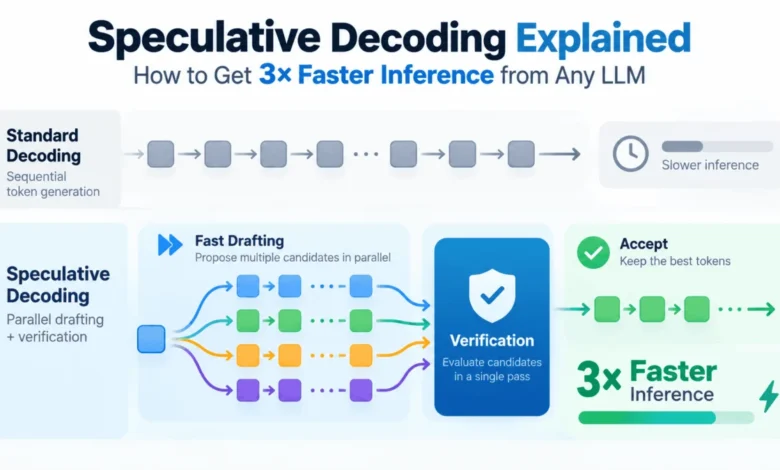
The deployment of Large Language Models (LLMs) has transformed the landscape of modern artificial intelligence, yet the technology remains constrained by a persistent bottleneck: the autoregressive nature of token generation. Every time a user interacts with a chatbot, the model must calculate the probability of the next token, append it to the sequence, and repeat the process. This sequential operation creates a significant latency wall, particularly as model parameters scale into the hundreds of billions. To address this, researchers have developed speculative decoding, a sophisticated inference strategy that achieves significant speed improvements without compromising the statistical integrity of the model’s output. By leveraging a two-tiered architecture, this method effectively transitions LLM inference from a strictly serial process to a parallelized verification task, allowing hardware to operate at maximum efficiency.
The Anatomy of the Inference Bottleneck
To understand the significance of speculative decoding, one must first examine the relationship between compute and memory in modern AI hardware. High-end hardware, such as the NVIDIA H100 or A100 Tensor Core GPUs, possesses immense computational throughput. However, the architecture of an LLM requires that the entire set of model weights be read from high-bandwidth memory (HBM) into the GPU’s compute units for every single token generated.
This architectural requirement renders the system "memory-bandwidth bound." While the processor is theoretically capable of performing trillions of floating-point operations per second (FLOPS), it spends the vast majority of its time waiting for the model’s parameters to traverse the memory bus. In a standard inference scenario, the GPU is essentially idling while it waits for the weight data to arrive, creating a massive discrepancy between theoretical compute power and realized speed. Because this process occurs once per token, the total time required to generate a long response scales linearly with the length of the text, often resulting in sluggish performance that disrupts the user experience in real-time applications like coding assistants or conversational agents.
Evolution of the Speculative Decoding Paradigm
The concept of speculative decoding gained significant traction in early 2023, following seminal research papers from Google and DeepMind. The industry recognized that if a smaller, faster "draft" model could predict the next several tokens, a larger "target" model could verify them in parallel.
The chronology of this development began with the realization that LLMs are often over-parameterized for simple tasks. Researchers discovered that a smaller model—containing perhaps 100 million parameters—could successfully "guess" the next four to eight tokens that a 70-billion-parameter model would eventually select. By allowing the draft model to generate a speculative sequence, the target model could then evaluate all those tokens simultaneously in one forward pass.
This breakthrough allowed for a paradigm shift: instead of 10 separate memory-intensive passes, the system performs one large pass. If the draft model is accurate, the target model validates the entire sequence at once. If the draft model errs, the target model corrects it, but the computational cost remains manageable. This methodology maintains a formal mathematical guarantee: the resulting distribution of the output is identical to that of the target model acting alone, ensuring that quality is not sacrificed for speed.
Supporting Data and Performance Metrics
Empirical data from various benchmarks suggests that speculative decoding can improve token generation speeds by 2x to 3x, depending heavily on the task and the quality of the draft model. In scenarios involving highly predictable text—such as standardized code completion or routine document summarization—acceptance rates for draft tokens often exceed 80 percent.
In a typical production environment, the latency savings are most pronounced when the model is serving a single request rather than a large batch. When a system is under heavy load with multiple concurrent users, the trade-offs become more complex. In high-throughput, multi-tenant environments, the draft model consumes memory and compute cycles that might otherwise be allocated to other incoming requests. Consequently, engineering teams must evaluate whether the reduction in latency per request justifies the potential impact on overall system throughput.
Modern Implementations: Beyond Two-Model Systems
While the dual-model approach remains the gold standard for accuracy, the engineering community has evolved the technique to reduce the overhead of managing two distinct model architectures. Modern implementations now fall into three primary categories:
- Draft-Model Systems: The original implementation using a small, independent model (e.g., using a TinyLlama draft model to speed up a Llama-3 70B target model).
- Multi-Head Prediction (Medusa): Instead of a separate model, developers attach specialized "prediction heads" to the final layer of the target model. These heads predict multiple future tokens simultaneously based on the internal activations of the target model itself.
- Prompt Lookup Decoding: This method requires no secondary model. It scans the existing prompt or conversation history to identify recurring phrases or patterns, which are then used as candidates for the target model to verify. This has proven exceptionally effective for technical documentation and source code, where specific syntax or variable names appear repeatedly.
Industry Adoption and Official Responses
Major open-source inference frameworks have moved quickly to integrate these capabilities. Projects such as vLLM, Hugging Face’s Text Generation Inference (TGI), and llama.cpp have incorporated speculative decoding into their core libraries.
In a statement regarding their infrastructure roadmap, maintainers of the vLLM project emphasized that speculative decoding represents a "fundamental shift in how we approach the cost of intelligence." By reducing the time-to-first-token and increasing the total throughput of tokens per second, these libraries are enabling developers to build agents that feel significantly more responsive. The industry consensus suggests that as these techniques become more refined, they will move from optional "experimental" features to standard configurations in commercial AI deployments.
Broader Implications for AI Infrastructure
The rise of speculative decoding has significant implications for the economics of AI. If a company can achieve 2x higher throughput on the same hardware, they effectively halve the cost of inference per token. This scalability is critical for the long-term viability of AI-powered SaaS products.
Furthermore, this development highlights a broader trend in computer science: optimizing performance not through brute-force hardware upgrades, but through architectural ingenuity. By understanding the physical limitations of GPU memory bandwidth, software engineers are finding ways to "outsmart" the hardware.
However, practitioners must be cautious. The "best-case scenario" assumes a high level of synergy between the draft and target models. If the draft model is poorly suited to the task, the system may spend more time correcting errors than it would have spent generating the text conventionally. Proper model pairing—ensuring that the draft model shares the same vocabulary and "logic" as the target model—remains the most significant engineering hurdle.
Future Outlook: The Path Toward Real-Time Intelligence
Looking ahead, the next phase of speculative decoding will likely involve more dynamic, self-optimizing draft mechanisms. We are already seeing the emergence of "self-speculation," where the model learns to draft its own sequences during the training phase.
As LLMs continue to be integrated into everything from medical diagnostic tools to real-time translation services, the demand for low-latency inference will only grow. Speculative decoding serves as a critical bridge between the high-latency models of today and the near-instantaneous AI agents of the future. While it is not a "magic bullet" that eliminates all performance concerns, it is a robust, mathematically sound, and highly effective tool that has fundamentally changed the economics and operational feasibility of large-scale language model deployment. By shifting the bottleneck from the memory-intensive generation process to the compute-efficient verification process, developers are successfully unlocking a new level of responsiveness that was previously thought to be impossible without significantly more expensive hardware.