Austrian E-commerce Growth Surges as Digital Retail Reaches 12.4 Billion Euro Milestone in 2025

The digital transformation of the Austrian retail landscape reached a significant inflection point in 2025, with online channels capturing more than 16 percent of total consumer retail spending. This figure represents a notable expansion from the 14.9 percent recorded in the previous year, signaling a consistent shift in consumer behavior toward digital marketplaces. According to the latest comprehensive analysis provided by RegioData Research, this growth trajectory has propelled the total volume of the Austrian e-commerce market to approximately 12.4 billion euros. This surge is not merely a quantitative increase but reflects a qualitative shift in how the average Austrian household allocates its disposable income, with annual per-capita spending on digital goods now hovering around 1,400 euros.
The Chronology of Digital Adoption in Austria
To understand the current state of the Austrian e-commerce market, one must examine the progression of the last decade. Following the global pandemic, which acted as a catalyst for digital adoption across Europe, Austria experienced a rapid recalibration of retail expectations. In the early 2020s, the market was characterized by a cautious transition from brick-and-mortar dependency to hybrid shopping models. By 2023, the market began to stabilize, but the acceleration seen in 2024 and 2025 suggests that online retail has moved beyond a "pandemic convenience" phase and into a structural component of the national economy.
The 1.1 percentage point increase in total retail market share from 2024 to 2025 may appear incremental on the surface, yet it represents hundreds of millions of euros flowing into digital channels rather than traditional high-street storefronts. This shift has forced domestic retailers to accelerate their omnichannel strategies, investing heavily in logistics, user experience, and digital payment infrastructure to remain competitive against international giants.
Sector-Specific Digital Penetration
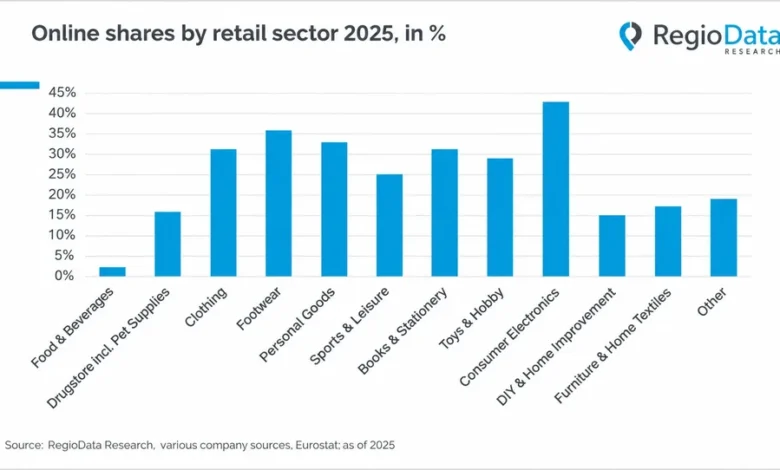
The shift toward e-commerce is far from uniform across different retail categories. The data reveals a clear hierarchy of digital dominance, where products with high standardization and clear technical specifications lead the charge.
Consumer electronics remains the undisputed leader in the digital shift, with an impressive 43 percent of all consumer spending in this sector occurring online. This high penetration rate is attributed to the ease of comparing technical specifications, the transparency of pricing, and the logistical maturity of electronics delivery services. Footwear follows closely, with 36 percent of the market share captured by e-commerce platforms. The success of online footwear retailers is largely linked to the implementation of "try-before-you-buy" policies and streamlined return processes, which have mitigated the traditional concerns regarding fit and comfort.
Personal goods, such as cosmetics and accessories, account for 33 percent of online retail activity, while both clothing and the publishing sector (books) maintain a 31 percent online share. These figures suggest that consumers are increasingly comfortable purchasing items that require a degree of aesthetic or intellectual evaluation without physical inspection, provided that the online retailer offers robust digital imagery and reliable user review systems.

A Comparative Look at the European Landscape
When placed within the broader European context, Austria occupies a pragmatic middle ground. The European e-commerce market is characterized by significant regional variance, driven by differences in logistics infrastructure, digital literacy, and cultural attitudes toward card-based payments.
The United Kingdom remains the clear frontrunner in Europe, with an online market share approaching 29.3 percent. The UK’s dominance is largely historical, stemming from an early-mover advantage in digital infrastructure and a highly concentrated delivery network. Austria’s 16 percent share places it in close alignment with its neighbor, Germany, which reports an online retail share of 16.8 percent. This proximity is unsurprising, given the linguistic and economic ties between the two nations and the shared reliance on cross-border logistics.
At the other end of the spectrum, nations such as Serbia show a much lower digital adoption rate, with only 6.7 percent of retail spending flowing through online channels. This gap highlights the digital divide that continues to exist across the continent, where underdeveloped payment gateways and less efficient last-mile delivery services act as friction points for broader e-commerce integration.
The Dominance of Cross-Border Platforms
Perhaps the most critical finding for domestic Austrian retailers is the imbalance between local and international e-commerce revenue. Only slightly more than 40 percent of total online spending in Austria is captured by local online stores. The remaining majority is directed toward cross-border sellers, which operate on a scale that domestic players struggle to emulate.
The concentration of market power among a few global players is stark. Amazon continues to dictate the pace of the Austrian market, commanding a 35.1 percent share of online retail. Following the American giant are newer, aggressive entrants such as Temu, which has captured 5.1 percent of the market, and the veteran marketplace eBay, with 4.1 percent.
The rise of Chinese-backed e-commerce platforms—specifically Temu, Shein, and AliExpress—has become a significant point of interest for market analysts. Together, these entities now hold a 7.9 percent market share. Their ability to leverage massive supply chain efficiencies and aggressive digital marketing strategies has disrupted traditional retail models, putting immense pressure on smaller, domestic Austrian businesses that lack the capital to compete on price or logistics speed.
Implications for the Austrian Retail Economy
The sustained growth of e-commerce carries profound implications for the Austrian economy. For urban planning and commercial real estate, the trend poses a long-term challenge to the viability of traditional city centers. As retail spending migrates online, the role of physical stores is shifting from pure transactional spaces to experiential centers, where the focus is on brand interaction rather than inventory volume.

Furthermore, the reliance on cross-border platforms raises questions regarding the "leakage" of tax revenue and the sustainability of domestic retail employment. While the consumer benefits from lower prices and greater product variety, there is a mounting conversation among policymakers regarding how to level the playing field for local SMEs. Industry experts suggest that the future of Austrian retail lies in "phygital" strategies—integrating digital convenience with the unique value proposition of local service and regional accountability.
Expert Perspectives and Future Outlook
Industry analysts monitoring these trends suggest that the growth of e-commerce in Austria will not necessarily reach a ceiling in the near future. As artificial intelligence continues to personalize the shopping experience and as logistics networks become more automated, the barrier to entry for shopping online will effectively disappear.
"We are witnessing the maturity of the digital consumer," notes a representative from the retail analysis sector. "The convenience once reserved for early adopters is now the baseline expectation for all demographics. For the Austrian retailer, the challenge is no longer about ‘getting online,’ but about providing a value-add that a massive, centralized, cross-border platform cannot—such as hyper-local service, sustainability transparency, or specialized product knowledge."
Looking toward 2026 and beyond, the expectation is that the online share of retail will continue to climb, albeit at a potentially more measured pace as it approaches the saturation points already seen in the UK. The primary battleground will likely shift from market share acquisition to customer retention, as the novelty of online shopping gives way to a highly competitive environment defined by loyalty programs, delivery speed, and the integration of social commerce.
In conclusion, the 2025 data serves as a definitive roadmap for the Austrian retail sector. With over 12.4 billion euros now flowing through digital channels, the mandate for both business leaders and regulators is clear: the digital economy is no longer an alternative to traditional retail—it is the dominant force shaping the commercial future of the nation. As local retailers navigate the influence of global giants, their success will depend on their agility, their ability to harness data, and their capacity to offer a distinct, localized experience that keeps the consumer engaged in the domestic market.