Four Critical Linux Kernel Flaws Exposing Systems to Local Privilege Escalation Disclosed by Security Researcher

Security researcher Asim Manizada has publicly released working exploit code targeting four distinct vulnerabilities within the Linux kernel. These flaws allow a local, unprivileged user to escalate their privileges to root—the highest level of administrative access on a Linux-based operating system. Although core kernel maintainers have aggressively rolled out patches over the past several weeks, the public availability of exploit material underscores an urgent imperative for systems administrators to apply the latest security updates immediately, particularly on multi-user systems and shared environments.
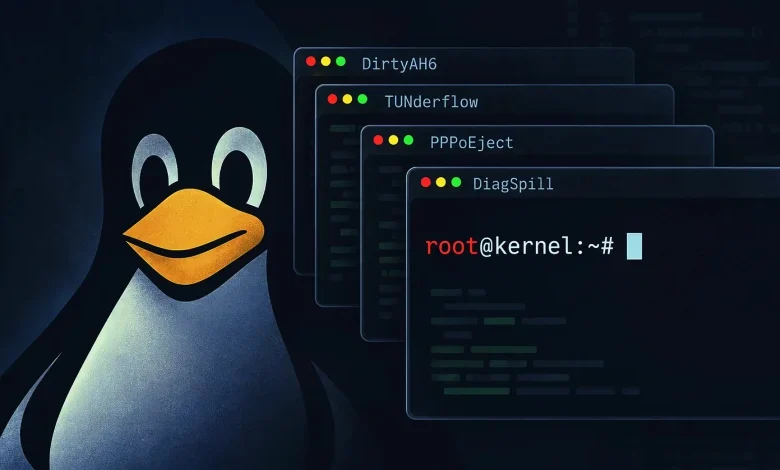
The vulnerabilities, collectively dubbed the "LPE Quartet," comprise DirtyAH6, TUNderflow, PPPoEject, and DiagSpill. Each flaw resides within the deep networking subsystems of the Linux kernel, representing memory-safety vulnerabilities that date back over a decade. Manizada officially reported the issues to the Linux kernel security team in mid-July. Following a coordinated disclosure timeline designed to give major Linux distributions adequate runway to test and deploy fixes, Manizada published his technical analysis and working exploit code on September 18.
At the time of disclosure, there are no documented instances of these exploits being utilized in active, real-world cyberattacks. The exploit scripts developed by Manizada are specifically calibrated to precise kernel builds and carry a non-trivial risk of causing a kernel panic or system crash, meaning they are presently suited primarily for isolated laboratory environments. Nevertheless, the public release of functional local privilege escalation (LPE) primitives dramatically lowers the barrier to entry for malicious actors who have already established a low-level foothold on a target machine.
Chronology and Coordinated Disclosure Timeline
The discovery and remediation of the LPE Quartet followed standard industry protocols for responsible vulnerability disclosure, emphasizing collaboration between independent security researchers, core kernel maintainers, and downstream Linux distribution vendors.
Mid-July marks the initial phase of the incident lifecycle, when Asim Manizada completed his analysis and submitted formal vulnerability advisories to the Linux kernel security team. This notification triggered an internal review and code audit by maintainers responsible for the affected networking submodules.
Throughout August and early September, core developers formulated and backported patches to stable kernel branches, distributing them privately to major enterprise and consumer Linux distributions—including Debian, Ubuntu, Red Hat, and SUSE—to prepare localized packages.

On September 18, the coordinated embargo lifted. Manizada published his comprehensive technical write-up detailing the mechanics of the exploits, alongside proof-of-concept code, empowering administrators worldwide to audit and update their enterprise assets.
Technical Analysis: Vulnerability Breakdown and Prerequisites
The four vulnerabilities stem from historical memory-safety flaws hidden within networking components of the Linux kernel. The underlying codebase mistakes have persisted undetected for periods ranging from 10 to 21 years, highlighting the ongoing challenge of securing complex, legacy operating system components.
Three of the four flaws—DirtyAH6, TUNderflow, and PPPoEject—require an ordinary, unprivileged user to operate within an unprivileged user namespace to successfully trigger the exploit chain. User namespaces are a widely adopted security feature in modern Linux distributions that allow standard users to map themselves as a pseudo-root user inside an isolated sandbox environment. Because many distributions enable unprivileged user namespaces by default out of the box, attackers can leverage this mechanism to acquire the requisite network and administrative capabilities necessary to interact with vulnerable subsystems.
The fourth vulnerability, DiagSpill, diverges from this pattern by requiring neither user namespaces nor any special local privileges, provided that the system has the SCTP (Stream Control Transmission Protocol) networking module loaded and available.
To provide a clear technical overview of the affected components, the following table summarizes the CVE identifiers, targeted kernel areas, local prerequisites, and remote exposure vectors for each vulnerability:
| Flaw Name | CVE Identifier | Kernel Subsystem | Local Prerequisite | Remote Impact Vectors |
|---|---|---|---|---|
| DirtyAH6 | CVE-2026-80844 | IPsec AH6 (IPv6) | Unprivileged user namespaces | Denial of service (Crash) under specific IPv6 routing and transport mode configurations |
| TUNderflow | CVE-2026-81000 | TUN/TAP virtual network devices | Unprivileged user namespaces | None (Local only) |
| PPPoEject | CVE-2026-68121 | PPPoE (Point-to-Point Protocol over Ethernet) | Unprivileged user namespaces | None (Local only) |
| DiagSpill | CVE-2026-74469 | SCTP (sctp_diag) |
None | Denial of service (Crash) only when non-default SCTP options are active |
Beyond their primary function as local privilege escalation vectors, Manizada demonstrated that two of the flaws—DirtyAH6 and DiagSpill—can theoretically be triggered across a network under highly restrictive and narrow conditions, primarily resulting in a system crash rather than remote code execution.
DirtyAH6 can induce a kernel panic on a host acting as an IPv6 router or gateway that processes incoming traffic utilizing an IPsec Authentication Header in transport mode. Similarly, DiagSpill can crash a machine only when specific, non-default SCTP diagnostic options are explicitly enabled. Manizada noted that while he achieved remote root execution using DirtyAH6 within a controlled laboratory setting through careful memory manipulation, orchestrating such an attack purely from a remote position without prior local insight remains exceptionally difficult. For DiagSpill, he observed no viable execution path toward remote code execution or privilege escalation under any configuration.

Furthermore, security analysts have noted that these memory corruption primitives could theoretically assist an attacker in executing container escapes, although functional escape exploits were not constructed during this research cycle.
The Role of Artificial Intelligence in Vulnerability Discovery
A notable aspect of the discovery of the LPE Quartet is the methodology employed by the researcher. Manizada revealed that these four vulnerabilities were identified utilizing an artificial intelligence-assisted workflow. This custom tooling systematically mapped how the Linux kernel manages memory allocations and reasoned through complex kernel memory layouts to pinpoint subtle logic errors.
The integration of artificial intelligence into vulnerability research represents an accelerating trend within the cybersecurity landscape. Throughout 2026, a series of high-profile Linux kernel privilege escalation flaws have been disclosed, several of which were uncovered with the analytical assistance of large language models and automated code-reasoning engines. For instance, Manizada previously disclosed a related Open vSwitch flaw designated as OVSwrap in July. Additionally, one of the exploit primitives utilized in the LPE Quartet successfully reuses a memory-spraying and layout technique originally developed for the "Dirty Frag" vulnerability disclosed earlier in May by an independent researcher.
The influence of this AI-driven approach is explicitly documented in the official source tree; the kernel commit patching the DirtyAH6 vulnerability features an "Assisted-by" credit acknowledging Manizada’s automated methodology. Manizada has indicated that this comprehensive disclosure likely concludes the public phase of his current AI-assisted vulnerability hunting research cycle.
Mitigation Strategies and Remediation Guidance
The definitive remediation for the LPE Quartet is to update the Linux kernel to versions containing the official vendor patches. Because the Linux kernel ecosystem relies heavily on upstream projects integrated into diverse downstream distributions, administrators must consult security advisories specific to their operating system vendor—such as Canonical (Ubuntu), Debian, Red Hat, or SUSE—rather than relying solely on mainline kernel version numbers.
In enterprise environments where immediate patching and server reboots are operationally constrained, systems administrators can implement temporary mitigations to reduce exposure:
- Disable Unprivileged User Namespaces: On distributions that permit it, restricting unprivileged user namespaces via kernel sysctl parameters (such as
kernel.unprivileged_userns_clone) effectively blocks three of the four exploits (DirtyAH6, TUNderflow, and PPPoEject) by removing the sandbox capabilities required to reach the vulnerable code paths. - Unload Unused Kernel Modules: Restricting or blacklisting optional networking modules, such as the SCTP module required by DiagSpill, limits the attack surface available to unauthorized local users.
Security experts strongly emphasize that these configuration changes should be treated strictly as stopgap measures. Permanent patching remains the only reliable defense, as alternative code paths or future exploitation vectors targeting the same underlying subsystems may still exist within unpatched operating systems.