Meta Unveils React Native 0.85 with Revolutionary Animation Backend and Performance-Driven Architecture Upgrades

Meta Platforms Inc. has officially announced the release of React Native version 0.85, a landmark update that introduces a fundamental shift in how the framework handles mobile animations and developer tooling. This latest iteration represents a significant milestone in the ongoing evolution of the cross-platform framework, focusing heavily on performance optimization, architectural modularity, and enhanced security for development environments. By introducing a new shared animation backend and streamlining the core package through the decoupling of testing utilities, version 0.85 signals Meta’s commitment to maintaining React Native as the industry standard for high-performance mobile application development.
A New Era for Mobile Fluidity: The Shared Animation Backend
The centerpiece of the React Native 0.85 release is the introduction of the New Shared Animation Backend. Developed in close collaboration with Software Mansion—the primary maintainers of the widely used Reanimated library—this new internal engine represents a complete overhaul of the animation reconciliation process. Historically, React Native developers faced a dichotomy between the built-in Animated API and community-driven solutions like Reanimated. These two systems often operated on different logic paths, leading to inconsistencies and performance bottlenecks when attempting complex layout transitions.
The new shared backend unifies the internal logic that powers both the core Animated library and the third-party Reanimated library. By moving the primary animation update logic into the React Native core, the framework can now achieve levels of performance and stability that were previously unattainable. This architectural shift ensures that animation updates are synchronized more effectively with the UI thread, reducing frame drops and jitter during complex transitions.
One of the most immediate benefits for developers is the newfound ability to animate layout properties—such as width, height, and Flexbox attributes—using the native driver. Previously, React Native’s native driver was restricted to non-layout properties like opacity and transform. Animating layout-related props required the JavaScript thread to calculate every frame, which often led to laggy UI if the thread was occupied with heavy business logic. With 0.85, these constraints are largely removed, allowing for buttery-smooth layout transitions that run entirely on the native side of the application.
Modernizing the Testing Infrastructure: Jest Package Migration
In an effort to further the "Lean Core" initiative—a long-standing project aimed at reducing the size and complexity of the main react-native package—version 0.85 migrates the Jest preset to a dedicated package. Previously bundled directly within the core, the Jest configuration now resides in @react-native/jest-preset.
This move is more than just a house-cleaning exercise; it provides developers with greater flexibility in managing their testing environments. By decoupling the testing logic from the runtime core, Meta can iterate on testing utilities more rapidly without necessitating a full framework update. For development teams, this requires a simple one-line update in their jest.config.js files, transitioning from the legacy preset: 'react-native' to the modern @react-native/jest-preset. This change reflects a broader industry trend toward monorepo structures and modular dependency management, ensuring that projects only import the specific tools they require for their CI/CD pipelines.
Enhanced Security and Developer Experience: Metro TLS Support
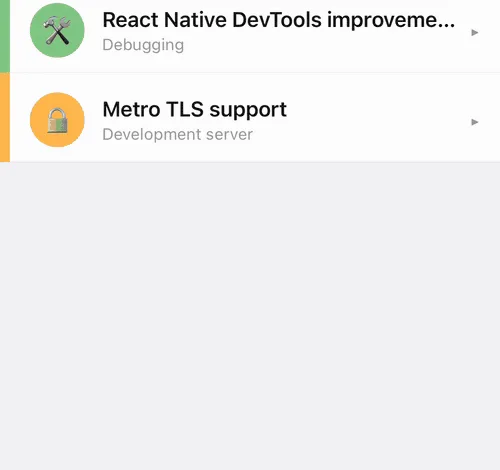
Recognizing the increasing security requirements of modern web and mobile APIs, React Native 0.85 introduces native support for Transport Layer Security (TLS) within the Metro development server. In previous versions, testing local APIs that enforced secure HTTPS or WSS (WebSocket Secure) connections often required complex workarounds or third-party proxy tools.
The new Metro TLS configuration allows developers to define a TLS object directly within metro.config.js. By providing paths to Certificate Authority (CA), certificate, and key files, developers can now run their development server over HTTPS. This is particularly critical for features like Fast Refresh, which can now operate over WSS. The inclusion of this feature simplifies the development of applications that interact with secure banking, healthcare, or enterprise-grade APIs, where non-secure connections are often blocked by default. Meta recommends tools like mkcert to generate locally-trusted certificates, further streamlining the setup for developers working in highly regulated industries.
Dropping Legacy Support and Addressing Breaking Changes
As with any major version update, React Native 0.85 moves the ecosystem forward by shedding support for outdated technologies. This release officially drops support for end-of-life (EOL) Node.js versions, specifically requiring version 20.19.4 or higher. This shift aligns React Native with the Node.js Long Term Support (LTS) lifecycle, ensuring that developers are utilizing a runtime environment that receives critical security patches and performance optimizations.

Furthermore, the release sees the removal of several deprecated APIs, most notably StyleSheet.absoluteFillObject. Developers are encouraged to transition to StyleSheet.absoluteFill or to define custom positioning styles. While seemingly minor, these removals are essential for maintaining a clean API surface and preventing technical debt from accumulating in large-scale codebases. The release also includes various breaking changes across General, Android, and iOS categories, necessitating a thorough review of the official changelog and the use of the React Native Upgrade Helper for teams migrating from version 0.84 or earlier.
Chronology of Development and Community Impact
The journey to React Native 0.85 has been marked by a rigorous development cycle involving over 604 commits from 58 unique contributors. This release cycle highlights the collaborative nature of the React Native ecosystem, where Meta engineers work alongside community powerhouses like Software Mansion and independent developers to solve core infrastructure challenges.
The development timeline for 0.85 began shortly after the stabilization of version 0.84, with a focus on refining the "New Architecture" (Fabric and TurboModules). While the New Architecture has been available for several versions, 0.85 represents a phase of "deep optimization," where the internal mechanics—like the animation backend—are being re-engineered to take full advantage of the synchronous threading model provided by Fabric.
Technical Analysis: Strategic Implications for the Mobile Industry
The implications of React Native 0.85 extend beyond simple feature additions. The framework is positioning itself to compete more aggressively with native development (Swift/Kotlin) and other cross-platform rivals like Flutter. By solving the "layout animation problem," React Native addresses one of the most persistent criticisms of JavaScript-based frameworks: the perceived "jank" during complex UI shifts.
From a strategic standpoint, the partnership with Software Mansion is a masterstroke in ecosystem management. By integrating the logic of a popular community library into the core, Meta reduces fragmentation. Developers no longer have to choose between the stability of core APIs and the power of community libraries; they can now enjoy the best of both worlds with a unified engine.
For enterprise organizations, the move to Metro TLS and the strict Node.js versioning provides a more predictable and secure development lifecycle. As mobile apps become more integrated with complex cloud infrastructures, the ability to mirror production security environments during local development is no longer a luxury but a necessity.
The Path Forward: Upgrading and Ecosystem Readiness
Meta has confirmed that version 0.85 is now the latest stable release, while version 0.82.x has officially moved to unsupported status. This transition follows React Native’s established support policy, which typically maintains the three most recent minor versions.
For developers looking to adopt the new features, particularly the experimental animation backend, Meta recommends opting into the experimental channel. This feature will be fully accessible starting with version 0.85.1, which is slated for release in the immediate future.
The broader ecosystem is already preparing for the shift. Expo, the most popular toolset for React Native development, has announced that its upcoming SDK 56 will include React Native 0.85 as its foundation. This ensures that a vast majority of the React Native community will have a streamlined path to adopting these new performance improvements and architectural changes by the next major SDK release.
As the mobile development landscape continues to demand higher performance and better developer ergonomics, React Native 0.85 stands as a testament to the framework’s maturity. By focusing on the fundamentals—animations, testing, and security—Meta and the React Native community are ensuring that the framework remains robust enough to power the world’s most demanding mobile applications for years to come.
Related posts: