React Native 0.72 Introduces Beta Support for Package Exports in Metro Bundler to Enhance Ecosystem Compatibility

React Native 0.72 marks a significant milestone in the evolution of the mobile framework’s development experience, introducing beta support for the "exports" field in package.json within Metro, the platform’s dedicated JavaScript bundler. This update represents a concerted effort by Meta and the broader open-source community to align React Native’s module resolution logic with modern Node.js standards, effectively bridging a long-standing gap between mobile development and the wider JavaScript ecosystem. By implementing support for this field, Metro allows developers to define clear entry points for their packages, manage subpath mapping, and enforce encapsulation, all while providing a standardized mechanism for multiplatform targeting.
The Evolution of JavaScript Module Resolution in React Native
For years, the React Native ecosystem relied primarily on the "main" field and the "react-native" root field in package.json to resolve module entry points. While functional, this approach lacked the granularity required by modern, complex libraries that target multiple environments, such as Android, iOS, and the web. The "main" field typically points to a single file, forcing library maintainers to use non-standardized workarounds or deep-importing hacks to expose specific parts of a package.
The introduction of the "exports" field in Node.js 12.7.0 was designed to solve these issues by providing a powerful, flexible way to define how a package’s internal files are exposed to consumers. However, because Metro serves as a specialized bundler optimized for the unique constraints of mobile environments—such as the need for rapid hot-reloading and specific platform extensions—it did not immediately adopt the "exports" specification. With the release of version 0.72, this integration has entered the beta phase, signaling a transition toward a more robust and spec-compliant future for React Native dependency management.
Understanding the Package Exports Field
The "exports" field is often described as a modern replacement for the "main" field, though it can coexist with it for backward compatibility. Its primary function is to define a mapping of subpaths that can be externally imported. This allows a package maintainer to hide internal implementation details while exposing a clean public API. For instance, a package named @ui/components can map the subpath ./buttons to an internal file located at ./src/elements/button/index.js, allowing consumers to simply write import Button from '@ui/components/buttons'.
Beyond simple mapping, the "exports" field supports conditional exports. This allows a single import statement to resolve to different files depending on the environment in which the code is running. This is particularly critical for the React Native community, which frequently deals with hybrid projects using React Native for Web. Previously, resolving the correct version of a library across web and mobile platforms was often ambiguous and prone to configuration errors. The "exports" field eliminates this ambiguity by allowing maintainers to explicitly define "browser", "node", and "react-native" conditions.
Technical Implementation and the New "react-native" Condition
A pivotal component of this update is the introduction of "react-native" as a community-recognized condition within the conditional exports framework. This elevates React Native to a first-class citizen alongside other established runtimes like Node.js and Deno. By using the "react-native" condition, library authors can provide a specific entry point optimized for mobile bundles, separate from the versions intended for server-side rendering or standard web browsers.
Metro’s implementation of this feature is designed to be spec-compliant yet pragmatic. When the feature is enabled via the resolver.unstable_enablePackageExports flag in metro.config.js, Metro prioritizes the "exports" field over other fields like "main" or "module." If a match is found within "exports," Metro follows that path directly. This adherence to the specification ensures that React Native projects behave predictably when consuming the approximately 16,600 packages that currently utilize the "exports" field in the npm registry.
The Road to Standardization: Chronology and Development
The journey toward supporting package exports in Metro was not an overnight development but the result of extensive collaboration between Meta’s engineering teams and the React Native community. The process began with a formal Request for Comments (RFC) aimed at identifying the specific needs of mobile developers.
- Node.js 12.7.0 (2019): The "exports" field is introduced to the JavaScript world, setting a new standard for package entry points.
- Community Discussions (2021-2022): Developers increasingly report friction when using modern web libraries in React Native, as Metro cannot resolve the "exports" field, leading to "module not found" errors or incorrect file resolutions.
- The RFC Process (Late 2022): A formal proposal is submitted to the React Native community. Key stakeholders, including maintainers of Expo and major UI libraries, provide feedback on how to handle platform-specific extensions (like .ios.js and .android.js) in conjunction with "exports."
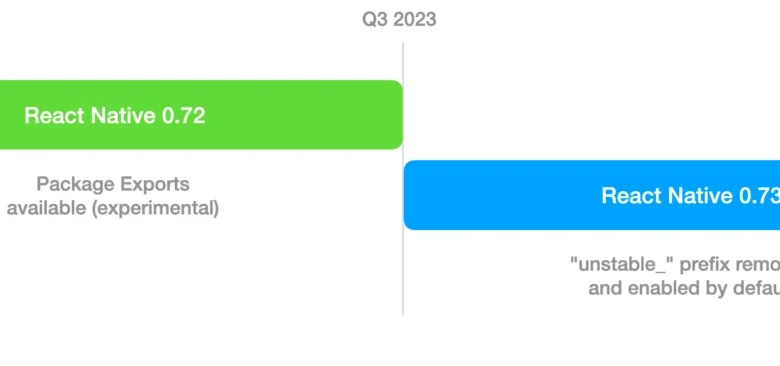
- Beta Release in 0.72 (June 2023): Metro officially includes the feature as an opt-in beta, allowing for real-world testing and bug reporting.
- Planned Default in 0.73 (Late 2023): The rollout plan targets version 0.73 for a stable release where "exports" support will be enabled by default for all new projects.
This timeline highlights the cautious, stability-first approach taken by the React Native core team. Given the massive scale of the React Native ecosystem, any change to module resolution carries the risk of breaking thousands of existing apps.
Impact on Application Developers and Migration Protocols
For the average application developer, the immediate impact of React Native 0.72 is the ability to use a wider range of modern JavaScript libraries without needing complex workarounds in their Metro configuration. However, enabling the feature requires a deliberate validation process.

The React Native team recommends that early adopters enable the unstable_enablePackageExports flag and perform a "dry run" of their dependency resolution. Because "exports" enforces package encapsulation—meaning any file not explicitly listed in the "exports" field is inaccessible—some older projects that rely on "deep imports" into a package’s internal folder structure may encounter warnings or errors.
To mitigate friction, Metro currently employs a "lenient" encapsulation mode. If a developer attempts to import a subpath not listed in a package’s "exports," Metro will log a warning rather than failing the build entirely. This allows developers to identify and fix illegal imports or request that library maintainers expose the necessary APIs before a future "strict" mode is implemented to match Node’s default behavior.
Library Maintenance: A New Paradigm for Encapsulation
Package maintainers stand to benefit the most from these changes, but they also face the greatest responsibility. The "exports" field provides a level of control over a library’s public surface area that was previously impossible. By defining specific entry points, maintainers can refactor their internal directory structures without fear of breaking consumer code, provided the mapped subpaths remain constant.
The migration guide provided by the Metro team emphasizes that adding an "exports" field should be treated as a breaking change. Maintainers are encouraged to use the new "react-native" condition to replace the older, non-standard "react-native" root field. This shift not only improves compatibility with Metro but also ensures that other tools, such as Vite, Webpack, and various test runners, can correctly interpret the package’s structure.
Comparative Analysis: React Native and the Broader Web Ecosystem
The move toward "exports" support is a clear signal that React Native is moving away from being a "walled garden" with its own unique rules and toward a unified JavaScript development model. In the broader web ecosystem, tools like Webpack 5 and Vite have already made "exports" the default standard. By bringing Metro into alignment, Meta is reducing the "knowledge tax" required for web developers to transition into mobile development.
From a performance standpoint, the "exports" field also aids in better tree-shaking and bundle optimization. When entry points are clearly defined, bundlers can more accurately determine which parts of a library are actually in use, potentially leading to smaller application sizes—a critical factor for mobile users on limited data plans or older hardware.
Official Responses and Community Feedback
The response from the React Native community has been overwhelmingly positive. Simen Bekkhus, a prominent contributor to the Jest and React Native ecosystems, noted that this change simplifies the testing infrastructure, as it reduces the discrepancy between how Metro and Jest (which uses Node resolution) see the same package.
Meta engineers Moatiz (motiz88) and Rob Hogan, who spearheaded the development, emphasized that while the feature is in beta, the goal is to reach a state of "boring" stability. "Supporting these features in Metro will allow the ecosystem to move forward," the team stated in their official documentation. They acknowledged that while React Native was previously a "holdout" for some packages to migrate to "exports," the framework is now ready to support the next generation of JavaScript development.
Future Outlook: The Transition to Default Support
As the React Native team looks toward version 0.73 and beyond, the focus remains on refining the performance of the new resolver. Module resolution is a hot path in the bundling process, and any overhead added by parsing complex "exports" maps must be minimized to maintain Metro’s reputation for speed.
The ultimate goal is a seamless environment where a developer can share code between a Node.js backend, a React web frontend, and a React Native mobile app, with all three environments resolving dependencies in a consistent, predictable manner. The beta support in 0.72 is the foundation for this unified future, ensuring that React Native remains a competitive and modern choice for cross-platform development in an ever-evolving technological landscape. By embracing industry standards like the "exports" field, React Native is not just keeping pace with the JavaScript ecosystem—it is actively participating in its standardization.