Building Agentic Workflows in Python with LangGraph: A Comprehensive Guide to Persistent AI Agents

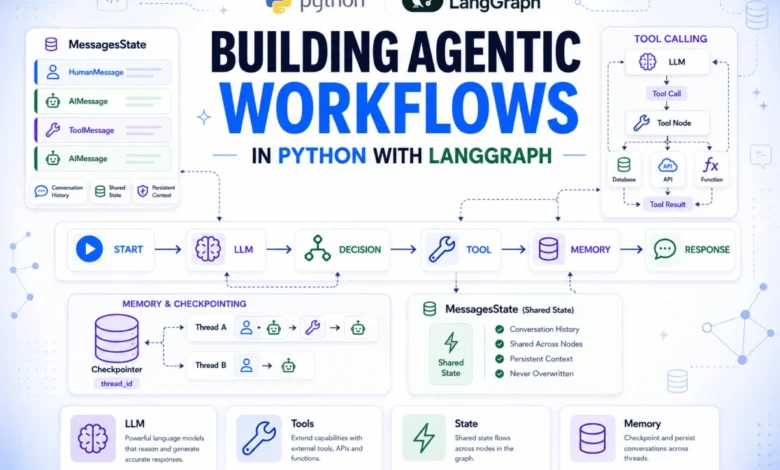
The landscape of artificial intelligence is currently undergoing a significant paradigm shift, moving away from simple, single-turn interactions toward complex "agentic workflows." While early implementations of Large Language Models (LLMs) focused primarily on zero-shot or few-shot prompting, the industry is now gravitating toward autonomous agents capable of iterative reasoning, tool usage, and long-term memory. At the forefront of this evolution is LangGraph, a library designed by the LangChain team to facilitate the creation of stateful, multi-actor applications. By representing AI agents as graphs, LangGraph addresses the limitations of linear chains, allowing for cycles, persistence, and complex decision-making processes that are essential for production-grade AI applications.
The Evolution of AI Architectures: From Chains to Graphs
In the early stages of the generative AI boom, developers relied heavily on "chains"—sequences of pre-defined steps where the output of one model call served as the input for the next. However, real-world problem-solving is rarely linear. Human reasoning involves loops: we try a solution, evaluate the result, and if it fails, we adjust our approach and try again. Traditional Directed Acyclic Graphs (DAGs) struggle to represent these cycles.
LangGraph solves this by introducing a graph-based framework where nodes represent functions (units of work) and edges define the control flow. Crucially, LangGraph allows for cycles, enabling the "ReAct" (Reason + Act) pattern. In this pattern, an agent thinks, takes an action, observes the result, and loops back to think again until the task is complete. This architectural shift is what enables "agentic" behavior, where the model, rather than the developer, determines the path of execution.
Core Components of the LangGraph Framework
To understand how LangGraph functions, one must look at its three primary primitives: State, Nodes, and Edges. These components work in tandem to create a cohesive, manageable workflow.
The Role of Shared State
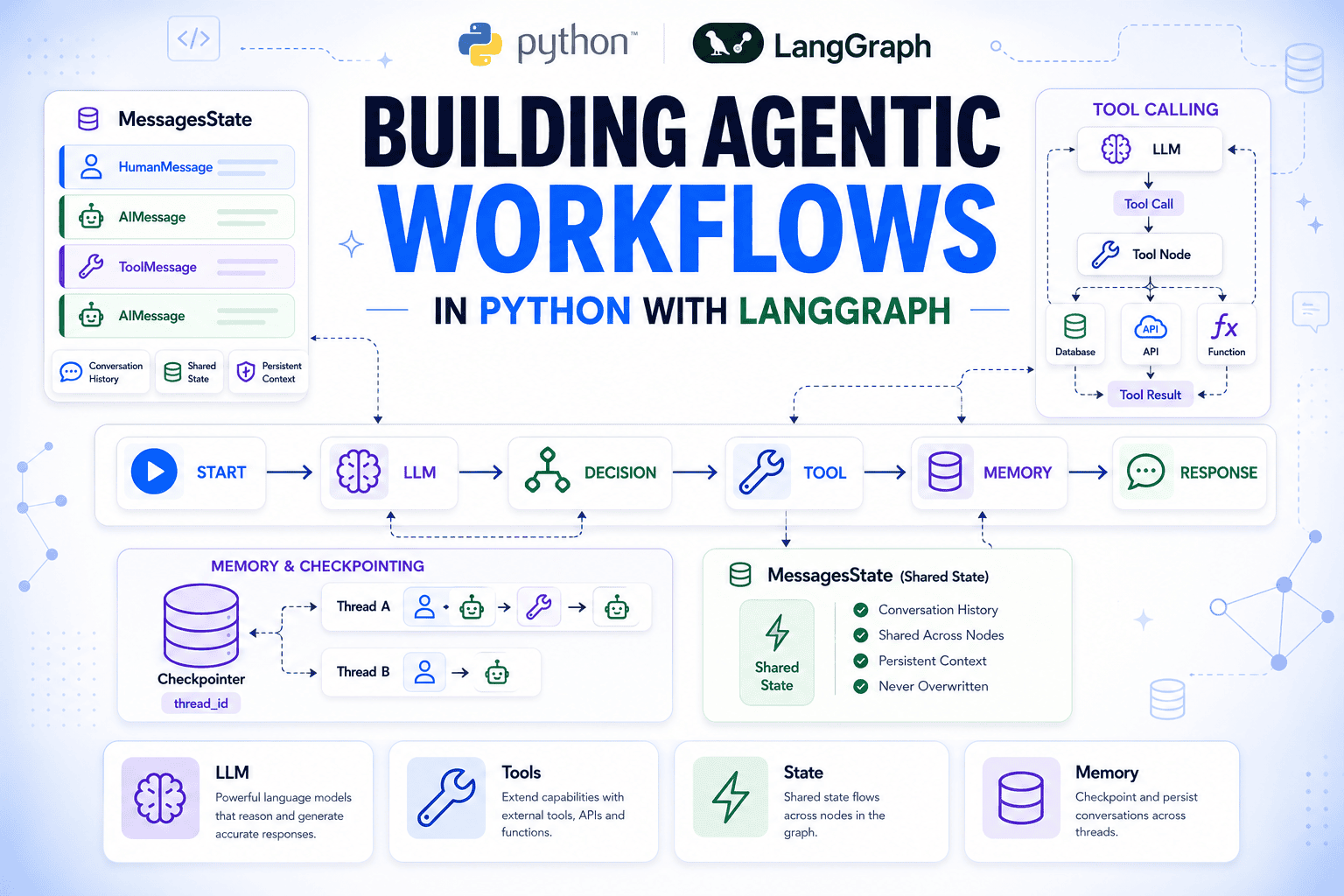
In a LangGraph implementation, the "State" is a shared memory object, typically defined as a TypedDict. Every node in the graph reads from this state and writes updates back to it. This design ensures that nothing passes between nodes through hidden side channels; the entire context of the conversation, including message history and tool outputs, is centralized. When a node completes its task, it returns only the fields it wishes to modify, and LangGraph’s "reducer" functions determine how those updates are merged into the existing state.
Nodes as Functional Units
Nodes are the "workers" of the graph. In Python, these are simple functions that accept the current state as an argument and return a dictionary of updates. Because nodes are plain Python functions, they are highly testable and modular. A node might contain a call to an LLM, a database query, or a simple logging operation.
Edges and Conditional Logic
Edges define the sequence of execution. A standard edge connects Node A to Node B, ensuring that B always follows A. However, the power of LangGraph lies in "conditional edges." These edges use a routing function to analyze the current state and decide which node to visit next. For instance, after an LLM call, a conditional edge might check if the model requested a tool. If so, it routes the execution to a tool-execution node; if not, it routes the execution to the end of the process.
Chronology of an Agentic Interaction
The lifecycle of a LangGraph agent follows a specific chronological sequence that ensures reliability and traceability:
- Initialization: The graph is defined with a specific
Stateschema. The developer registers nodes and defines the connections (edges). - Compilation: The graph is compiled into a "Runnable" object. At this stage, developers can attach "checkpointers" to enable persistence.
- Invocation: The graph is triggered with an initial input (e.g., a user message).
- The Reasoning Loop:
- The model analyzes the state and the system prompt.
- The model decides whether to provide a final answer or call a tool.
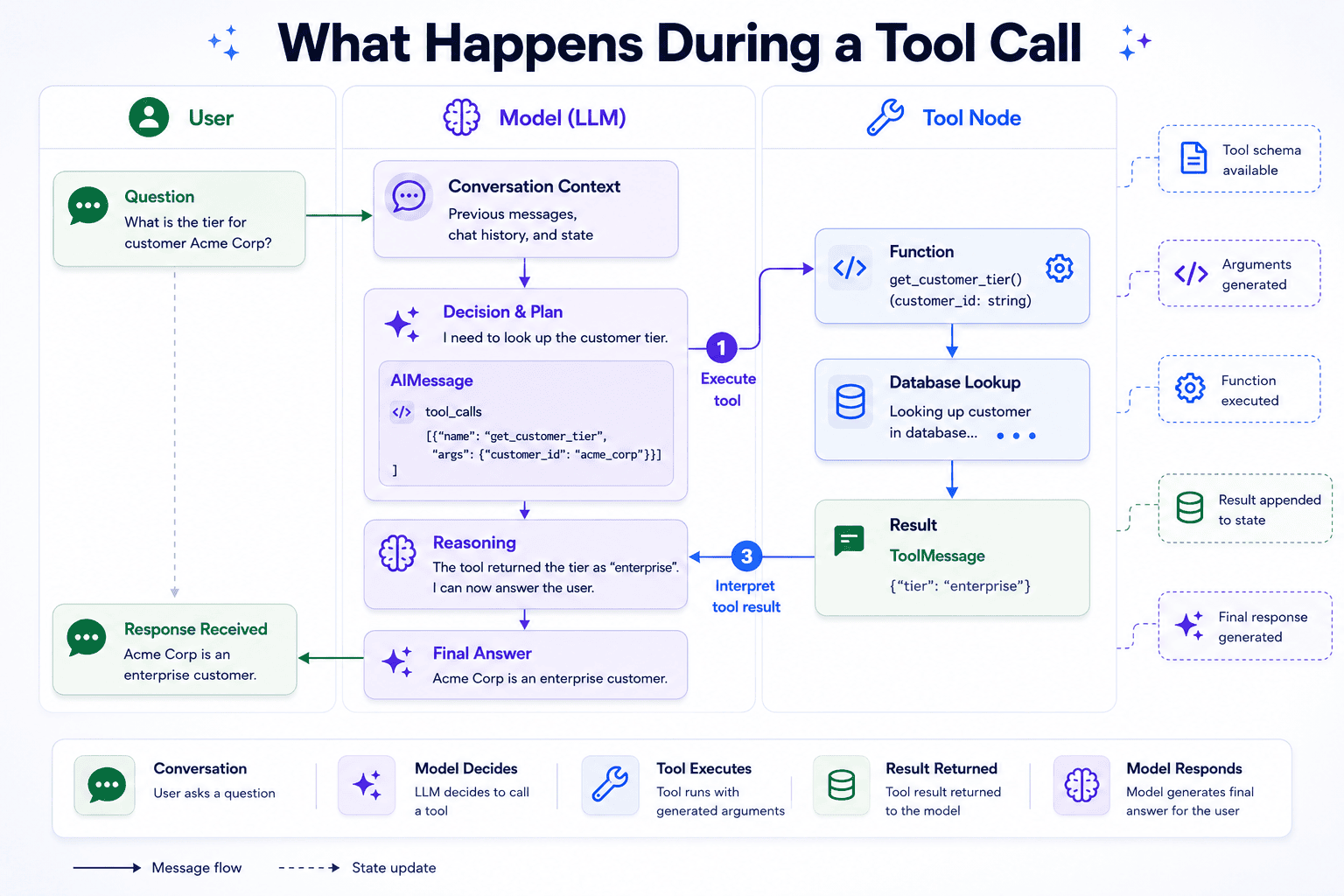
- If a tool is called, the graph transitions to a tool node, executes the function, and returns the result to the state.
- The graph loops back to the model, which now has the tool’s output in its context.
- Completion: Once the model provides a final response, the graph reaches the
ENDstate and returns the final result to the user.
Implementing Conversation History with MessagesState
A common challenge in AI development is managing conversation history. Without a structured way to store past messages, the model loses context, leading to repetitive or nonsensical answers. LangGraph provides a built-in MessagesState to handle this automatically.
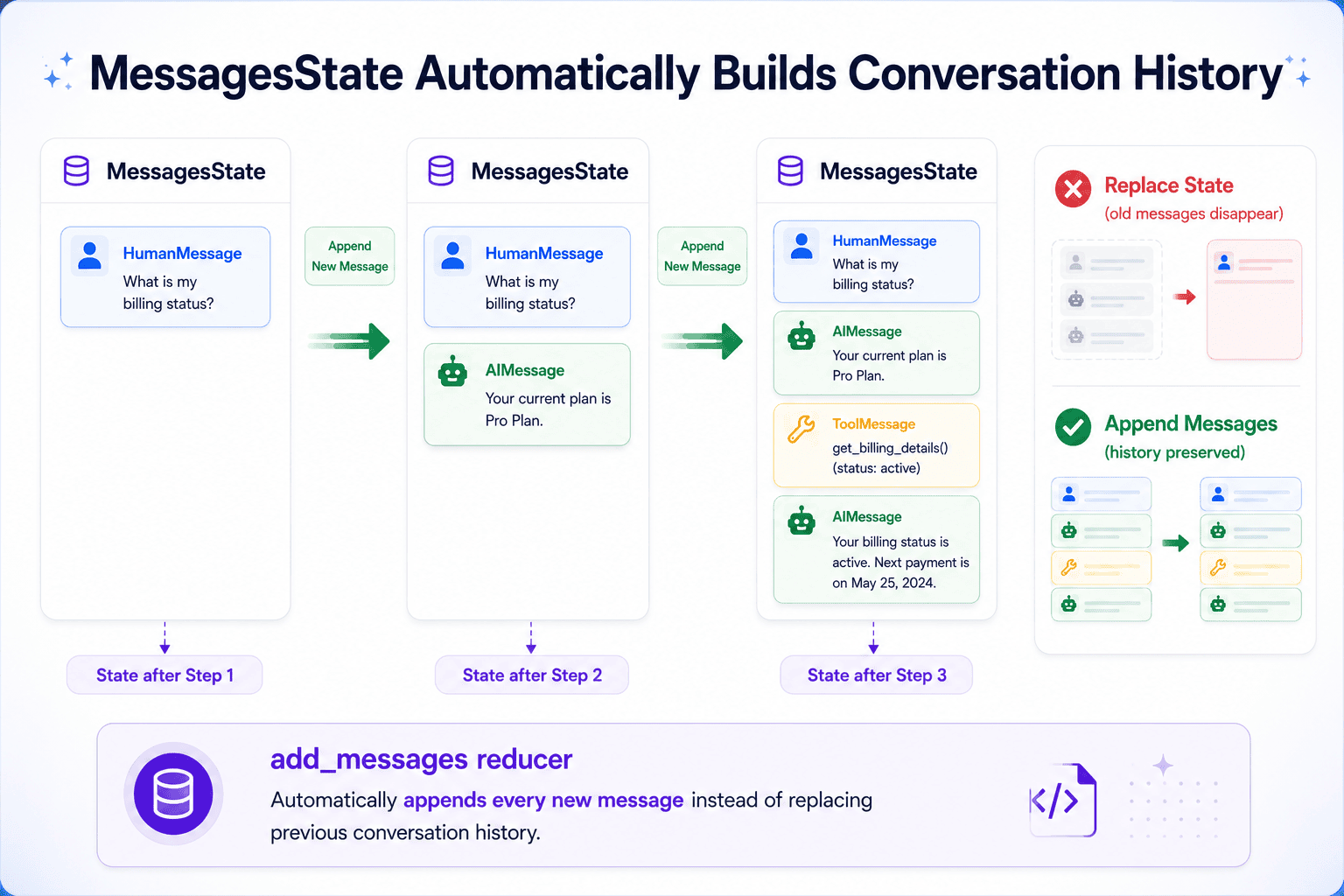
Using the add_messages reducer, LangGraph appends new model responses and user inputs to the state rather than overwriting them. This allows the model to "remember" that a user previously mentioned their account ID or a specific technical issue. In a professional support environment, this capability is non-negotiable, as it mimics the continuity of a human conversation.
Tool Integration and the ReAct Pattern
The true utility of an agent is its ability to interact with the real world. In LangGraph, this is achieved by "binding" tools to the LLM. Tools are Python functions decorated with a @tool tag, accompanied by descriptive docstrings. These docstrings are crucial; they serve as the "manual" that the model reads to understand when and how to use the tool.
When a model is bound with tools like get_customer_tier or query_database, its output changes. Instead of returning plain text, it returns a structured "tool call" if it deems the tool necessary. LangGraph’s ToolNode then intercepts this call, executes the underlying Python code, and feeds the result back into the message history as a ToolMessage. This loop is the essence of the ReAct pattern, ensuring the model’s answers are grounded in actual data rather than just training weights.
Supporting Data and Industry Implications
The move toward agentic workflows is supported by emerging data regarding LLM performance. Research indicates that models using iterative reasoning loops consistently outperform those using single-prompt strategies on complex tasks. According to industry analysis, the "agentic" approach can improve accuracy in specialized tasks—such as code generation or data analysis—by as much as 30% compared to standard zero-shot prompting.
Furthermore, the implementation of "checkpointers" in LangGraph addresses the critical need for "human-in-the-loop" workflows. By persisting the state of a graph in a database (like PostgreSQL or Redis), developers can pause an agent’s execution, allow a human to review the proposed action, and then resume the process. This is a vital safety feature for enterprise applications where autonomous actions (like processing a refund or deleting data) require oversight.
Official Responses and Developer Sentiment
Leading figures in the AI community have lauded the shift toward graph-based agents. Harrison Chase, CEO of LangChain, has emphasized that LangGraph was built specifically to give developers more control over the "cognitive steps" an agent takes. Similarly, Andrew Ng, a pioneer in the field of AI, has frequently stated that "AI agentic workflows will drive a lot of progress this year—perhaps even more than the next generation of foundation models."
The developer community has responded positively to the modularity of LangGraph. By decoupling the LLM from the tool logic and the state management, LangGraph allows teams to swap models (e.g., moving from OpenAI’s GPT-4 to Anthropic’s Claude 3.5) with minimal changes to the overall business logic.
Broader Impact and Future Outlook
The broader impact of LangGraph and agentic workflows cannot be understated. As these systems become more reliable through persistence and better state management, we will likely see a transition from "AI assistants" that simply answer questions to "AI workers" that manage entire business processes.
In the near future, the focus is expected to shift toward "multi-agent systems," where multiple specialized graphs interact with one another. In such a scenario, one agent might handle data retrieval, another might handle analysis, and a third might handle customer communication—all coordinated through a central "supervisor" graph.
LangGraph provides the foundational primitives—State, Nodes, and Edges—that make this complex future possible. By providing a clear structure for reasoning, action, and memory, it enables developers to build AI systems that are not only powerful but also predictable, inspectable, and enterprise-ready. As the industry continues to mature, the ability to build and manage these agentic workflows will become a core competency for software engineers and AI practitioners alike.