NVIDIA Expands AI for Media Suite and Unveils Breakthrough Software-Defined Broadcasting Tools at IBC 2026

The International Broadcasting Convention (IBC) opened its doors in Amsterdam, welcoming more than 44,000 attendees from over 170 countries to explore the cutting edge of media technology. Spanning four days across more than 14 exhibition halls, the annual conference serves as the premier global gathering for creative, technological, and business leaders in the media and entertainment sectors. Among the major announcements dominating the convention floor, NVIDIA Corporation revealed a sweeping expansion of its AI for Media ecosystem, alongside architectural breakthroughs designed to transition live broadcasting into software-defined, accelerated computing environments.
The announcements arrive at a critical juncture for the industry. Media companies are facing mounting pressures to modernize workflows, reduce distribution overhead, and engage increasingly fragmented global audiences without compromising the rigorous reliability required in live broadcast environments. By integrating advanced GPU-accelerated software development kits (SDKs), NVIDIA NIM microservices, and specialized reference pipelines, NVIDIA aims to position artificial intelligence as a foundational layer for live production, sports broadcasting, journalism, and streaming.
Revolutionizing Live Production with Expanded AI Capabilities
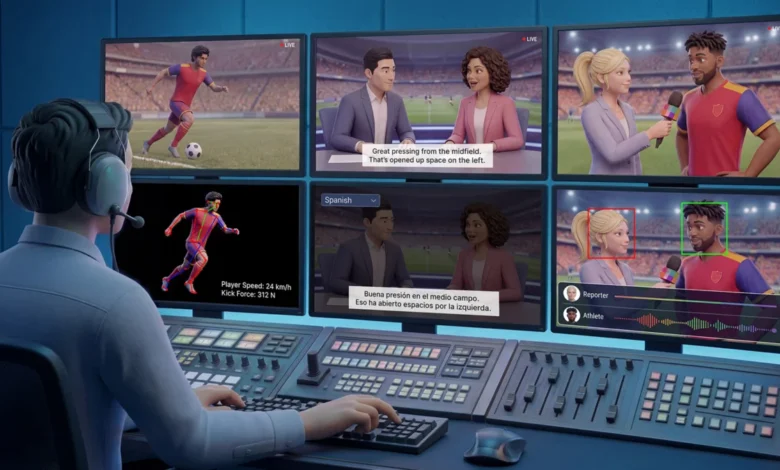
At the core of NVIDIA’s showcase is a robust upgrade to its NVIDIA AI for Media portfolio. The suite introduces sophisticated tools tailored to tackle some of the most persistent operational hurdles in broadcasting: content authenticity, spatial motion tracking, high-motion video interpolation, visual enhancement, and real-time multilingual localization.
Among the standout components is the NVIDIA Synthetic Video Detector (SVD) NIM microservice. Initially unveiled at SIGGRAPH earlier in the year, SVD has seen dramatic accuracy improvements, achieving a 99.3% success rate for text-to-video content and 97.7% for image-to-video material. As synthetic media becomes increasingly sophisticated, news organizations and digital forensics teams require reliable mechanisms to evaluate the authenticity of incoming footage.
Industry adoption of the SVD microservice is already underway. Software developer Dalet is actively integrating SVD into a secure, cloud-hosted verification workflow, allowing editorial teams to seamlessly submit footage and review authenticity scores and metadata directly within familiar interfaces. Similarly, TwelveLabs has announced the general availability of Compliance by TwelveLabs, a video intelligence application that incorporates SVD to provide frame-level authenticity signals during regulatory and compliance screening. Furthermore, Wowza is incorporating SVD into its widely utilized Wowza Streaming Engine via the Wowza Video Intelligence Framework, empowering broadcasters to analyze live feeds for signs of AI generation across on-premises, edge, cloud, and hybrid deployments.
Spatial Tracking and Visual Enhancement
Moving beyond content verification, NVIDIA addressed the demands of sports production and virtual studios with the introduction of NVIDIA 3D Body Pose. The technology estimates 2D and 3D human joint locations and angles from standard video captured by a single camera, eliminating the need for cumbersome marker-based motion capture systems. For sports organizations, this capability unlocks advanced biomechanical analysis, player movement tracking, officiating support, and immersive fan experiences. In virtual production, companies like Vizrt are leveraging Body Pose to drive real-time 3D lighting effects—such as reflections, shadows, and environmental rendering—using tracked body movements in live studio environments.
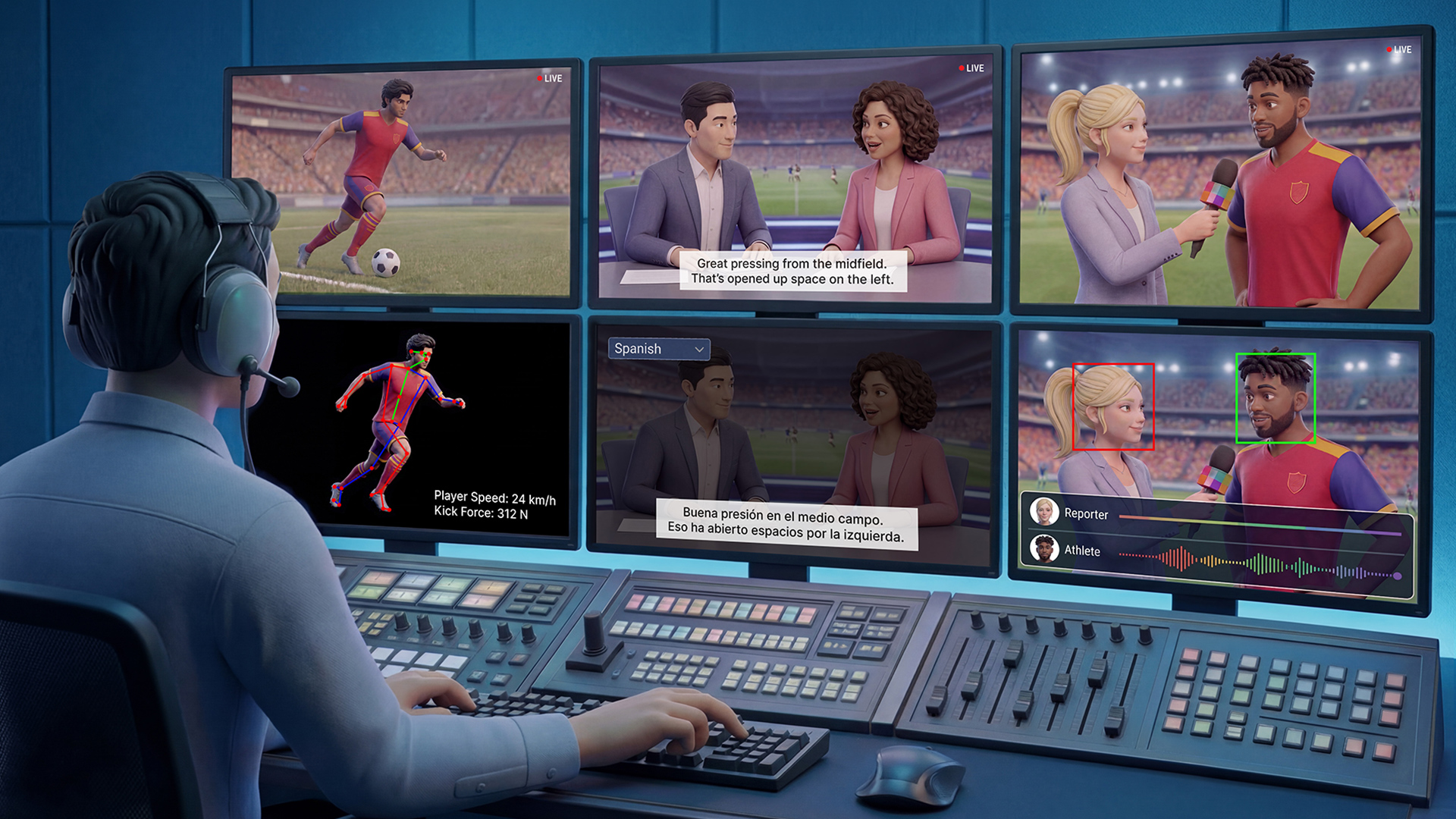
To address high-motion scenarios, NVIDIA introduced Video Frame Generation (VFG). By employing generative AI to synthesize intermediate frames between original captures, VFG can double or quadruple frame rates while maintaining temporal consistency and visual fidelity. Ross Video is capitalizing on this technology by integrating VFG into its Rio Replay platform, enabling 6x slow-motion generation for sports production and laying the groundwork for 8x interpolation. This allows broadcasters to deliver fluid, high-resolution slow-motion replays without necessitating expensive ultrahigh-frame-rate source cameras.
Complementing VFG are upgrades to NVIDIA Video Super Resolution (VSR) and NVIDIA TrueHDR. VSR utilizes AI to upscale video while eliminating noise, blur, and compression artifacts, now featuring 10-bit video support and adjustable controls for balancing real-time performance against image quality. When paired with TrueHDR—which converts standard-dynamic-range video into high-dynamic-range output reaching up to 2,000 nits in real time—media companies can efficiently revitalize legacy content libraries for modern streaming and display standards.
Software-Defined Infrastructure via Holoscan for Media and MXL
While individual AI microservices address specific creative and operational tasks, the underlying infrastructure of live broadcasting is undergoing an equally profound transformation. To support this shift, NVIDIA highlighted the integration of the Media Exchange Layer (MXL) with NVIDIA Holoscan for Media.
Holoscan for Media serves as an open reference architecture and developer toolkit designed for software-defined live production. By incorporating MXL, the architecture provides an open, standardized mechanism for software-based media functions to exchange live video, audio, and data across distributed environments. As traditional hardware-bound production functions migrate to software, this integration allows disparate applications to share accelerated computing resources, connect dynamically, and operate within a unified ecosystem. Broadcasters benefit from enhanced infrastructure efficiency and reduced custom integration friction, positioning their operations to adapt rapidly to emerging formats and AI capabilities.
Pioneering Multimodal Intelligence with Sports Intelligence Playbooks
In the realm of sports broadcasting, NVIDIA introduced Sports Intelligence Playbooks, marking a strategic shift toward domain-specific, fine-tuned open models built on proprietary organizational data. Sports leagues and media holders possess vast repositories of historical footage, specialized metrics, and proprietary annotations that general-purpose AI models struggle to fully comprehend.
The Sports Intelligence Playbooks provide a comprehensive framework spanning data preparation, fine-tuning, inference, evaluation, and deployment. By leveraging technologies such as Nemotron, NeMo AutoModel, Megatron Bridge, and NIM microservices, sports organizations can fine-tune foundational models to understand the nuanced rules, strategies, and contexts of specific athletic disciplines.
Early evaluations underscore the potency of this approach. When tested on unseen footage using domain-specific prompts, multiple-choice accuracy jumped from approximately 53% to 94%, while open-ended evaluation scores rose from 5.7% to 66%. Innovators like Machina Sports are already integrating these playbooks with their native data infrastructure to build deployable intelligence for live production and fan engagement. Moreover, through the NVIDIA AI-Q Blueprint, these domain models can function as expert intelligence within broader agentic AI systems capable of reasoning across video, enterprise data, and automated software workflows.
Seamless Multilingual Content Localization
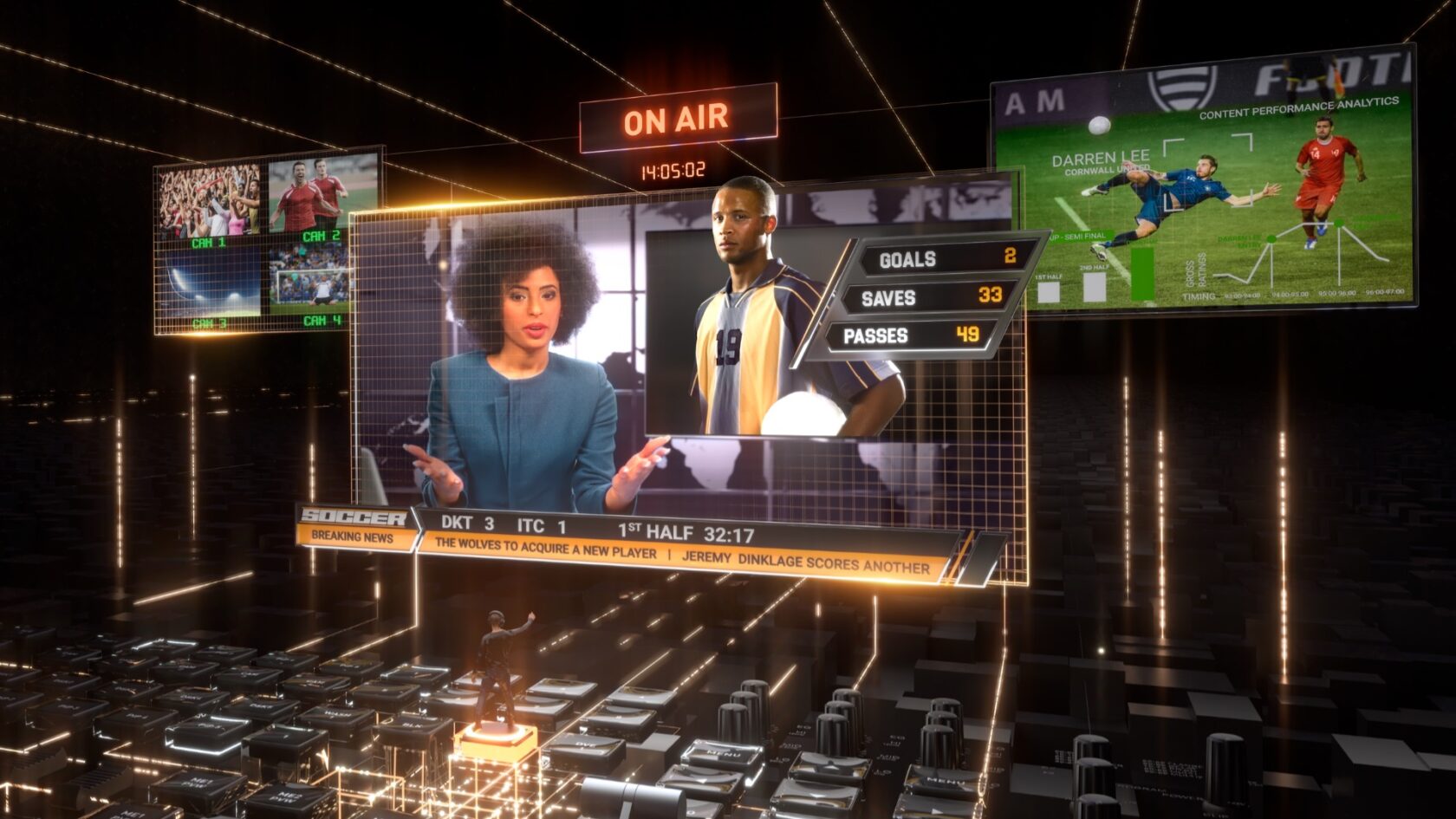
Addressing the complex demands of global distribution, NVIDIA showcased its advanced Content Localization technologies integrated directly into the Holoscan for Media toolkit. Reaching international audiences historically required maintaining separate, resource-intensive infrastructure for translation, dubbing, captioning, and graphic localization.
The new reference workflow unifies these elements, enabling broadcasters and streaming services to generate multiple regional language experiences from a single media stream. The pipeline incorporates advanced NVIDIA AI for Media capabilities, including enhanced LipSync—which adapts mouth movements to match target audio while preserving natural facial textures and head poses—and Active Speaker Detection, which simplifies multi-speaker dialogue attribution without requiring complex diarization.
Industry collaborators such as AI-Media, CAMB.AI, Chyron, and Panjaya are utilizing these tools to streamline everything from automated voice adaptation to synchronized graphic localization. Furthermore, NDI is deploying NVIDIA AI for Media, including the LipSync NIM microservice, to facilitate real-time translation and dubbing within standard broadcast environments, significantly lowering the bandwidth and operational complexity traditionally associated with global multilingual distribution.
Industry Implications and Future Outlook
The comprehensive suite of announcements at IBC 2026 illustrates a mature phase in the adoption of enterprise artificial intelligence within the media and entertainment sector. Rather than treating AI as an experimental novelty or an isolated post-production filter, the industry is systematically embedding accelerated computing into the core of live production, verification, and distribution pipelines.
By emphasizing open architectures, standardized exchange layers like MXL, and domain-specific customization through playbooks, NVIDIA is attempting to lower the barriers to entry for software-defined broadcasting. For technology vendors, these frameworks offer a scalable foundation to build interoperable multi-vendor solutions. For media enterprises, the promise is a more resilient, cost-effective infrastructure capable of meeting the escalating demands of real-time, hyper-localized, and verified digital content. As IBC 2026 continues through September 14, the tangible deployments demonstrated by industry leaders signal that the transition from broadcast hardware to software-defined intelligence is no longer a futuristic projection, but an operational reality.