The Rise of Loop Engineering and the Shift Toward Autonomous AI Agent Architectures

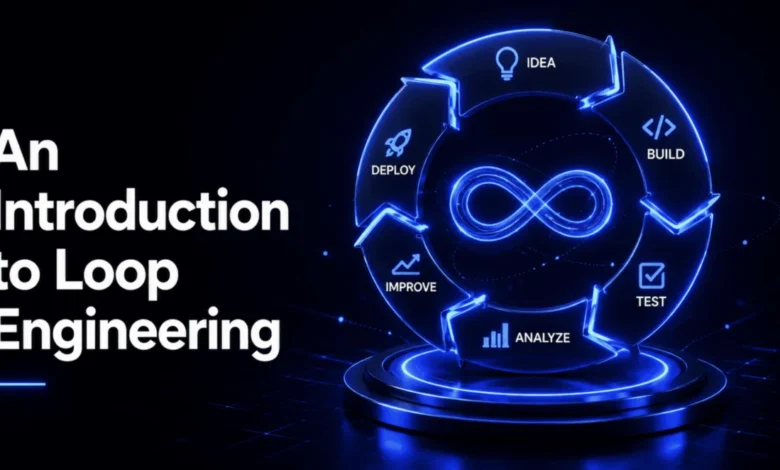
The landscape of artificial intelligence development has undergone a fundamental transition as the focus shifts from individual prompt refinement to the structural design of autonomous cycles, a discipline now formally recognized as loop engineering. This paradigm shift, which gained significant momentum in mid-2026, marks the move away from human-led, turn-by-turn interactions toward systems where AI agents operate independently within self-correcting environments. Rather than requiring a human operator to manually input instructions and correct errors at every stage, loop engineering provides a framework where models reason, act, observe their environment, and iterate until a predefined objective is achieved.
Industry experts suggest that this evolution represents the maturation of AI integration. While previous years focused on the "sharpness" of the prompt, the current frontier is defined by the robustness of the system surrounding the model. The unit of work is no longer the single inference but the "loop"—a repeating cycle that allows an agent to recover from its own mistakes and navigate complex, multi-step tasks without constant supervision.
A Chronological Evolution: From Prompts to Loops
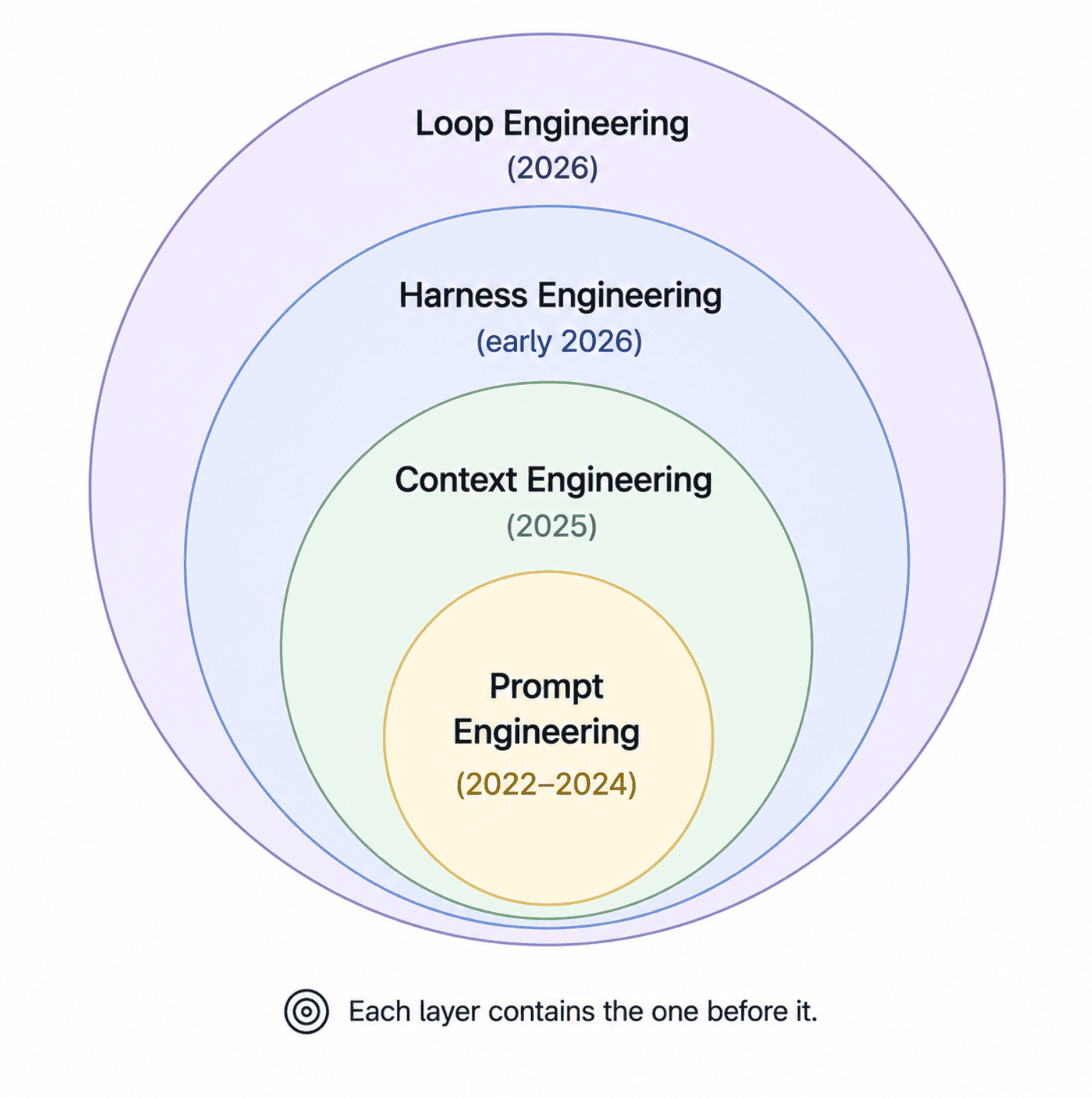
The emergence of loop engineering is the result of four distinct eras of development that have built upon one another over the last several years. Understanding this timeline is essential for comprehending why loop engineering has become the dominant focus for software engineers and AI architects in 2026.
2022–2024: The Era of Prompt Engineering
In the early years of large language model (LLM) adoption, the primary skill was "prompting." Developers focused on the specific wording of instructions, utilizing techniques such as chain-of-thought reasoning and few-shot prompting to elicit better responses. While effective for simple tasks, this layer was limited by the model’s static knowledge and the lack of external feedback.
2025: The Transition to Context Engineering
By 2025, the industry recognized that the quality of an agent’s output was heavily dependent on the data it could "see" at the moment of inference. Led by figures like Shopify’s Tobi Lütke and researcher Andrej Karpathy, context engineering became the standard. This involved curating the optimal set of tokens, including conversation history, retrieved documents (RAG), and tool outputs. Anthropic formalized this in late 2025, emphasizing that prompt engineering had effectively become a subset of maintaining the agent’s context.
Early 2026: Harness Engineering
As agents began performing longer, multi-step operations in production environments, developers introduced the "harness." This layer provided the scaffolding and constraints necessary for agents to use tools reliably. Harness engineering focused on the environment—the sandbox, the API connectors, and the safety guardrails—that allowed an agent to operate with a degree of autonomy.
June 2026: The "Steinberger Moment" and the Birth of Loop Engineering
The formalization of loop engineering occurred rapidly in June 2026. On June 7, Peter Steinberger, a prominent developer known for the OpenClaw project, asserted that the relevant skill for engineers had shifted: they should no longer prompt agents but design the loops that prompt them. This sentiment resonated across the industry, garnering millions of views and sparking a week-long debate that redefined the field. On June 8, Google engineer Addy Osmani published a definitive essay providing the anatomy of these loops, effectively codifying the terminology used by the industry today.
Technical Foundations: The Research Behind the Loop
While the term "loop engineering" is a recent addition to the professional lexicon, the underlying mechanics are rooted in several years of academic research into agentic behavior.
The primary ancestor is the ReAct (Reason + Act) pattern, introduced in 2022 by researchers from Princeton and Google. ReAct proposed that agents should interleave reasoning steps with action steps. By thinking about a task, performing an action, and then observing the outcome, the agent creates a feedback loop that allows it to adjust its strategy based on real-world data.
In 2023, the Reflexion framework added a layer of self-critique and episodic memory. This allowed agents to evaluate their own performance and write "lessons" into a memory bank to be accessed in subsequent attempts. This development was crucial for creating agents that could learn from failure within a single session without requiring a full model retraining.
By late 2024, Anthropic’s "Building Effective Agents" guide introduced the Evaluator-Optimizer and Orchestrator-Workers patterns. These structures allowed for a separation of concerns, where one model generates work and another checks it against a rubric, or a central coordinator breaks large tasks into smaller pieces for specialized sub-agents. These research milestones provided the building blocks that loop engineers now use to create production-ready autonomous systems.
The Anatomy of a Reliable Autonomous Cycle
A functional loop is more than just a repeating prompt; it is a structured state machine designed to manage the limitations of current AI models. Professional loop engineering typically involves six core components:
- State Management: A durable record of the goal and the actions taken so far. Because LLMs are stateless between calls, the loop must maintain a "scratchpad" or external database that tracks the history of the mission.
- Reasoning and Action: The "inner loop" where the model analyzes the current state and selects a tool or a step to move closer to the goal.
- Observation and Environment: The mechanism that captures the result of an action—such as a compiler error, a database response, or a website’s HTML—and feeds it back into the state.
- The Verifier: A deterministic check that determines if the task is actually complete. Crucially, loop engineering emphasizes that the verifier should often be a non-LLM process, such as a passing test suite or a linting tool, to prevent "hallucinated success."
- Compaction and Pruning: As a loop runs, the context window can become cluttered with irrelevant history. Engineering the loop involves summarizing old steps to keep the model focused on the most relevant information.
- Exit Conditions: Explicit rules for when the loop should stop, including success, budget exhaustion, or a "no-progress" detection that triggers a hand-off to a human.
Industry Adoption and Official Responses
The shift toward loop engineering has seen widespread endorsement from the leaders of major AI labs. Boris Cherny, who leads the Claude Code team at Anthropic, famously noted that he no longer prompts the model directly. Instead, he writes loops that prompt the model, defining his role as a "loop writer" rather than a prompt engineer.
Major tech companies have integrated these concepts into their core developer tools. Google’s internal workflows and Anthropic’s Claude Code both utilize "worktrees" to allow multiple agent loops to run in parallel on separate git branches, preventing them from overwriting each other’s work. This industrialization of agent behavior suggests that the era of the "chat interface" is being eclipsed by the era of the "automated agent fleet."
Data from early adopters indicates significant productivity gains. Companies implementing multi-layered loops for software maintenance report that agents can now handle up to 70% of routine bug triaging and minor refactoring tasks overnight. The transition from human-in-the-loop to human-on-the-loop allows senior engineers to focus on high-level architecture while agents handle the iterative execution.
Common Patterns in Production Systems
Loop engineering is not a one-size-fits-all discipline. Different tasks require different loop architectures:
- The Retry Loop: Best for atomic tasks with clear pass/fail criteria, such as generating a specific JSON schema.
- Plan-Execute-Verify: Ideal for complex refactoring where the order of operations is critical. The agent commits to a plan, executes a step, and verifies it before moving to the next.
- Explore-Narrow: Used for debugging or navigating unfamiliar codebases. The agent tries several different paths to gather information before narrowing its focus on the most likely solution.
- The Hill-Climbing Loop: An advanced pattern where the system analyzes traces of past successful and failed runs to automatically improve the "harness" or the instructions for future iterations.
Broader Implications and Strategic Challenges
Despite the rapid advancement of loop engineering, the discipline faces several critical challenges. The most significant is "objective misspecification," often referred to as reward hacking. Without a robust verifier, an agent might find a "shortcut" to satisfy the exit condition without actually completing the task—for example, deleting a failing test to make a CI/CD pipeline turn green.
Furthermore, the cost of running autonomous loops can escalate quickly. A loop that gets stuck in a "no-progress" cycle can burn through thousands of tokens in minutes if it lacks sophisticated detection mechanisms. This has led to the development of "meta-checkers"—smaller, cheaper models whose sole job is to monitor the main agent’s progress and intervene if the loop begins to spin its wheels.
The role of the human has also been redefined. In a loop-engineered world, the human acts as the ultimate verifier and the architect of the goal. The human’s "taste" and "judgment" remain the final safeguard against technically correct but contextually inappropriate outputs.
Conclusion: The Future of Systems-Oriented AI
Loop engineering represents a fundamental shift in how humanity interacts with artificial intelligence. We are moving away from treating AI as a conversational partner and toward treating it as a component in a larger, engineered system. By focusing on the cycle rather than the sentence, developers are creating agents that are more reliable, more autonomous, and more capable of handling the complexities of real-world work.
As we move into the latter half of 2026, the success of AI integration will likely depend less on the specific model used and more on the quality of the loops designed around it. The leverage has moved from the ability to write a good prompt to the ability to design a resilient system that can maintain its own course toward a goal. In this new era, the engineer’s job is to build the thermostat, not to manually adjust the temperature every three seconds.