South Korea and NVIDIA Forge Strategic Partnership at San Francisco AI Summit to Accelerate Global AI Leadership and Infrastructure Development

At this week’s AI Summit in San Francisco, South Korean President Jae Myung Lee, accompanied by a high-level delegation of the country’s premier business leaders and academic researchers, convened with NVIDIA leadership and key ecosystem partners to delineate the future trajectory of South Korea’s artificial intelligence sector. This high-profile gathering serves as a critical milestone in the burgeoning technical alliance between the East Asian nation and the Silicon Valley semiconductor giant, building upon the foundational discussions initiated during NVIDIA founder and CEO Jensen Huang’s visit to Seoul last month. The summit underscores a comprehensive "full-stack" national strategy aimed at fortifying South Korea’s AI infrastructure, expanding its domestic expertise, and cementing its status as a top-tier global hub for AI innovation.
The discussions in San Francisco are not merely symbolic but represent a tangible acceleration of collaborative efforts across the entire AI value chain, from high-bandwidth memory (HBM) production to the development of sophisticated agentic AI models. By aligning national policy with NVIDIA’s industry-leading hardware and software ecosystems, South Korea seeks to navigate the complexities of the global technological landscape and secure a competitive edge in the rapidly evolving digital economy.
Establishing the Vanguard: The NVIDIA-KAIST Joint AI Research Lab
One of the most significant announcements to emerge from the summit is the formal launch of a joint AI research laboratory between NVIDIA and the Korea Advanced Institute of Science and Technology (KAIST). Situated within the KAIST Kim Jaechul Graduate School of AI in Seoul, this facility marks a historic precedent as the first collaborative AI laboratory established between a South Korean academic institution and a major global technology corporation. The laboratory’s primary mission is the advancement of "agentic AI"—a frontier of artificial intelligence focused on systems capable of autonomous reasoning, goal-oriented planning, and independent execution of complex tasks.
The collaboration is designed to create a synergistic research environment that bridges the gap between theoretical academic excellence and industrial application. By integrating NVIDIA’s full-stack AI expertise—which encompasses advanced GPU architectures, the CUDA programming model, and the NVIDIA NeMo framework—with the scientific talent at KAIST, the initiative aims to solve some of the most pressing challenges in AI deployment. Researchers at the lab will have access to NVIDIA Nemotron open models and NVIDIA AI Cloud partner computing resources, providing the computational power necessary to train large-scale models tailored for the South Korean market and beyond.
KAIST, consistently ranked among Asia’s premier research universities, provides a fertile ground for this partnership. The inclusion of the Kim Jaechul Graduate School of AI signifies a targeted investment in high-level human capital, ensuring that the next generation of Korean engineers and data scientists are well-versed in the tools and methodologies that define the modern AI era.
A Chronology of Collaboration: From Seoul to Silicon Valley
The current summit in San Francisco is the culmination of a series of strategic engagements that have intensified over the past quarter. In June, NVIDIA CEO Jensen Huang traveled to South Korea to meet with government officials and industry titans, including leaders from SK Group and Samsung. During that visit, the groundwork was laid for an expanded partnership centered on the critical role of memory technology in AI performance.
Following the June meetings, SK hynix—the world’s leading provider of High Bandwidth Memory—announced an expanded collaboration to co-develop next-generation memory solutions specifically optimized for NVIDIA’s AI platforms. This includes memory architectures designed for data center AI infrastructure, personal AI applications in consumer electronics, and physical AI systems used in robotics and industrial automation.
Simultaneously, SK Telecom, the nation’s largest telecommunications provider, unveiled ambitious plans to build out a robust domestic AI infrastructure. This initiative focuses on "physical AI," a domain where artificial intelligence interacts directly with the physical world through sensors and actuators. The integration of SK Telecom’s connectivity and infrastructure with NVIDIA’s processing power is expected to catalyze innovations in smart manufacturing, autonomous logistics, and urban mobility within South Korea.
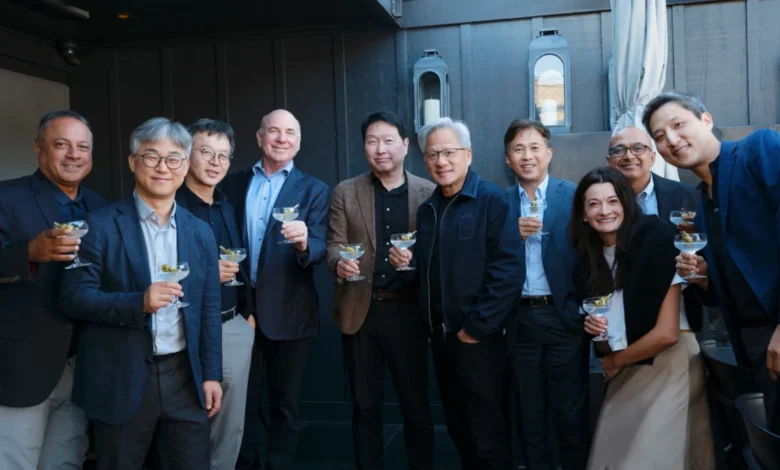
The timeline reached a celebratory peak on Thursday, July 23, when Jensen Huang hosted SK Group Chairman Chey Tae-won and senior executives from SK hynix and SK Telecom for a private dinner in Woodside, California. This meeting, held on the eve of the San Francisco AI Summit, served to reinforce the personal and professional ties between the leadership teams, signaling a long-term commitment to shared technological goals.
Supporting Data: The Strategic Importance of HBM and Infrastructure
The depth of the NVIDIA-South Korea partnership is driven by the technical requirements of modern generative AI. Large Language Models (LLMs) and diffusion models require massive amounts of data throughput, making memory bandwidth a primary bottleneck in system performance. SK hynix has emerged as a linchpin in NVIDIA’s supply chain, currently dominating the market for HBM3E, the ultra-fast memory required for NVIDIA’s H100 and Blackwell-series GPUs.
Industry data suggests that the demand for HBM is expected to grow at a compound annual growth rate (CAGR) of over 50% through 2030. By securing a "codevelopment" status with NVIDIA, South Korean firms are moving beyond the role of mere suppliers to become architectural partners. This shift allows Korean engineers to influence the design specifications of future NVIDIA platforms, ensuring that Korean hardware and software are natively compatible with the world’s most advanced AI chips.
Furthermore, the South Korean government has pledged significant fiscal support for the AI sector. The "AI-Semiconductor Initiative," recently bolstered by President Lee’s administration, involves billions of dollars in subsidies and tax incentives for R&D. The goal is to move South Korea into the "G3" (Global Top 3) of AI nations, alongside the United States and China. The San Francisco summit serves as the international platform to validate these domestic investments through global partnerships.
Official Responses and Strategic Vision
While the summit proceedings remain ongoing, the rhetoric from both government and corporate leaders emphasizes a vision of mutual growth. President Jae Myung Lee has characterized the AI push as a "second semiconductor miracle" for South Korea, referencing the country’s historic rise to dominance in the memory chip market during the late 20th century. In discussions with business leaders, the President highlighted the necessity of a "sovereign AI" capability—ensuring that South Korea possesses the infrastructure and models to protect its cultural and data integrity while participating in the global market.
Jensen Huang has frequently praised South Korea’s engineering prowess and its unique position in the technology stack. During the summit, NVIDIA representatives noted that the collaboration with KAIST and SK Group is a model for how technology companies can partner with entire nations to accelerate the deployment of AI. By providing the "brains" (GPUs) and "nervous system" (networking/software) to complement Korea’s "memory" (HBM) and "industrial muscle" (manufacturing), NVIDIA is effectively helping to build a localized AI ecosystem.
Broader Impact and Global Implications
The implications of the South Korea-NVIDIA alliance extend far beyond the borders of the two entities. Geopolitically, this partnership strengthens the technological corridor between the United States and South Korea at a time when global supply chains are under intense scrutiny. As nations race to secure their AI supply chains, South Korea’s deep integration with NVIDIA provides it with a level of "tech-security" that few other countries can claim.
For the global AI industry, the focus on "agentic AI" at the KAIST lab suggests a shift in research priorities. While much of the past two years has been dominated by generative chatbots, the next phase of the AI revolution will likely involve autonomous agents capable of managing supply chains, conducting scientific research, and operating complex machinery. The joint lab in Seoul is positioned to be a global leader in this transition.
Moreover, the "physical AI" initiatives led by SK Telecom could set a global standard for how 5G and 6G networks are utilized to support AI-driven robotics. By creating a domestic testbed for these technologies, South Korea can export not just chips and software, but entire integrated AI systems to international markets.
As the AI Summit in San Francisco continues, the international community is watching closely. The synergy between South Korea’s industrial policy and NVIDIA’s technological dominance represents a potent blueprint for national digital transformation. With the conclusion of the summit’s initial rounds of meetings, the focus now shifts to the implementation of these broad agreements, as the joint KAIST lab begins its operations and the next generation of AI-optimized memory moves into production. Check back for further updates as President Lee and Jensen Huang continue their high-level deliberations on the future of the global AI landscape.