The rapid evolution of artificial intelligence has shifted the focus of developers from simple prompt-response interactions to the construction of complex, autonomous agentic systems. As these agents move from experimental notebooks to high-traffic production environments, the fundamental architectural decision regarding state management—whether an agent should be stateless or stateful—has emerged as a primary determinant of system performance, cost, and scalability. This choice dictates not only how an agent processes information but also the underlying infrastructure required to support it, from load balancers to persistent storage layers.
The Core Conflict: Where Does the Memory Reside?
In the context of AI agents, "state" refers to the collective memory of an interaction, including conversation history, retrieved context, and the current progress of a multi-step task. As organizations deploy agents using high-performance inference engines like the Groq API and advanced models like Llama 3.1 8B, they must decide where this memory is stored.
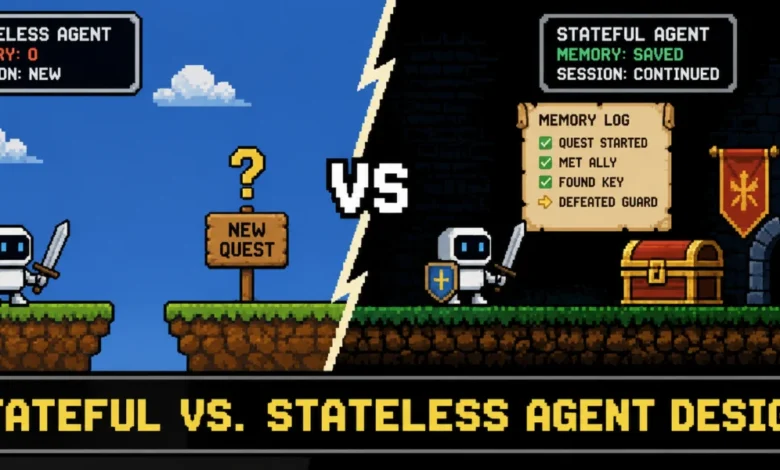
A stateless agent treats every incoming request as a vacuum-sealed event. It possesses no inherent memory of previous interactions, requiring the client—typically a frontend application—to provide the entire context with every new prompt. Conversely, a stateful agent assumes responsibility for its own memory, retrieving historical data from a database based on a session identifier before processing a request.
While the distinction may appear to be a minor implementation detail, it represents a significant fork in the road for system architecture. The stateless approach favors horizontal scalability and simplicity in the backend, while the stateful approach offers a more seamless client experience and supports the complex, long-running workflows required for sophisticated enterprise automation.
The Stateless Paradigm: Efficiency Through Isolation
Stateless agents operate on a "fire and forget" logic. This design aligns with the principles of RESTful API architecture, where each request contains all the information necessary for the server to fulfill it.
The Mechanics of Statelessness
In a stateless configuration, when a user interacts with an agent, the frontend must bundle the current prompt with the relevant history of the conversation. For example, if a user named Alice informs the agent of her name in Turn 1, and asks for her name in Turn 2, the frontend must re-send the transcript of Turn 1 along with the Turn 2 query. Without this "injection" of history, the language model (LLM) will fail to recognize the user, resulting in a loss of continuity.
Technical Advantages and the "Token Tax"
The primary benefit of a stateless architecture is its ease of scaling. Because the agent does not rely on local or session-specific data, a load balancer can route an incoming request to any available server instance. This makes it highly resilient; if one instance fails, another can pick up the request without any loss of data, as the data is provided in the payload itself.
However, this architecture introduces what engineers call the "Context Window Snowball Effect." As a conversation progresses, the payload sent to the LLM grows exponentially. In a 20-turn conversation, the 20th request might include 19 previous turns of dialogue. This leads to a significant "token tax," where organizations pay for the same information repeatedly across multiple requests. For high-volume systems, this can lead to hit rate limits on APIs and increased latency as the model processes increasingly large input sequences.
The Stateful Paradigm: Continuity Through Persistence
Stateful agents shift the burden of memory from the client to the server. Under this model, the client only needs to send the newest prompt and a unique session ID. The agent then performs a lookup in a database—ranging from a simple SQLite instance for prototyping to a robust Redis or PostgreSQL cluster for production—to retrieve the conversation history.
Managing Complex Workflows
The stateful approach is often mandatory for agents performing asynchronous tasks. If an agent must pause to wait for a human approval or a slow third-party API response, a stateful design allows it to "hibernate." The current state is saved to a database, and when the external trigger occurs, the agent resumes exactly where it left off.
The Challenge of Distributed Memory
While stateful agents offer a superior user experience and reduce the amount of data transferred over the wire, they introduce significant infrastructure complexity. In a horizontally scaled environment with multiple server instances, a stateful agent faces the risk of "localized amnesia." If Turn 1 is handled by Server A and stored in its local memory, and Turn 2 is routed to Server B, the agent will lose context unless a centralized memory layer is implemented.
To combat this, production-grade stateful systems typically employ a centralized cache like Redis. This ensures that regardless of which server instance handles the request, the agent can access the global state of the session. This adds a layer of latency—the time required to query the database—but often results in a net gain in efficiency by reducing the number of tokens processed by the LLM.
Supporting Data: The Impact of Model Choice and API Limits
The decision between stateful and stateless designs is often influenced by the specific capabilities of the models and APIs being utilized. Current industry benchmarks highlight the importance of model efficiency in these architectures.
Throughput and Rate Limits
Using the Groq API as a benchmark, the Llama 3.1 8B Instant model provides a compelling case for rapid agentic development. At the time of analysis, Groq’s free tier allows for 14,400 requests per day. In a stateless system, a single user session of 10 turns consumes 10 of those requests. However, because each request is larger (due to the history), the "tokens per minute" (TPM) limit becomes the tighter bottleneck rather than the "requests per day."
Context Window Utilization
Llama 3.1 models feature a 128,000-token context window. In a stateless architecture, developers must implement aggressive "context pruning" or summarization strategies to prevent the payload from exceeding these limits or becoming prohibitively expensive. In a stateful system, these summarization tasks can be performed as a background process, updating the database in the "dead time" between user prompts, thereby optimizing the performance of the live interaction.
Chronology of an Agent Deployment
To understand the practical implications of these designs, one can look at the typical lifecycle of an AI agent’s development:
- Prototyping (Stateless): Developers typically begin with a stateless script. It is easy to debug and requires no database setup. Memory is handled via simple Python lists.
- Alpha Testing (Stateful Integration): As multi-turn logic becomes more complex, developers introduce a local database (like SQLite) to manage sessions. This allows for more natural testing of the agent’s "personality" and recall capabilities.
- Beta Scaling (Centralized Memory): When moving to a cloud environment (AWS, GCP, or Azure), the local database is replaced by a managed service (like Amazon ElastiCache or Redis). This is where the complexities of session stickiness and database concurrency are first addressed.
- Production Optimization (Hybrid Approaches): Advanced systems often use a hybrid approach—stateless for high-speed, single-turn tasks (like intent classification) and stateful for the core reasoning engine that manages the long-term user relationship.
Industry Perspectives and Analysis
Tech leads at major AI infrastructure firms suggest that the industry is moving toward a "State-as-a-Service" model. Tools like LangChain’s LangGraph and LlamaIndex provide abstractions that attempt to make the transition from stateless to stateful seamless for the developer.
The consensus among system architects is that while statelessness is the "cleaner" software engineering approach, the human-centric nature of AI demands statefulness. Users expect an agent to remember their name, their preferences, and the context of a conversation held three days ago. Providing this experience requires a robust state management strategy.
However, the "Stateful Tax" remains a concern. A stateful system is inherently more difficult to make "statelessly" resilient. If the database goes down, the entire agentic system becomes incapacitated. This necessitates high-availability database configurations and rigorous backup protocols, increasing the total cost of ownership (TCO) for stateful agentic systems.
Broader Implications for the Future of AI
The choice between stateful and stateless design is more than a technical hurdle; it reflects a philosophical shift in how we view AI. A stateless agent is a tool—a calculator for language. A stateful agent is a collaborator—a digital entity that grows and learns through interaction.
As context windows continue to expand—with some models now supporting up to 2 million tokens—the pressure to use stateful architectures may temporarily decrease, as it becomes easier to simply pass the entire history. However, for truly autonomous agents that operate over months or years, no context window will ever be large enough. Consequently, the development of sophisticated state management systems, involving vector databases for long-term "semantic memory" and relational databases for short-term "working memory," will remain the frontier of AI systems engineering.
In conclusion, developers must weigh the horizontal scalability and simplicity of stateless designs against the continuity and complex workflow support of stateful ones. For simple utility bots, stateless remains king. But for the next generation of AI coworkers and personal assistants, the investment in a stateful, database-backed architecture is the only path toward creating a truly intelligent and reliable user experience.