Android Studio Quail 4 Arrives in Stable Release Bringing Advanced AI Capabilities and Native Gemma 4 Integration to Developers Worldwide

Google has officially announced the stable release of Android Studio Quail 4, marking the culmination of the Quail series of integrated development environment (IDE) updates designed to radically transform mobile application development. Aimed at empowering developers to build premium, production-ready applications with unprecedented efficiency, this latest iteration introduces deeply embedded AI competencies, native offline model integrations, and enhanced workflow optimizations. As the final stable milestone in the Quail release cycle, version 4 addresses one of the most persistent hurdles in modern software engineering: the tendency of generic Large Language Models (LLMs) to generate outdated or structurally flawed code when confronted with rapidly shifting Android frameworks and platform-specific migrations.
The introduction of Android Studio Quail 4 follows a methodical evolutionary roadmap that began with earlier iterations of the Quail series, each building incrementally upon developer feedback and emerging artificial intelligence paradigms. By shifting the focus from general-purpose coding assistants to domain-specific, deeply integrated development tools, Google aims to reduce the overhead associated with boilerplate configurations and manual setup protocols. Industry analysts and early-access enterprise developers have noted that the integration of platform-specific intelligence directly within the IDE marks a significant departure from traditional cloud-reliant coding plugins, providing a more secure, contextual, and responsive environment for mission-critical mobile deployments.
Grounding Artificial Intelligence with Bundled Android Skills
A primary friction point for developers utilizing AI-driven coding assistants has been the discrepancy between generic programming knowledge and the nuanced, fast-moving ecosystem of Android APIs. Standard LLMs frequently default to deprecated methods or incorrect architectural patterns when tasked with complex configuration structures or platform migrations. To mitigate this issue, Android Studio Quail 4 introduces bundled Android skills—a curated suite of modular, AI-optimized instructions developed and maintained by the engineering teams responsible for the Android platform itself.

Adhering to the open-standard agent skills specification, these 23 pre-loaded skills act as specialized behavioral guidelines that direct LLMs through complex Android workflows with high precision. When a developer submits a prompt to the integrated Android Studio agent, the IDE automatically analyzes the request against the metadata of all installed skills. If a relevant skill is identified, it is invoked dynamically, granting the agent immediate domain expertise without requiring the user to manually draft exhaustive context-setting prompts or download supplementary configuration files.
For teams operating outside the primary IDE environment or utilizing command-line interface (CLI) development setups, Google has also provided interoperability through the Android CLI, allowing engineers to execute commands such as android skills add --all. Furthermore, development teams retain complete autonomy over their coding environment; organizations requiring strict adherence to internal workflows can construct custom agent skills, while teams preferring a traditional coding experience can completely disable the bundled skill set via an IDE-wide toggle located within the global settings menu.
Offline Privacy and Performance via Native Gemma 4 Integration
Data privacy, latency, and offline accessibility remain paramount concerns for enterprise development teams handling proprietary codebases. Addressing these priorities, Android Studio Quail 4 natively integrates Gemma 4, Google’s advanced open-source AI model, directly into the IDE architecture. This native integration eliminates the friction, security vulnerabilities, and configuration overhead previously associated with setting up third-party local models.
By leveraging Gemma 4 locally, developers can execute complex code refactoring, receive context-aware completions, and query architectural documentation entirely offline. This capability ensures that sensitive enterprise source code, proprietary algorithms, and internal API structures never leave the local machine, complying with stringent corporate security mandates and data governance frameworks. Initial benchmarks and developer feedback indicate that local execution significantly reduces round-trip latency compared to cloud-based API calls, resulting in a more fluid, responsive, and uninterrupted coding workflow.

Enhanced Multitasking and Parallel Agent UX Notifications
Building upon the agentic multitasking capabilities first introduced in Android Studio Quail 2, version 4 refines the user experience by introducing sophisticated UI enhancements and transparent progress monitoring systems. Modern mobile engineering often requires developers to run multiple complex operations simultaneously—such as debugging a legacy module while generating UI layouts for a new feature.
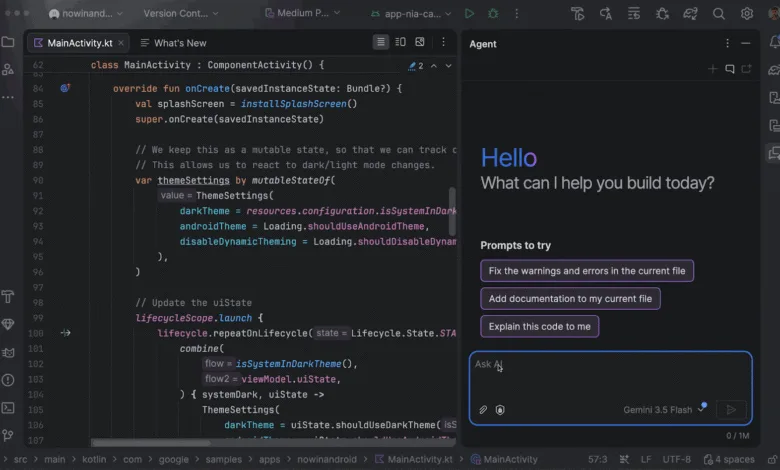
The updated Recent Chats panel in Android Studio Quail 4 provides real-time visibility into parallel agent threads. Developers can now monitor the progress, status, and output generation of multiple background AI tasks concurrently without losing context in their primary editor window. These notification improvements reduce cognitive load, allowing engineers to orchestrate complex multi-step refactoring tasks with greater confidence and operational clarity.
Flexible Access Tiers for Advanced Enterprise Workloads
While Android Studio Quail 4 provides a robust, fully functional default Gemini model out-of-the-box at no additional cost—dynamically managed to ensure optimal performance—Google recognizes that heavy enterprise workloads demand higher resource quotas and access to the most powerful underlying architectures. To accommodate varying organizational scales, the IDE offers three distinct upgrade pathways for developers requiring expanded token limits, deeper analytical capabilities, or extended coding session quotas. This tiered approach ensures that independent developers, growing startups, and large multinational engineering organizations alike can tailor their AI resource allocation precisely to their production pipelines.
Chronology and Evolution of the Quail Release Cycle
The rollout of Android Studio Quail 4 represents the culmination of a rigorous release strategy aimed at iterative refinement and rapid stabilization of developer tooling:

- Android Studio Quail (Initial Release): Laid the foundational architecture for the subsequent generation of IDE features, focusing on baseline performance optimization and modernizing the core developer experience.
- Android Studio Quail 2: Introduced groundbreaking agentic multitasking capabilities, enabling parallel chat threads and early multi-tasking workflows powered by integrated AI agents.
- Android Studio Quail 3: Focused on deep ecosystem integration, expanding diagnostic tools, streamlining Gradle synchronization speeds, and refining the underlying performance metrics of the IDE.
- Android Studio Quail 4 (Current Stable Release): Unifies the series by introducing bundled Android skills, native Gemma 4 local model support, and advanced parallel agent user interface notifications, now fully available in the stable channel for production environments.
Broader Industry Implications and Future Outlook
The stabilization and deployment of Android Studio Quail 4 signal a broader industry shift toward specialized, domain-grounded artificial intelligence in software development. As foundational models become commoditized, the competitive advantage in developer tooling increasingly relies on contextual depth and ecosystem integration. By embedding platform-specific expertise directly into the development environment, Google is lowering the barrier to entry for modern Android development while simultaneously equipping senior engineers with advanced automation capabilities.
Industry observers note that the emphasis on local execution through Gemma 4 highlights a growing market demand for data sovereignty within software engineering pipelines. As regulatory scrutiny regarding code data privacy intensifies, local-first hybrid development environments are expected to become the industry standard.
Getting Started and Community Feedback Channels
Android Studio Quail 4 is available immediately for download through the official stable channel. Developers currently utilizing earlier iterations can update directly via the IDE update mechanism or by downloading the latest binaries from the official Android Developers portal.
Google has emphasized that community feedback remains vital to the ongoing evolution of the Android toolchain. Engineers encountering unexpected behaviors or wishing to submit feature requests are encouraged to consult the known issues documentation or file structured reports through the official bug tracker. Additionally, developers can engage with the broader engineering community and access educational content across Google’s official channels on platforms including LinkedIn, X (formerly Twitter), Instagram, and YouTube.