Navigating the Noise: How Enterprise AI Adoption is Overwhelming Security Operations Centers

Enterprise security operations centers (SOCs) are facing an unprecedented operational challenge as the rapid adoption of artificial intelligence tools and coding agents reshapes the corporate threat landscape. According to recent telemetry data and comprehensive industry analyses, security teams are witnessing a massive surge in alerts triggered not by sophisticated cyberattacks, but by the ordinary, everyday digital footprint of organizations utilizing AI. While artificial intelligence remains a relatively minor fraction of overall telemetry volume, its exponential growth trajectory and unique behavioral patterns are fundamentally altering how security analysts prioritize threats, manage resources, and distinguish between benign automation and genuine security risks.
The Changing Composition of Enterprise Alert Streams
Over the past year, security researchers tracking enterprise environments have observed a new class of telemetry alerts rising faster than any other category in monitoring streams. These alerts are predominantly generated by developers deploying sophisticated coding agents, non-technical personnel connecting consumer-grade AI platforms to corporate accounts, and automated scripts interacting with cloud-based generative models.
To understand the macro-level impact of this shift, analysts reviewed approximately 16.9 million SOC alerts across numerous enterprise deployments. The resulting data reveals a striking dichotomy. AI-related activities currently account for just 0.43% of all security alerts, representing roughly 73,000 individual notifications in the studied datasets. Viewed in isolation, this percentage appears reassuringly small, suggesting that AI integration is not yet a primary driver of operational volume.

However, this metric masks a steep upward momentum. Month-over-month growth figures indicate that AI-triggered alerts are climbing at an extraordinary rate. Between February and June, monitored AI-related alert volumes surged by an unprecedented 685%. This monotonic increase—where every full month surpasses the preceding one, punctuated by accelerated growth phases—demonstrates that the current 0.43% share represents a baseline floor rather than a ceiling. Organizations that size their incident response and alert-handling capacities around today’s volume risk becoming severely under-provisioned within a single quarter.
Categorizing the AI Alert Phenomenon: Noise, Risk, and Real Attacks
The true operational dilemma facing security teams is not the sheer volume of AI-generated alerts, but rather their complex composition. When security platforms and human analysts inspect the underlying activities triggered by AI agents, the data sorts into three distinct categories: benign noise, genuine security risks, and confirmed attacks.
Empirical investigations into these alerts reveal a heavily lopsided distribution:
- 94.1% of AI-related alerts constitute routine, legitimate activity that trips legacy detection mechanisms.
- 5.8% represent genuine security exposures or unsafe usage patterns.
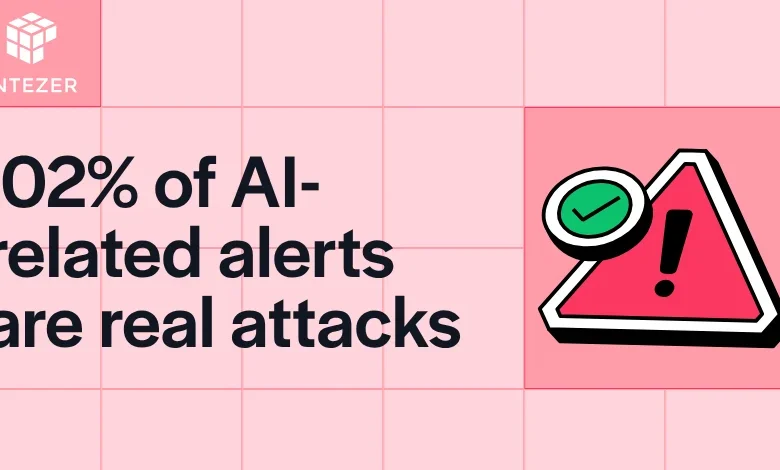
- 0.02% correspond to actual, confirmed malicious attacks leveraging or targeting AI systems.
This breakdown highlights a critical reality for modern security operations. The primary cost of enterprise AI adoption is not an immediate wave of catastrophic breaches, but rather an escalating tide of alarming-looking notifications that almost invariably turn out to be harmless. Consequently, these high-volume false alarms threaten to bury a small, quiet set of genuine exposures that demand urgent human intervention.

The Loud Half and the Quiet Half of AI Adoption
Enterprise AI integration is characterized by two distinct operational behaviors unfolding simultaneously. The first is technical and highly visible: software developers installing coding agents that dynamically spawn command shells, read local credential stores, open network tunnels, download third-party software packages, and execute security diagnostic utilities. To traditional endpoint detection and response (EDR) engines, these legitimate developer workflows are virtually indistinguishable from the early reconnaissance and lateral movement phases of a human-led cyber intrusion.
The second behavior is administrative, subtle, and largely invisible to traditional endpoint monitoring: employees granting OAuth permissions to third-party generative AI applications, sharing internal communications, and pasting proprietary source code or sensitive documents into cloud-based AI platforms. While this quiet half rarely trips endpoint behavioral detectors, it represents the primary channel through which corporate data leaves the secure perimeter.
Both operational halves converge within the central SOC, creating immediate demands for advanced triage frameworks designed to separate genuine signals from ambient noise.
Category Analysis: Dissecting Real Attacks, Unsafe Use, and Legacy Noise

Real Attacks and the Illusion of AI Compromise
Confirmed cyberattacks involving AI account for a minuscule fraction (0.02%) of the analyzed alert stream. Interestingly, investigations into high-severity alerts bearing titles such as "AI agent running credential dumping tools" or "reverse shell initiated from coding utility" consistently revealed that the underlying activity was either routine developer work or a detection misfire.
Instead of sophisticated threat actors subverting internal enterprise AI agents, security teams observed a different vector: external adversaries weaponizing AI brand names as psychological lures in phishing campaigns. Threat actors frequently deploy malicious emails featuring the names and branding of major generative AI corporations. Because employees now routinely expect legitimate notifications, updates, and communications from these familiar platforms, the social engineering lure succeeds with higher frequency. Furthermore, adversaries have been documented utilizing device-code phishing tactics designed to trick users into authenticating malicious OAuth applications under the guise of AI service integrations.
Unsafe Use and the Permission-Bypass Dilemma
Accounting for roughly 5.8% of AI-related alerts, unsafe usage patterns represent the most critical category requiring proactive security oversight. These incidents do not involve external attackers or compromised infrastructure; rather, they occur when an AI agent—behaving precisely as instructed by a user—performs an action that materially exposes organizational assets.

The most prominent driver of unsafe-use alerts is the utilization of permission-bypass flags (such as execution parameters that instruct coding agents to bypass confirmation prompts before executing system commands). While developers frequently employ these flags to streamline productivity and avoid repetitive authorization prompts, doing so removes critical safety rails. In documented software supply-chain incidents, threat actors have exploited environments where coding agents operated without permission safeguards, allowing malicious code snippets introduced via dependencies to execute freely on host machines.
Beyond permission bypasses, security teams frequently encounter instances where autonomous agents inadvertently expose API keys, commit hardcoded secrets to public or shared repositories, or establish unauthorized external network connections during automated debugging sessions.
Legacy Detection Noise and False Positives
The vast majority of AI-generated alerts—94.1%—fall squarely into the category of operational noise. This phenomenon stems from a fundamental mismatch: detection rules written years before the widespread deployment of AI agents now trigger at high severity upon encountering standard, day-to-day agent operations.
Prominent examples include the installation packages of verified, legitimate desktop applications for AI assistants, such as Anthropic’s Claude Desktop installer. Code-signed installations of these tools frequently trigger severe EDR alerts, including notifications for "Ransomware Operations Detected" or "Encoded PowerShell Download and Execution." The installers are entirely benign, yet their underlying unpacking and execution routines match historical behavioral signatures associated with malware deployment.

Statistical analysis of specific high-volume AI detections reveals false-positive rates ranging between 77% and 99%. In several instances, detection mechanisms generate erroneous high-severity alerts on AI-driven workflows more than four times out of five. Without systematic tuning, this high baseline of false positives rapidly induces alert fatigue among security analysts.
Strategic Recommendations for Enterprise Security Teams
As enterprise reliance on artificial intelligence continues its rapid expansion, security leadership must adapt their defensive postures to prevent operational gridlock. Industry experts recommend a multi-layered approach to managing AI integration within the SOC:
-
Tune Legacy Detection Rules: Security engineering teams must proactively refine existing detection signatures to account for the standard behaviors of authorized coding assistants, package managers, and AI desktop clients, thereby drastically reducing the volume of high-severity false positives.
-
Establish Clear Governance Policies: Organizations must define explicit usage policies governing what corporate data, intellectual property, and credentials can be shared with or accessed by third-party AI platforms.

-
Isolate AI Execution Environments: Because autonomous agents execute system-level commands using the host user’s credentials and permissions, organizations should mandate that developer tools and coding agents operate within isolated, resource-constrained environments—such as dedicated virtual machines or containerized Docker instances. Isolation limits potential blast radii and helps security analysts clearly differentiate between human-initiated actions and automated agent behavior.
-
Shift Toward Proactive Threat Hunting: Rather than reacting reactively to a rising flood of alerts, security teams should implement proactive monitoring for high-risk configurations, including permission-bypass flags, unauthorized network tunneling tools, and overly permissive OAuth token grants.
Implications for the Future of Security Operations
The rapid proliferation of enterprise AI has not ushered in an immediate wave of AI-driven cyber breaches, but it has triggered an unprecedented expansion of operational friction. Security operations centers that treat every automated agent action as a high-probability intrusion risk exhaustion and burnout. Conversely, organizations that successfully adapt their detection engineering, implement rigorous behavioral baselines, and isolate autonomous tooling will maintain operational resilience. Navigating this new technological era requires a deliberate transition from reactive alert management to contextual intelligence, ensuring that security teams remain capable of identifying genuine risks hidden beneath the rising tide of AI-generated noise.
Related posts: