How Tinder Used the R8 Configuration Analyzer to Slash App Size and Boost Performance

In the hyper-competitive landscape of mobile applications, performance metrics such as load times, APK size, and responsiveness can make or break user retention. For Tinder, one of the world’s leading social discovery applications, managing a massive and scaling Android codebase presented an ongoing engineering hurdle. As the application evolved to serve new generations of singles globally, its underlying technical complexity expanded in tandem. Prior to a recent, highly targeted optimization initiative, roughly 70 percent of Tinder’s Android application remained unoptimized. The app carried 17 DEX (Dalvik Executable) files—including three dedicated exclusively to startup routines—leading to sluggish cold starts and an increased frequency of user-perceived Application Not Responding (ANR) errors.
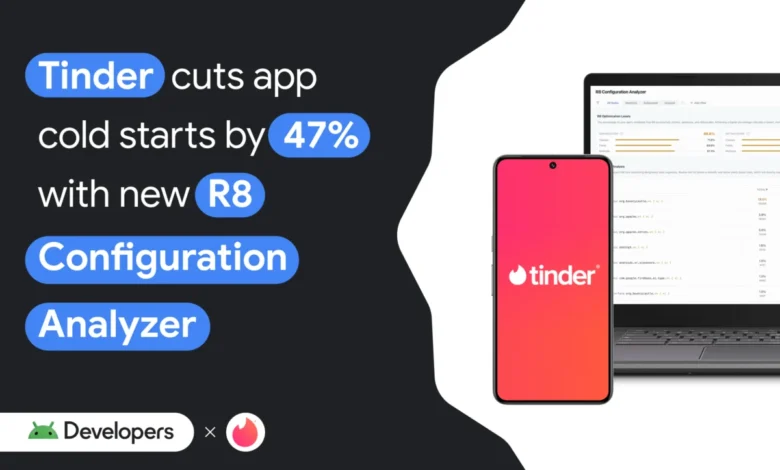
The turning point for the engineering team came with the adoption of Google’s newly introduced R8 Configuration Analyzer. By systematically auditing and refining their code minification rules, Tinder achieved staggering performance gains: a 47 percent reduction in app cold starts, a 28.98 percent decrease in download size down to 61.5 MB, and a 28 percent drop in user-perceived ANR rates. These technical victories not only streamlined the codebase but also translated into tangible business growth, particularly in resource-constrained international markets where data consumption and device storage are critical user barriers.
Background Context: The Anatomy of Android Optimization and R8
To understand the magnitude of Tinder’s engineering achievement, it is necessary to examine the mechanisms of modern Android development. R8 is the standard shrinking, obfuscation, and optimization tool used in Android Studio to convert project bytecode into optimized DEX format. It removes unused code, renames classes and fields with shorter names to reduce size, and applies advanced optimizations. However, for R8 to function effectively, it relies on configuration files containing "keep rules." These rules instruct the compiler which parts of the code must not be removed or altered—typically classes invoked dynamically via reflection, third-party libraries, or internal frameworks.
Historically, configuring R8 has been notoriously difficult for large development teams. When codebases scale across hundreds of engineers and multiple years, keeping track of keep rules becomes a monumental task. Developers frequently apply broad or over-inclusive keep rules to prevent runtime crashes caused by missing classes or methods. While these wide rules act as a temporary safety net, they inadvertently block R8 from optimizing large swaths of the application.

Before integrating the R8 Configuration Analyzer, Tinder had already enabled R8 full mode, yet its overall optimization score languished at a modest 28 percent. The team knew inefficiencies existed, but pinpointing the exact rules choking the compiler was akin to searching for a needle in a haystack.
Pinpointing Hidden Blockers and the In-House Library Culprit
The investigation into Tinder’s codebase revealed a surprising source of technical debt: an internal library developed in-house. While external open-source libraries often come scrutinized with well-defined optimization parameters, internal company libraries that are assumed to be stable can introduce hidden performance penalties.
Using the R8 Configuration Analyzer, Tinder’s engineering team audited their configuration and uncovered a broad, unscoped keep rule originating from their internal library. The rule explicitly stated:
-keep public class
public protected ;
This sweeping directive prevented optimization across all public classes along with all of their public and protected members. Because this over-inclusive rule successfully prevented runtime crashes, developers continuously bypassed adding granular rules for new features that relied on reflection. Over time, these hidden inefficiencies compounded, bloating the application and degrading the user experience.

Armed with insights from the R8 Configuration Analyzer, the team traced the specific classes impacted by this broad keep rule. They discovered that optimization was being blocked in larger, non-dynamically invoked classes where R8 could safely perform code reduction. By refining this single keep rule, Tinder untangled years of legacy configurations and watched their R8 optimization score jump from 28 percent to 50 percent almost overnight.
The Mechanics of the R8 Configuration Analyzer
The R8 Configuration Analyzer serves as a diagnostic dashboard for Android developers, tracking shrinking, optimization, and obfuscation scores to highlight clear areas for refinement. By evaluating broad, redundant, or obsolete keep rules—including those buried deep within external and internal dependencies—the tool allows engineers to visualize the exact impact of their configuration files.
Key metrics provided by the analyzer include granular visibility into optimization blockers, allowing teams to isolate the top rules restricting code reduction. To further streamline these workflows, Google recently published the R8 Analyzer skill, designed to integrate with agentic development tools. This skill automates the summarization of configuration reports, displaying core scores and immediately highlighting the five most impactful keep rules blocking code optimization.
Chronology of the Optimization Push
The transformation of Tinder’s Android application followed a structured engineering lifecycle:

- Identification Phase: Recognizing that 70 percent of the codebase was unoptimized and that the app carried 17 DEX files, the team diagnosed that standard R8 usage was being bottlenecked by unknown configuration rules.
- Integration Phase: The team adopted the R8 Configuration Analyzer to audit their project files and inspect the impact of existing keep configurations.
- Discovery and Remediation: The analyzer isolated the overly broad keep rule within an internal library. The team replaced the sweeping rule with targeted parameters, unlocking R8’s ability to compress non-dynamically invoked classes.
- Deployment and CI/CD Automation: Following the immediate performance victories, Tinder integrated optimization monitoring directly into their continuous integration and continuous deployment (CI/CD) pipelines to prevent future regressions.
Statements and Engineering Reactions
Although specific executive quotes regarding the rollout were encapsulated through technical documentation and developer relations reports, industry observers and the engineering team emphasized the shift from reactive debugging to proactive performance governance.
Ajesh R Pai, Developer Relations Engineer at Google, alongside Ulises Uriel Verduzco Diaz, Software Engineer at Tinder, and Tracy Agyemang, Product Marketing Manager, underscored that solving code minification cannot remain a one-time fix. By embedding optimization reporting directly into daily developer workflows, Tinder ensured that every subsequent code contribution is automatically evaluated for its impact on app size and startup latency.
"When advising other developers considering R8 configuration integration, the team emphasizes the importance of auditing internal dependencies," noted engineering reports following the deployment. While third-party libraries receive intense scrutiny, internal legacy projects frequently harbor the most damaging, overly broad rules.
Broader Business Implications and Market Impact
While the reduction of DEX files from 17 to a more streamlined architecture is a victory for software craftsmanship, the downstream business implications are equally profound. In the mobile application ecosystem, download size directly correlates with acquisition rates. A reduction of nearly 29 percent in app download size—bringing the APK down to 61.5 MB—lowers the friction for prospective users downloading the app over cellular data connections or on mid-range and entry-level devices.

Furthermore, the 47 percent reduction in cold-start times directly addresses user drop-off during the critical initial launch phase. In emerging markets where hardware specifications and network speeds can be constrained, a faster, lighter application ensures equitable access and superior user retention. Coupled with a 28 percent decrease in user-perceived ANR errors, Tinder’s technical overhaul has established a robust foundation for scalable global growth.
Future Outlook and Continuous Integration
Tinder’s engineering organization is not resting on its laurels. The team is actively working to push their R8 optimization score even higher, exploring further opportunities to prune obsolete code and refine dependencies. By institutionalizing optimization checks within their CI/CD pipeline, Tinder has transformed performance monitoring from an ad-hoc cleanup task into an automated, everyday standard.
For developers seeking to replicate these results, the availability of the R8 Configuration Analyzer across modern Android Gradle Plugin (AGP) versions provides a standardized pathway to healthier, faster, and more efficient Android applications. As mobile software continues to scale in complexity, tools that bridge the gap between aggressive compiler optimization and developer configurability will remain indispensable to the industry.