Light-Driven Nanorobots Smaller Than a Human Hair Open New Frontiers in Microbiology

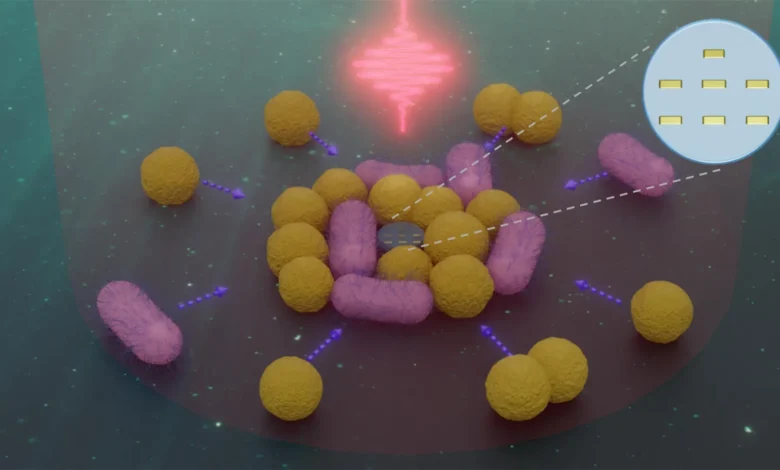
A pioneering multidisciplinary research team at Julius-Maximilians-Universität Würzburg has engineered sub-micrometer robotic devices capable of operating directly within the microbial world. Measuring roughly fifty times smaller than the diameter of a human hair, these light-powered microdrones represent a monumental leap forward in nanotechnology. For decades, the precise manipulation of individual biological entities, such as cells and bacteria, has remained an elusive goal due to the physical limitations of handling matter at microscopic scales. The newly unveiled nanorobots bridge this gap, demonstrating an unprecedented ability to autonomously navigate fluid environments, locate specific microorganisms, collect them, transport them across microscopic distances, and deposit them at predetermined locations.
This breakthrough transcends conventional mechanical manipulation by utilizing the fundamental momentum of light. By harnessing the physical principles of photon recoil, the Würzburg research team has bypassed the traditional requirement for onboard power sources, complex internal circuitry, or tethered magnetic fields. As the scientific community looks toward an era where microscopic diagnostics and targeted cellular assembly become standard practice, this development provides a foundational framework for active intervention in cellular environments. The implications extend deep into biomedical engineering, pharmacology, and environmental microbiology, offering an entirely new modality for interacting with matter at the scale of life itself.
Chronology of Light-Powered Microscale Propulsion
The realization of sub-micrometer robots is the culmination of years of iterative engineering and fundamental physics research led by Professor Bert Hecht and his experimental team at the Department of Experimental Physics V at Julius-Maximilians-Universität Würzburg. The developmental trajectory of these microdrones reflects a systematic reduction in scale paired with increasingly sophisticated optical control mechanisms.
In earlier phases of research, the scientific community focused heavily on thermal convection and chemical gradients to propel microscopic agents. However, these methods often suffered from slow response times, thermal damage to sensitive biological samples, and limited directional control in aqueous solutions. Recognizing these limitations, Hecht’s laboratory turned its attention to plasmonic nanoantennas—structures capable of interacting strongly with light at the nanoscale.
Initial iterations of light-driven microdrones demonstrated that photon pressure and recoil could be harnessed to generate motion. When photons strike a plasmonic nanoantenna tuned to specific wavelengths and helicities, the light is absorbed and subsequently scattered in a designated direction. According to the conservation of momentum, redirecting a photon imparts an infinitesimal recoil force on the nanoantenna. While imperceptible at the macroscale, this force produces substantial acceleration and velocity when applied to objects with near-zero mass.
Despite early successes, scaling down these devices while maintaining precise maneuverability posed a severe engineering bottleneck. Larger designs required complex assemblies of multiple optical components, which hindered their ability to operate in confined microbial environments. The turning point arrived when the Würzburg team successfully streamlined the architecture. By integrating nanoscale antenna wires directly into the robot’s body, the researchers achieved a dual-purpose system: the wires not only facilitated directional photon recoil but also functioned as passive alignment guides that responded directly to the polarization state of incoming laser light.
By dynamically adjusting the polarization of the steering laser, operators could instantaneously reorient the nanorobot in three-dimensional space while maintaining continuous propulsion. This breakthrough allowed the team to shrink the overall footprint of the devices to under one micrometer, successfully breaching the threshold of the microbial domain.
Technical Specifications and Operational Mechanics
Operating effectively within an aqueous cellular environment requires overcoming the low Reynolds number physics that govern microscale fluid dynamics. At this scale, viscous forces completely dominate inertial forces; objects do not coast when propulsion ceases, and fluid resistance is absolute. Overcoming this environment demands continuous, highly responsive propulsion mechanisms.
The Würzburg nanorobots address these physical constraints through an intricate arrangement of up to four plasmonic nanoantennas. Fabricated from advanced metallic nanostructures, these antennas are engineered to capture specific frequencies of light. When illuminated by a specialized laser setup, the localized surface plasmon resonance within the antennas causes directional scattering of the incident photons.
The resulting photon recoil acts as an integrated jet propulsion system. Because the total mass of the nanorobot is measured in picograms, the cumulative momentum transfer from the scattered photons translates into rapid acceleration. Furthermore, the incorporation of nanoscale antenna wires provides an elegant steering mechanism. These metallic wires naturally align parallel to the electric field vector of linearly polarized light. Consequently, altering the polarization angle of the steering laser forces the nanorobot to pivot swiftly, enabling sharp 90-degree turns within microseconds.
This agility is essential for navigating the crowded, chaotic topography of biological samples. Jin Qin, the lead experimental scientist on the study, noted that the simplified architecture allows the devices to function as highly efficient microscopic cleaners. Despite their minuscule size, the robots maintain structural integrity and functional maneuverability while carrying loads significantly larger than themselves—such as clusters of bacteria. Although the added hydrodynamic drag and mass reduce the top speed of the microdrone, the propulsion system retains enough reserve power to complete complex transport tasks without stalling.
Expert Insights and Statements from the Research Team
The unveiling of these sub-micrometer cleaners has generated considerable discussion within the international physics and biophysics communities. The ability to mechanically engage with individual bacteria using purely optical controls opens pathways that were previously restricted to theoretical simulations.
Reflecting on the philosophical and practical implications of the work, Professor Bert Hecht emphasized the transition from passive observation to active construction at the microscopic scale. "This is a striking example of how light can be used not only to observe the microscopic world, but also to actively shape it," Hecht stated. "The idea of tiny robotic cleaners may sound futuristic, but we are already demonstrating the physical principles that make it possible."
Jin Qin elaborated on the operational realities observed during laboratory trials. "In essence, we have built a light-driven nanorobot that can track down and collect bacteria," Qin explained. "By simplifying the design, we reached a size at which these robots can operate directly in the microbial world—almost like microscopic cleaning devices."
Independent biophysicists not directly involved in the JMU project have noted that the elimination of chemical fuels is one of the study’s most significant achievements. Many previous nanorobotic designs relied on catalytic chemical reactions—such as the decomposition of hydrogen peroxide—to generate movement. While effective, these chemical methods are toxic to living cells, strictly limiting their utility in real-world biological and medical applications. By contrast, photon-driven propulsion relies on non-destructive light fields, preserving the viability of delicate cellular structures during handling, transport, and release cycles.
Broader Implications and Future Applications
The successful demonstration of light-powered nanorobots capable of handling biological matter marks the beginning of a new chapter in applied nanotechnology. While current experiments have been successfully executed under controlled laboratory conditions, the transition toward clinical and industrial integration is already underway.
In the field of microbiology, these devices offer researchers a precision tool for isolating single-cell strains from heterogeneous cultures without contaminating the surrounding media. Traditional methods of cell sorting, such as fluorescence-activated cell sorting (FACS), process large volumes of cells statistically but struggle with the deterministic isolation of specific micro-architectures or biofilms. Light-driven microdrones could allow technicians to hand-pick individual microorganisms for genetic sequencing, targeted culture growth, or synthetic biology applications.
In biomedical research and pharmacology, the implications are equally profound. The ability to transport localized payloads across microfluidic channels points toward future applications in targeted drug delivery, where sub-micrometer carriers could be guided by external light sources to specific cellular targets within micro-engineered tissue models. Furthermore, the principles demonstrated by the JMU team could pave the way for microscopic assembly lines, where nanoparticles and biological building blocks are stitched together to create advanced bio-hybrid materials.
As research progresses, the team plans to optimize the optical systems to allow for the simultaneous control of multiple nanorobots in swarms. Scaling up from single-unit operations to coordinated multi-agent systems will dramatically increase the throughput of microscopic cleaning and assembly tasks. Although challenges remain regarding optical scattering in dense biological tissues and the scaling of laser guidance systems for in vivo applications, the foundational physics have been firmly established. The boundary between macroscopic engineering and the microbial universe has officially been crossed, setting the stage for innovations that will redefine our relationship with the microscopic world.
Related posts: