AWS Revolutionizes Serverless Architectures with the Launch of Enhanced Custom Event Bus for Amazon EventBridge

Organizations building complex, event-driven applications on Amazon EventBridge have long navigated the friction between architectural agility and operational overhead. Historically, developers scaling these systems across multiple AWS accounts were forced to implement intricate workarounds, such as cross-account rules or complex bus-to-bus configurations. These legacy approaches often reintroduced the very operational burdens that serverless architectures were intended to eliminate. Addressing these industry-wide challenges, AWS has officially launched the Enhanced Custom Event Bus for Amazon EventBridge, a centralized, scalable solution designed to streamline cross-team collaboration and simplify event routing for large-scale enterprise environments.
The Evolution of Event-Driven Infrastructure
The genesis of this update lies in the rapid adoption of multi-account AWS environments. As organizations grow, they frequently move from a monolithic architecture to a distributed, team-based structure where each business unit operates within its own dedicated AWS account for security and billing isolation. While this improves governance, it complicates the flow of data. Prior to this update, a platform team would need to configure disparate event buses and establish complex permission layers to allow one team to consume events generated by another.
This fragmented approach led to three primary pain points: diminished visibility for platform engineers, compounding costs due to inefficient routing, and the absence of native event ordering. Many teams were forced to implement third-party middleware or intermediate storage layers like Amazon Simple Queue Service (SQS) simply to ensure data integrity and sequence—a departure from the lightweight, serverless philosophy. The new Enhanced Custom Event Bus effectively consolidates these requirements into a single, unified backbone.
Chronology of Amazon EventBridge Advancements
Amazon EventBridge has been the cornerstone of AWS’s serverless strategy since its evolution from CloudWatch Events. Its journey from a simple rule-based router to a sophisticated event backbone has been iterative:

- 2019: AWS launches Amazon EventBridge, rebranding and expanding the capabilities of CloudWatch Events to allow for third-party SaaS integration.
- 2020-2022: Introduction of Schema Registry, Event Replay, and Pipes to facilitate better developer tooling and data transformation.
- 2023-2024: Incremental improvements in cross-account connectivity and API destinations.
- September 2026: The official introduction of the Enhanced Custom Event Bus, representing a paradigm shift in how event buses are provisioned, shared, and managed at scale.
This current release marks the most significant architectural change to the service in its history, shifting the focus from "point-to-point" routing to a centralized, "hub-and-spoke" model that is natively integrated with AWS Resource Access Manager (AWS RAM).
Core Features and Technical Capabilities
The Enhanced Custom Event Bus introduces several capabilities that address the specific needs of modern software development teams:
Centralized Sharing via AWS RAM
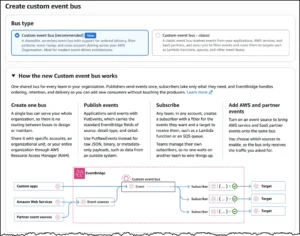
By leveraging AWS Resource Access Manager, the new bus allows platform teams to share a single event bus across an entire organization or specific organizational units. This eliminates the need for manual cross-account permission management. Administrators can now define access policies at the bus level, ensuring that producers and consumers operate within a secure, controlled environment without the administrative burden of traditional bus-to-bus routing.
Native Event Ordering and Synchronous Processing
One of the most requested features for EventBridge has been the ability to maintain sequence. In logistics, financial services, and telecommunications, the chronological order of events is non-negotiable. The new bus introduces the EventGroupId parameter. When events are tagged with this ID, EventBridge ensures they are delivered in sequence to subscribers opting for ordered delivery. Furthermore, the inclusion of synchronous invocation for targets like AWS Lambda removes the necessity for "buffer" queues, reducing both latency and the total cost of ownership.
The Subscriber Resource
The introduction of the "Subscriber" object represents a consolidation of legacy EventBridge resources. Previously, developers had to manage rules, targets, retry policies, and dead-letter queues as separate entities. The Subscriber resource unifies these configurations into a single, cohesive unit. This simplifies the developer experience and makes auditing and compliance reporting significantly easier for enterprise platform teams.

Data-Driven Economic Implications
The transition to a new pricing model is as significant as the technical updates. The previous per-event model for cross-account routing often created "bill shock" when events were passed through multiple hops in a complex architecture. The new ingress and egress throughput model is designed to be more predictable.
Industry analysis suggests that for organizations with high-volume, cross-account event traffic, this shift will likely result in a reduction of total infrastructure costs. By eliminating the need for intermediary SQS queues—which previously carried their own storage and polling costs—and reducing the administrative "tax" of maintaining complex routing rules, the Enhanced Custom Event Bus lowers the total cost of ownership (TCO) for serverless applications.
Strategic Impact on Enterprise Architecture
For CTOs and Lead Architects, the implications of this release are twofold: improved operational efficiency and faster time-to-market. By centralizing the event backbone, organizations can move toward a "self-service" model. Application teams no longer need to request infrastructure changes from a central platform team to begin consuming events; they can simply subscribe to the shared bus, provided they have the necessary permissions.
Furthermore, the support for JSONata expressions and the ability to deserialize Apache Avro or Protocol Buffers natively on the bus allows for a more flexible data strategy. Teams can now handle schema evolution and event transformation within the bus itself, rather than in the application code, which reduces the complexity of downstream microservices.
Implementation and Regional Availability
The Enhanced Custom Event Bus is not a mandatory migration. AWS has maintained the "Classic" custom event bus for existing workloads, ensuring that current production systems remain stable. Teams can adopt the new bus architecture at their own pace, starting with new projects or migrating critical workflows as needed.
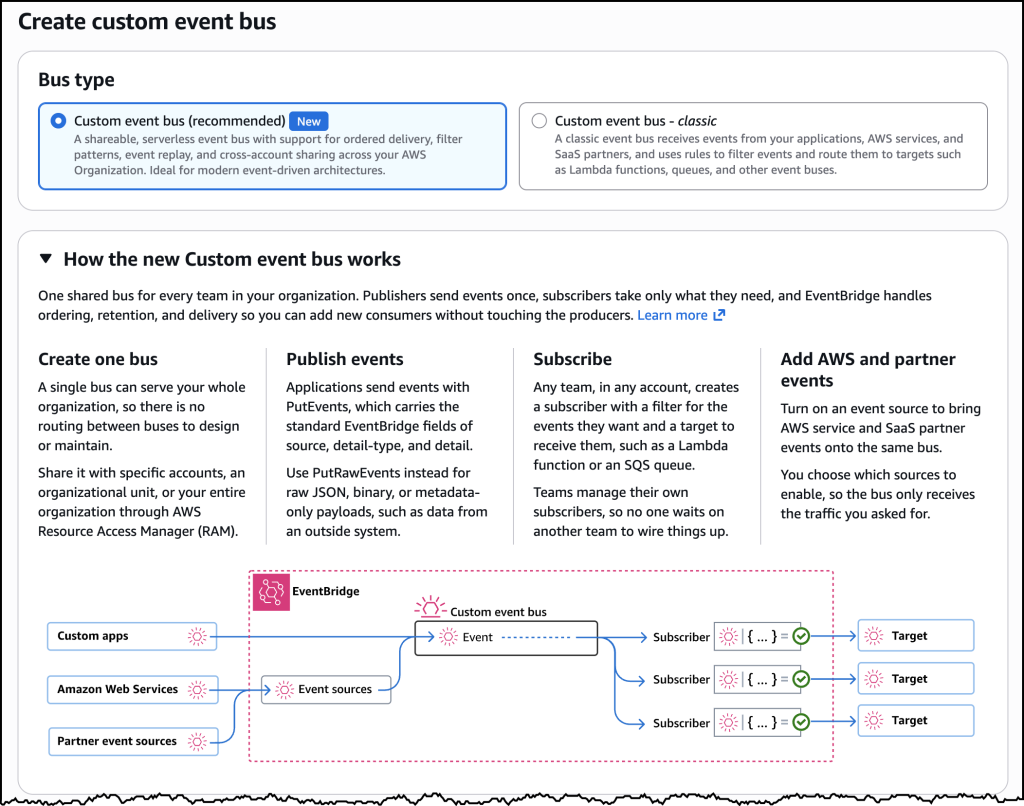
At launch, the service is available in major AWS regions, including US East (N. Virginia, Ohio), US West (Oregon), and a wide array of European and Asia-Pacific regions. For teams looking to implement this, the process is straightforward: navigating to the EventBridge console, selecting the "New" custom event bus option, and utilizing AWS RAM to set the sharing scope.
Conclusion: The Future of Event-Driven Systems
The launch of the Enhanced Custom Event Bus signals a maturity in the serverless ecosystem. By moving beyond the limitations of initial event-driven designs and addressing the complexities of multi-account governance, AWS is enabling organizations to scale their architectures with greater confidence. As enterprises continue to adopt event-driven patterns to increase responsiveness and decrease coupling, tools like this will be essential in maintaining the delicate balance between high-velocity development and robust, observable, and cost-effective operations. The ability to guarantee order, simplify subscription management, and lower the economic barrier to entry positions Amazon EventBridge as the clear standard for enterprise-grade event-driven infrastructure in the coming years.