The challenge lies in the shift from treating AI as a novelty to treating it as an industrial component. According to industry data from 2026, over 60% of enterprise AI projects fail to transition into production due to a lack of rigorous financial modeling. Adnan Masood, Chief AI Architect at UST, argues that the resolution to this stagnation is not merely technical, but methodological. By shifting the focus from "generative capabilities" to "measurable workflow outcomes," businesses can bridge the gap between innovation and sustainable ROI.
The Anatomy of an AI Workflow
To quantify value, organizations must move beyond broad metrics like "tokens processed" or "user clicks." A workflow represents a repeatable, value-added sequence of steps—such as automated security triage, customer support ticket resolution, or software code review—that contributes directly to the bottom line.
Establishing a baseline is the critical first step. Before introducing a generative AI model, teams must document the "as-is" performance of the workflow under normal operating conditions, accounting for seasonality and standard error rates. Without this historical baseline, the performance gains attributed to AI lack the credibility required to justify recurring cloud and inference costs.

Constructing the ROI Equation
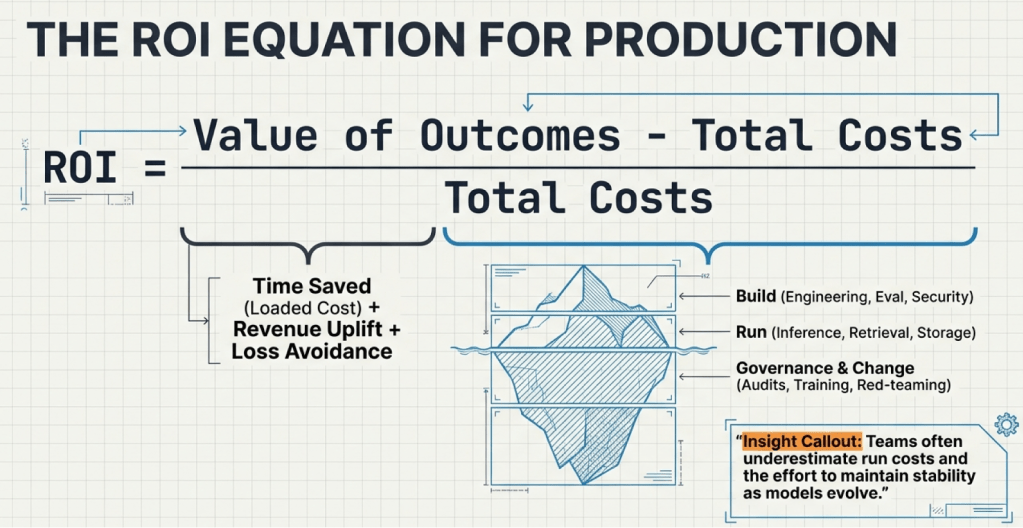
The financial failure of many AI projects stems from a narrow definition of costs. Many teams focus exclusively on the cost of the model’s inference (the price per query), ignoring the comprehensive lifecycle expenses that define true ownership. The equation for a realistic ROI calculation is as follows:
- ROI = (Value of Outcomes – Total Costs) / Total Costs
The "Value of Outcomes" should include tangible time savings (multiplied by the loaded labor cost of the staff), revenue uplift from improved conversion rates, and loss avoidance from more accurate compliance or security monitoring. Conversely, "Total Costs" must aggregate four distinct categories:
- Build Costs: Initial engineering, integration with legacy systems of record, and model evaluation.
- Run Costs: Inference fees, retrieval infrastructure (RAG pipelines), data storage, and ongoing monitoring.
- Governance Costs: Regulatory audits, mandatory red-team security testing, and policy maintenance.
- Change Management: Training sessions, UX design to minimize context switching, and internal support.
Recent surveys indicate that enterprises often underestimate "Run Costs" by 30% to 40% when projects scale, as the complexity of maintaining stable retrieval systems and handling model drift is significantly higher than the initial development phase.
A Four-Layer Metrics Stack
To maintain oversight, technical leadership should implement a tiered metrics stack that connects high-level business goals to low-level technical performance. This stack allows stakeholders to diagnose exactly where a project is failing if the expected ROI does not materialize.

- Activity Layer: Tracks engagement, such as the volume of queries or the number of active users. If activity grows without a corresponding improvement in outcomes, it indicates poor integration or a lack of user adoption.
- Performance Layer: Monitors technical latency, error rates, and model reliability.
- Workflow Layer: Tracks the speed and accuracy of the end-to-end business process.
- Outcome Layer: Ties results back to financial impact, such as the reduction in average handling time (AHT) for support tickets or the decrease in defect escape rates in engineering.
By instrumenting these metrics directly into the systems where employees conduct their work—such as Jira, Salesforce, or proprietary ERPs—organizations gain a real-time view of AI efficacy.
Overcoming Adoption Friction
The most technically sound model will fail to deliver ROI if it does not integrate seamlessly into the user’s daily routine. High levels of context switching—the need to toggle between a chat interface and a work application—are primary drivers of low adoption. Successful implementations prioritize "in-situ" assistance, where the generative tool provides context-aware suggestions directly within the existing software environment.
Furthermore, training should move away from generic "prompt engineering" workshops toward role-specific playbooks. These documents should provide concrete examples of how to handle high-frequency tasks, ensuring that the AI tool acts as an extension of the professional’s existing workflow rather than an additional task to manage.
The 90-Day Path to Credible ROI
For teams looking to move beyond the pilot phase, a structured 90-day plan is essential to demonstrate value to executive stakeholders:
- Days 1–30: Define the workflow, establish the baseline metrics, and implement the tracking instrumentation within the existing production system.
- Days 31–60: Conduct a controlled rollout with a limited cohort. Compare this group against a control group to isolate the effects of the AI tool on performance.
- Days 61–90: Analyze the results, adjust the model or workflow based on "reason codes" captured from user feedback, and finalize the total cost of ownership (TCO) report.
Critical Failure Modes and Risk Mitigation
Common pitfalls frequently derail even well-funded projects. One frequent error is "scope creep," where the team attempts to solve too many problems at once, diluting the focus on a single, high-leverage workflow. Another is the "black box" syndrome, where a lack of traceability leads to distrust from users and regulatory scrutiny.
To mitigate these, organizations should implement a "Minimum Viable Checklist" before moving to production:
- Defined Owners: Every workflow must have an accountable owner.
- Instrumented Outcomes: Automated tracking must be in place.
- Governance Controls: Security and privacy policies must be codified and audited.
- Baseline Documentation: Historical performance data must be verified.
- Budgeted Run Costs: A clear understanding of the monthly operating expenditure must be agreed upon.
- User Feedback Loop: A simple mechanism for capturing user dissatisfaction or error reporting.
- Exit Strategy: A defined path for model deprecation or pivot if the ROI threshold is not met.
Broader Implications for Enterprise Strategy
The shift toward ROI-focused generative AI marks a maturation of the technology sector. As the novelty fades, companies are moving toward a more disciplined, engineering-first approach. This shift favors vendors and internal teams that can demonstrate reliability, auditability, and clear financial benefits over those promising generic "transformational" results.
The long-term impact of this trend is a more sustainable AI ecosystem. By grounding investment in concrete workflow improvements, firms can avoid the "hype cycles" that characterized earlier waves of software adoption. Ultimately, the successful enterprises of the next decade will be those that treat AI not as a magic bullet, but as a measurable, scalable, and manageable part of their operational infrastructure. As Adnan Masood notes, when the measurement is clear, the path to value becomes undeniable, allowing teams to move beyond the pilot phase with confidence and fiscal rigor.
Related posts: